It took 80 years, but in 2019, Einstein proved Einstein wrong when the Event Horizon Telescope—actually a network of eight linked ground telescopes all over the world—produced the first-ever image of a black hole. Or, the shadow of a black hole, to be pedantic.
It’s hard to overstate the bigness of this big deal. Einstein’s 1915 theory of relativity proposed that gravity is a curving of space and time, laying a mathematical foundation for the concept of black holes (which wouldn’t be called “black holes” until decades later). But it was German physicist Karl Schwarzschild who took the next step to solve Einstein’s equations—while serving on the front lines of World War I, no less—and calculate what would happen if you crammed enough mass into a tiny enough point: It would create a “singularity” at which gravity would become so strong that even light couldn’t escape.
Einstein was impressed by Schwarzschild’s math but scoffed at the idea of such a singularity existing in nature. He felt strongly enough about the matter to publish a paper in 1939 arguing that the singularities proposed by Schwarzschild’s calculations were mathematical curiosities that could not possibly exist as physical realities. But, just months later, J. Robert Oppenheimer (yes, that one) and his student Hartland Snyder published a paper using Einstein’s own equations to verify that when massive stars collapse, black holes weren’t just possible, they were inevitable, proving that even when Einstein was wrong, he could still be right.
To understand the tremendous density of a singularity, imagine the mass of the planet Earth crammed into a space the size of a marble. Surrounding this marble is the event horizon, a perimeter that marks the point of no return. Once photons succumb to the gravity of the singularity and cross this line, they’re gone forever, making black holes among the darkest objects in the universe. (Whether they’re truly gone, or just no longer observable, remains a hot debate.)
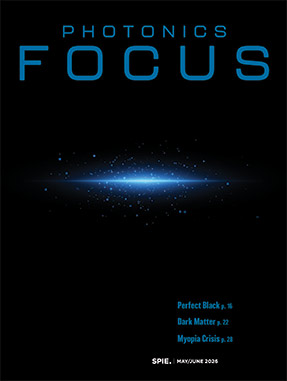
While Photonics Focus readers usually spend their careers chasing light, this issue is dedicated to its quiet companion, the dark. We look at researchers attempting to mimic nature’s ultrablack coloration using pigmentation and nanostructures for defensive camouflage, art, and even fashion. We learn about astronomers’ search for dark matter, which has pushed the development of improved detectors. And we explore the increasing prevalence and severity of myopia, which accounts for 20% of blindness, and the novel tools being explored for monitoring and treatment.
The stories in this issue navigate the depths of the dark. However, as this is my last editorial as the Editor-in-Chief of Photonics Focus, I find myself most curious about the event horizon. If you were to observe an object crossing the event horizon, you’d see it turn red, slow way, way down, and finally linger at the edge forever, even though the object itself has passed through. I like the idea that you might pull this issue of Photonics Focus off a dusty stack, years from now, and find me still here, frozen in the act of saying goodbye, a permanent fixture of Photonics Focus’s horizon. But from my perspective, I’ve already crossed over, accelerating towards something new.
My career at SPIE will refocus on the monumental shifts underway in scholarly publishing, while the magazine will continue to evolve and grow in the capable hands of Managing Editor William Schulz.
Thank you for six years of shared focus.

Gwen Weerts, Editor-in-chief