
The SPIE International Day of Light Photo Contest is held annually to raise awareness about the International Day of Light and to demonstrate the impact that light has on cultural, economic, and societal aspects of our world. Amateur and professional photographers alike are encouraged to submit photos for a chance to win cash prizes.
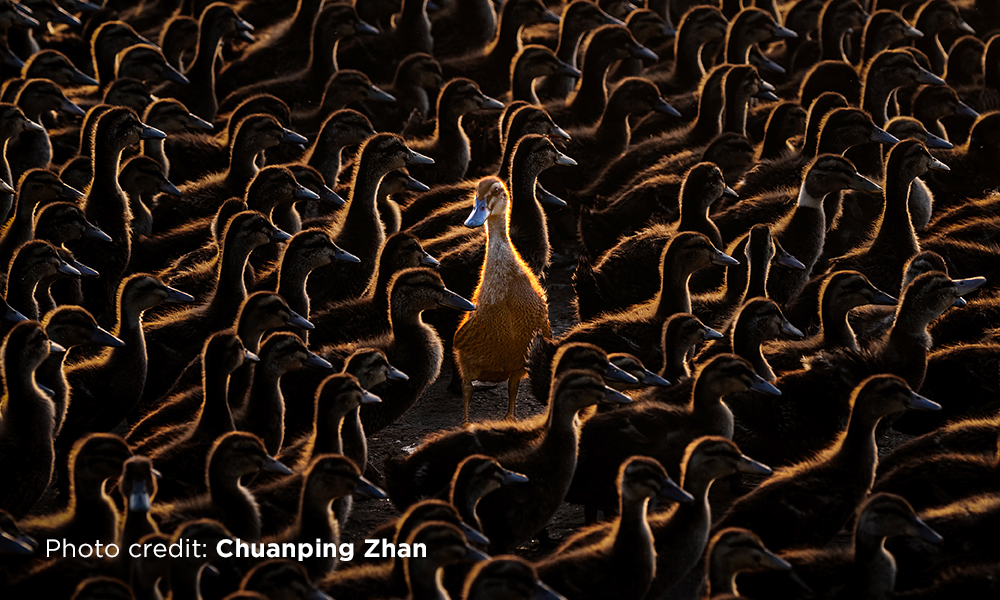

"I was deeply moved by the poetic rhythm of life in Cua Dai Fish Trap Village. At dawn, when the first golden rays touch the river, the fishermen begin their day in harmony with light, water, and tradition. That moment, where human effort and nature intertwine, inspired me to capture this photograph.
The scene unfolds very early, and I had to sit on another small, unsteady boat in the middle of the river, rocking with the waves while waiting for the right light. It was quite difficult to keep my balance and camera steady. When I finally captured the moment, my clothes were covered with the smell of fish from the nets — not the nicest scent, but it made me smile because it was part of the experience and joy of being there.
I’m proud that the image not only shows a beautiful landscape but also preserves the soul of a long-standing craft village in Vietnam. It reflects the dignity, perseverance, and harmony between humans and nature that I deeply admire. Photography allows me to tell stories of ordinary people living extraordinary lives, stories filled with resilience, beauty, and emotion. It’s a way for me to connect my heart to the world through light."

“One early morning, the inspiration struck me as the sunrise over the sea was tranquil, yet this very calm jolted my heart: If a massive meteor were to crash into these azure waves at this moment, I thought, what an earth-shattering spectacle that would be! This vision ignited my creative desire, compelling me to inject a striking dynamic force into still-life conceptual photography by re-creating it indoors in Nanjing.
Though the concept was clear to me, actual shooting required controlling a host of uncertainties. The most challenging part was capturing the ideal state of the splashing water droplets — each needed to be exquisitely crystal-clear, while also sharply defining the contours and three-dimensional texture of fruits. To achieve this, I repeatedly adjusted the height and angle of the lighting, experimenting with its direction. At the same time, to convey the force of the falling fruit within the limited frame, I depicted three stages: a red fruit frozen mid-air like a suspended sun, some colliding with the water to create an explosive spray, and others sinking, blending intimately with the water below.
The pursuit of perfection breeds persistence. Using high-speed continuous shooting, I tried again and again to capture the image in my mind’s eye. Ultimately, I found the one that fully realized my vision in the metaphorical ocean of nearly nine hundred shots, where light, like a precise chisel, at the exact place and moment, perfectly froze the most brilliant eruption of force.
For a photographer, the deepest joy lies in capturing that irreplaceable instant amid the chaos of the world, the kind of trembling excitement Henri Cartier-Bresson described, when one simultaneously recognizes the significance of an event and discovers the perfect composition. When intuition presses the shutter before reason, it feels as though we have stolen a grain of gold dust slipping through the fingers of the god of time. The world, within the viewfinder, condenses into pure poetry. Each shutter is a luminous moment of communion between the soul and the earthly realm.”

"This image was taken with a multi-rotor drone at the beginning of the drone era, as residents of Copacabana passed by the sidewalks of the famous Brazilian beach during their morning walk. Our theme is light, and here we have the shadows it reveals, seen from above.
I lived in this place in Rio de Janeiro, and I always followed the same path as these people, observing these cast shadows; by using the drone, the view became unique. One specific challenge that I needed to address was taking special care with nearby power lines and, finally, keeping the drone stationary: at the time, its GPS technology was not yet so good. I’m particularly proud of my patience in capturing this image, in waiting for the right moment and the right pattern of shadows cast by people. It’s such a random pattern, but it came at the perfect moment.
As a photographer, I believe we have a privileged view of forms and nature. With time and practice, we can develop an art that we can admire and seek to immortalize."

“With this image, we aim to contribute to the celebration of the International Day of Light as part of the International Year of Quantum Science and Technology. The image is a Scanning Electron Microscopy (SEM) photograph of the compound eye of the fruit fly (Drosophila melanogaster). SEM photography is a high-resolution imaging technique that utilizes focused electron beams to visualize surface structures at the micro- and nanoscale. In contrast to optical photography, SEM detects secondary or backscattered electrons emitted from a specimen’s surface, generating monochromatic images with exceptional depth of field and magnification. It is extensively used in materials science, biology, and nanotechnology for analyzing morphology, composition, and topography. Although SEM images are naturally grayscale, digital colorization is often applied for enhanced interpretation. SEM photography provides insights into structures invisible to traditional light microscopy. Here, the transformation from the original monochromatic image to the colorized version was executed through a meticulous and time-intensive process.
The compound eye of Drosophila melanogaster consists of approximately 800 individual units known as ommatidia. This anatomical organization provides the fruit fly with a wide panoramic field of vision and exceptional motion detection capabilities. Consequently, Drosophila can perceive motion with extremely high temporal resolution, effectively “seeing” in slow motion at rates of up to 250 frames per second.
The eye color of Drosophila has played a significant role in the development of genetics. Mutations in the white gene, which affects eye pigmentation, represented a pivotal breakthrough in 1910 for elucidating the principles of inheritance, constituting a true milestone in the history of genetic research.
We conducted SEM imaging in several stages. After identifying the samples, they were prepared and coated with gold prior to imaging. The initial records were then optimized by adjusting the imaging position, tilt angle, or magnification. Finally, after selecting the most suitable image, the most time-consuming step – digital post-processing – was carried out. The image was lightly retouched; however, the main objective was to colorize the grayscale SEM records through digital post-processing. Approximately 50-60 hours were invested in producing this image, which was rendered using more than 30 layers.
Through our SEM photography, we aim to emphasize and highlight the inherent beauty of nature. Moreover, we seek to inspire young people to develop an interest in physics and the sciences through our visualizations. At present, these techniques are being integrated into the media technology curriculum for media students at our university, Offenburg University of Applied Sciences, in Germany.
Nothing surpasses the beauty of nature, and, through our work, we strive to make it more visible.”