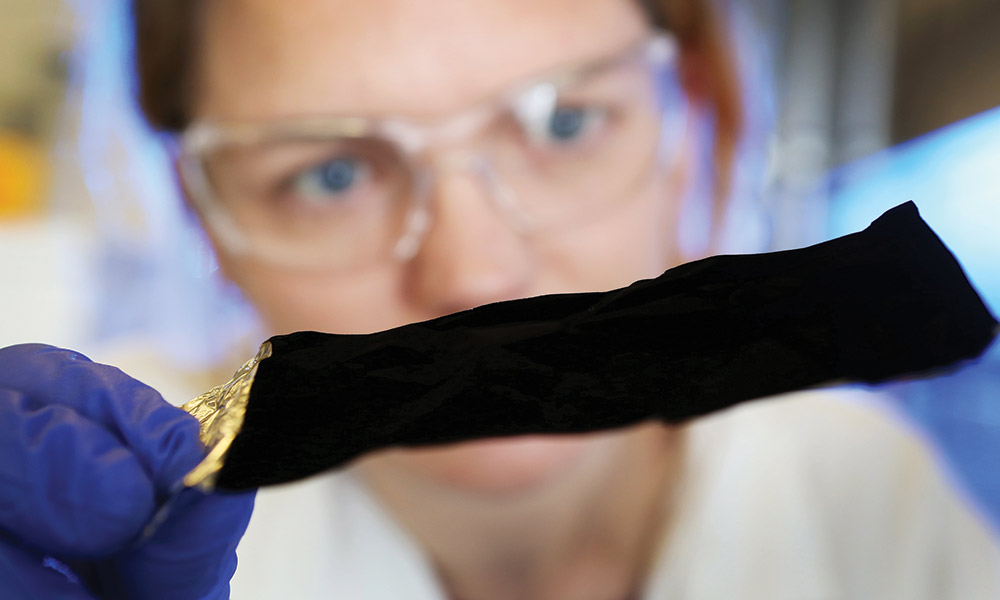
Physics dictates that a perfect black body does not exist in nature; even a black hole emits a little bit of Hawking radiation. Nevertheless, the idea of a perfect black body has been transformative in physics, giving us quantum mechanics and a hard limit from which to gauge thermal radiation, a key basis for a raft of modern technologies. It also sets an unreachable upper bound for a target we have been heading towards, often unknowingly, since early humans started depicting Paleolithic life on cave walls: A substance that absorbs 100% of the visible light that hits it—the perfect black.
In some of the oldest discovered cave paintings dating back some 20,000 years, such as those in Lascaux, France, and Ekain, Spain, can be found carbon-based black pigments, derived from wood or bones placed on a fire. The pigments are extremely black with a reflectance value of about 5% in the visible spectrum—that is assuming near-total opacity where transmission is zero and the pigment absorbs about 95% of the photons that hit it.
Over subsequent millennia since the paintings first appeared, humanity has made faltering progress toward concocting the perfect black. For instance, during the Renaissance, a method for creating lamp black—a pigment made from the soot of oil lamps—was perfected. And Mars black—a synthetic iron oxide alternative to natural earth pigments—was developed at the beginning of the 20th Century. Both substances only pushed absorption limits to 97%. But then a big leap came with the advent of nanotechnology.
A self-taught scientist, Ben Jensen was experimenting with nanosurfaces at the University of Surrey’s Advanced Technology Institute in the UK when he started looking at the properties of carbon nanotubes grown via chemical vapor deposition. “He was mostly interested in just solving some optical problems for shrouding, thermal management, etc.,” says Alex Darnley. “But he ended up with what was visibly really, really black material.”
After a couple of years of experimentation, and through his company, Surrey Nanosystems (where Darnley is manager of research and development), Jensen unveiled Vantablack in 2014: a vertically aligned nanotube array—hence Vanta in the name.
Each carbon nanotube in Vantablack has a very high tendency to absorb incoming light, and they are vertically aligned at different heights to form a microstructured forest. This means that light that is not immediately absorbed by the first nanotube it encounters is reflected into this maze-like forest, where it is effectively trapped until at some point it can be absorbed and eventually dissipated as heat. So black as to appear as a void, the material absorbs up to 99.965% of visible light measured perpendicular to it.
From the get-go, Vantablack attracted curiosity and interest from both the public and various industries. Film studios wanted to use it as a backdrop for scenes involving computer-generated imagery, to replace green screens. Fashion designers wanted to make clothes out of it. Militaries wanted it for many hush-hush reasons. But, apart from a handful of applications in satellites and as a dark background for a luxury watch dial—as well as artist Anish Kapoor controversially buying exclusive rights to the original Vantablack for artistic use—Surrey Nanosystems had to turn almost all of them down.
A large part of the reason was that Vantablack is just not practical. It is not a pigment or a liquid, or anything else a customer could simply buy and use. It is a very delicate nanostructure. Moreover, it requires that the object it is to be grown on be flat, or almost flat, and able to withstand vacuum reactor conditions at around 450 degrees Centigrade.
To make matters worse, in September 2019, a team of MIT engineers announced an even blacker material than Vantablack. MIT black, as it became known, is the result of carbon nanotubes being grown on aluminum that has had its oxide layer removed. Absorbing 99.995% of light that reaches it, MIT black is an order of magnitude darker than Vantablack.
But how can scientists even tell the difference between two materials that, on face value, give the impression of staring into the depths of space? Distinguishing between such extreme levels of darkness requires specialized equipment and a specific measure: total hemispherical reflectance. This metric accounts for both specular reflectance—the mirror-like glint off a surface—and diffuse reflectance, where light is scattered in all directions. By summing every stray photon, scientists get a true reading of a material’s blackness.
Total hemispherical reflectance is determined in a hollow cavity called an integrating sphere coated with a highly reflective white material. Inside the sphere, a light source is shone at the ultrablack sample. Photons that are not absorbed but instead reflected back out of the sample bounce around the sphere until they hit a spectrometer. The number of photons that the spectrometer counts gives a percentage reading of reflectance.
Today, MIT black remains the blackest human-made material in existence. But just like Vantablack, MIT black has found little practical use. For those developing ultrablack materials now, the focus has shifted away from breaking records. Ultrablack materials need to serve a practical purpose.
That is why Surrey Nanosystems no longer makes the original Vantablack. Instead, the company produces three grades of ultrablack product for differing applications: one with 2% reflectance, another with 1%, and a third with 0.2% that absorbs 99.8% of light that falls upon it.

Preparing a sample of ultrablack material for plasma treatment (left); Immersing undyed merino wool in a polydopamine dye bath is part of a nature-inspired approach to creating visibly ultrablack fabric (middle); Wearable ultrablack garments may result from process innovations pioneered by the Responsive Apparel Design Laboratory (right). Photo credits: Ryan Young/ Cornell University.
While the first two grades are based on carbon black—made by injecting liquid hydrocarbons into a high-temperature gas flame to produce tiny carbon particles—the latter, darker product is more sophisticated. “Instead of growing carbon nanotubes directly onto a surface like Vantablack, we take carbon nanotubes of preferred aspect ratio, dimensions, number of walls, etc., and we put those into a solution,” explains Darnley. “We then deposit them through a carefully refined spray process directly onto parts.”
Though not quite as black as the original when viewed face-on, the spray-coated solution replaces Vantablack’s vertically aligned nanotube forest with a randomly aligned forest, which has a different benefit: angular performance. This means the material will absorb light just as well from whichever direction you look at it—particularly useful in applications where light is often incident at very small grazing angles.
Further processing steps include passing it through a plasma to etch in different pore sizes, and thereby tuning absorption for different wavelengths of light from UV to infrared, as well as a final plasma process where fluorine is deposited onto the material to make it hydrophobic and chemically resistant to atomic oxygen (the latter a particular problem in low-Earth orbit).
The resulting nanomaterial has found myriad uses, particularly in space. Darnley gives the example of star trackers—optical devices that measure the positions of stars in order to position satellites in space. Star trackers currently require long baffles to screen the sun’s blinding light. “By coating them in a highly absorbing material with good angular performance, you can reduce the baffle’s size and still have the same screening effect,” he says. “And by reducing the size, you’re reducing the weight and material cost that you’re having to fire up into space.”
Though Surrey Nanosystems has been working on ultrablack coatings for more than a decade, nature has been perfecting analogs of Vantablack for millions of years. For instance, biologist and zoologist Stanislav Gorb of Kiel University, has happened upon several interesting animals with ultrablack coloring over his career.
In 2024, Gorb and collaborators conducted a detailed study of the black patterns adorning the body of the female Brazilian velvet ant, an insect more closely related to wasps than ants. “The one striking thing about this group is that females can sting very painfully,” says Gorb. “And that’s why they have a high contrast warning coloration; something very dark and something very bright.”
Combining scanning electron microscopy, transmission electron microscopy, confocal laser scanning microscopy, and optical spectroscopy, Gorb’s team found that the ultrablack segments of these creatures absorb more than 99.5% of all incident light, and they do so via a number of physical effects. Overlapping microstructured layers of tissue pigmented by melanin sit below a dense forest of hairlike setae. The combination works by trapping any incident light that reaches the cuticle directly and forcing any reflected light to pinball about the setae and sophisticated arrangement of microstructured layers until it is absorbed, so that almost no light can escape.
Even more impressive is the ultrablack coloration of some deep-sea fish, such as the dreamer anglerfish—an ambush predator that captures unsuspecting prey with a luminescent lure. Identified in a 2020 study of 16 ultrablack deep-sea fish species, it absorbs a staggering 99.949% of incident light across the visible spectrum, ensuring no tiny reflections from its skin give away its position.
Karen Osborn—a marine scientist at the Smithsonian Institution’s National Museum of Natural History—alongside collaborators, discovered that the dreamer anglerfish and other deep-sea fish in the study all relied on the same unusual skin structure to absorb light.
“Fish skin usually has an outer membrane of live cells, then some collagen layers that make it tough, and then intermingled with those layers and underneath them is usually whatever color they have,” Osborn says. “But on these guys, this pigmented layer was right on the surface, consisting of small melanin granules packed very tightly in a very thin layer.”
Using a combination of scanning electron microscopy, transmission electron microscopy, light microscopy, and reflectance computer simulations, the researchers discovered that the size, shape, and structure of these granules were exactly right to direct any light that was not immediately absorbed by the granules at 90 degrees. “What isn’t absorbed immediately is passed sideways within the layer and is absorbed by the melanin,” adds Osborn. “So, they shape their absorbing material to do double duty—both trapping photons in the layer and absorbing them.”
Coming from a more applications-oriented angle is Larissa Shepherd. She leads the Responsive Apparel Design Laboratory, or RAD Lab, at Cornell University, where she recently studied the black coloration of the riflebird. The males of this species of bird of paradise, found in New Guinea and Australia, perform an extravagant dance to win their mate, with the ultrablack coloration of most of their body serving to make their iridescent blue-green crown pop.

Australian riflebird. Photo credit: Getty Images - James Yu.
Previous research had shown how riflebird feathers achieve 0.05% face-on reflectance (99.95% absorption) and 3.14% total reflectance (96.86% absorption) in the visible spectrum. Shepherd and her team investigated this further, analyzing feather samples from the Cornell University Museum of Vertebrates. They discovered that the darkness of the feathers depends on where they are positioned on the bird’s body, and that ultrablack feathers’ color is a combination of melanin pigment with hierarchical nanostructures consisting of tightly bunched barbules, intra-barbule grooves, and smaller cavities—deflecting light inward and trapping it until it is absorbed.
Seeing this, and having heard of the velvet ant, dreamer anglerfish, and several other animals that exhibit ultrablack coloration through melanin pigmentation combined with some kind of nano- or microstructural modification, Shepherd and colleagues went about mimicking nature.
They dyed a white merino wool knit fabric with polydopamine, a synthetic melanin, and then etched the material in a plasma chamber to create spiky nanoscale growths known as nanofibrils. The resulting fabric was visibly ultrablack. Analyzing it using scanning electron microscopy, and a host of other methods, the team could see how plasma etching had created pores and collapsed the nanofibrils to form bundles that, when combined, delivered the ultrablack effect.
They also measured the textile’s darkness, confirming maximum 99.87% visible light absorption, and revealing consistent ultra-black performance across a 120-degree span of viewing angles. “You have to be looking at the riflebird at a specific angle to achieve that ultrablack effect, but in our case we actually had angle independence,” says Shepherd. “I don’t know if the bird would agree or care that we improved on it, but at least we do.”
Announced in late 2025, the patent-pending ultrablack Shepherd and her team created has drawn attention in particular for being a textile and therefore having the potential to be easily commercialized. “If we’re able to show that we can scale our method, the materials themselves are natural, and it’s certainly going to be more flexible, breathable, accessible, and cheaper than Vantablack or MIT black,” she says.
This opens the door to completely new uses, such as wearable ultrablack garments, whether it’s for military thermo-regulated camouflage or high-end fashion. “Ultrablack is an example in nature that is really awe-inspiring to me,” Shepherd concludes. “It just has so many uses for animals, and for humans I think there’s going to be a lot of applications, too.”
Benjamin Skuse is a science and technology writer with a passion for physics and mathematics whose work has appeared in major popular science outlets.