How do you look for something you can’t see? Scientists confront that problem as they search for dark matter, which doesn’t reflect, emit, or absorb light. This invisible matter interacts extremely weakly with the normal matter of everyday life, making detection even more difficult.
By studying subtle effects, though, scientists are nailing down where and what dark matter is. To accomplish this, they’re investigating everything from galaxies to atoms.
“We need the full picture,” says Vera C. Rubin Observatory Deputy Director Dennis Zaritsky. “You need it both at the small scale and short time span, and at the big scale and long time span.”
The small scale is at the level of dark matter particles and may last nanoseconds or less. The large scale spans the universe in space and time. At both scales, photonics power the search for dark matter answers.
The information is fundamental because dark matter makes up about 85% of all the matter in the universe. Dark matter is why we’re here, theory says. After the Big Bang, dark matter accelerated the formation of galaxies and stars, starting the fusion reactions that led to the creation of the key elements of life. Understanding dark matter could open new avenues for scientific research and technological innovation.
The existence of dark matter first came to light through astronomy. Because dark matter has mass, it produces gravitational effects on the luminous matter that star gazers study.
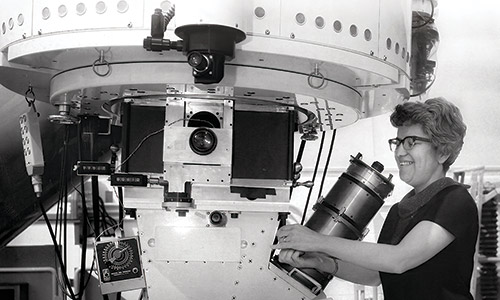
Obeying the tug of dark matter, galaxy clusters spin about a common center of gravity at speeds too fast to be accounted for by the stars within the clusters, an observation made by Swiss astrophysicist Fritz Zwicky in the 1930s. A similar too-rapid rotation happens in individual galaxies, according to studies in the 1970s by astronomer Vera C. Rubin.
“We measure velocities and then we infer there’s extra mass superimposed right on top of it
[normal matter],” says Zaritsky, who is also a professor of astronomy at the University of Arizona. Scientists think a halo of dark matter surrounds galaxies, explaining the rotation rate.
Scientists have also found evidence of dark matter on a small scale. The neutrino is a sub-atomic particle discovered in the 1950s. Neutrinos weigh almost nothing, barely interact with and pass ghostlike through normal matter, and travel close to the speed of light. Those characteristics, scientists say, make them hot dark-matter.

The Bullet Cluster is made up of two massive galaxy clusters that have collided. Blue represents mapped dark matter, invisible matter detected by its effects on normal matter. Photo credit: NASA, ESA, CSA, STScI, CXC; Science: James Jee (Yonsei University, UC Davis), Sangjun Cha (Yonsei University), Kyle Finner (Caltech/IPAC).
However, neutrinos and hot dark-matter in general aren’t causing the too-rapid rotation astronomers see because galaxies and structures within them exist. That existence is inconsistent with having a lot of hot dark-matter present.
“It [hot dark-matter] would erase too much of the small-scale structure of the galaxies,” says Shufang Su, a physics professor and dark matter theorist at the University of Arizona. She investigates dark matter and how it might fit into the standard model that covers such well-known particles as the proton, neutron, electron, and their constituents.
Some of the proposed extensions to that model call for cold dark-matter. These particles would be slow moving and heavy, hundreds of times the mass of a proton. However, other models postulate warm dark-matter, which would be faster moving and lighter. Dark matter could also be a mix of cold, warm, and hot. Still other models call for more exotic particles.
Figuring out which, or if, any model is right requires more data, which researchers are gathering. On an astronomical scale in addition to causing anomalous rotation rates, dark matter, like normal matter, leads to gravitational lensing. Because it has mass, dark matter distorts space, altering the path of light coming from a bright object or galaxy located on the other side of the dark matter.
“It does everything a lens will do,” Zaritsky says. “It magnifies things. It distorts their shapes. It makes them brighter.”
Most gravitational lensing is weak, only causing changes to what we see as the shape of galaxies. Scientists use such distortions to map out the location of dark matter. They catalog the deviations caused by gravitational lensing and then infer where the unseen mass must be that caused the distortions.
Zaritsky, for instance, was part of a team that studied the Bullet Cluster, officially galaxy cluster 1E 0675-556. The Bullet Cluster is actually two star-clusters that have collided. By looking at the distribution of normal matter and using gravitational lensing to map the location of the dark matter, astronomers proved that most of the mass in the clusters was found in two blobs of dark matter that had passed through one another.

Installation of state-of-the-art CCD sensors into the focal plane of the Rubin Observatory’s camera. Photo credit: Farrin Abbott/SLAC National Accelerator Laboratory.
“First order, this is a very straightforward argument for the reality of dark matter,” Zaritsky says of the finding. The astronomers published the results in a 2006 Astrophysical Journal Letters paper.
The studies used the Hubble Space Telescope (HST), which has been operational for decades. In 2022, the James Webb Space Telescope (JWST) began its scientific mission. It has a 6.5 m mirror, more than double the size of Hubble’s. That allows it to see galaxies nine times fainter. Designed and optimized for the infrared, JWST has better resolution than the Hubble in that part of the spectrum.
Astronomers are using JWST to investigate dark matter. Diana Scognamiglio is a postdoctoral astrophysicist. While working at NASA’s Jet Propulsion Lab, she was part of a group that used JWST to map dark matter to twice the resolution possible with HST. The group studied a part of the sky that’s about 2.5 times the width of the moon. This region is representative of the universe at large. It has been investigated by astronomers using ground- and space-based telescopes to map the location of normal and dark matter.
Scognamiglio and colleagues published their results in Nature Astronomy in January. Their findings matched what HST had discovered 20 years earlier, with the increase in resolution making it possible to see finer features in the distribution of dark matter.
Scognamiglio compared the new map to putting on a new pair of glasses and seeing more details. She added that JWST also allowed researchers to see further in space and thus further back in time to when galaxies and stars were forming more rapidly.
To do this mapping, astronomers were looking at galaxy shape distortions that were as small as 1%. Achieving such fine resolution requires space-based telescopes.
“A ground-based telescope has to look through the Earth’s atmosphere, which blurs the galaxy shapes. And weak lensing depends on measuring tiny distortion very accurately,” Scognamiglio says.
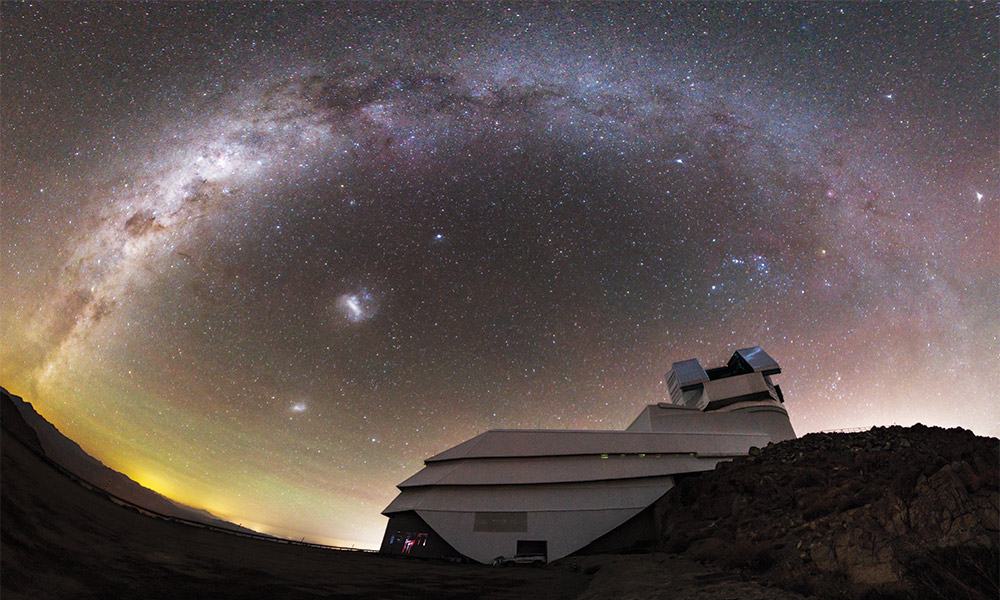
Dark matter mapping will also happen with the Rubin Observatory. Located in Chile and just entering service, the Rubin Observatory has an 8.4 m main mirror, which sends light into the world’s largest digital camera. Weighing three tons and the size of a minivan, the camera has 3.2 billion pixels. It’s made up of an array of 16-megapixel custom CCDs, with these scientific grade sensors forming an imaging surface, a focal plane, 64 cm across. This large detector array had some strict requirements, points out Aaron Roodman, a professor of particle physics and astrophysics at the SLAC National Accelerator Laboratory. He led the construction of the camera.
For example, Roodman notes specifications called for a departure from perfect flatness of less than five microns across all the CCDs. For the entire 64 cm focal plane, that’s equivalent to saying that from Los Angeles to New York hills and valleys must only be about 100 feet high or low. That tight spec is necessary because the camera had to quickly capture sharp images.
“To keep the whole focal plane in focus, you could not tolerate significant deviations from overall flatness,” Roodman says, adding that measurements show an average flatness variation of 4.2 µm.
Hitting the performance requirements requires chilling the CCDs so that their operating temperature is -100 degrees Centigrade, and the system maintains that to within 1/10 of a degree. The CCDs are in vacuum. Without that, Roodman points out, there’d be an iceberg atop them.
The telescope and all its equipment weigh 300 tons, but Roodman says it moves quickly. The camera captures images rapidly and the telescope has a field of view of 3.5 degrees, 7 times the diameter of the sun or moon. The observatory’s mission is to map the sky repeatedly, capturing any changes.
As for dark matter, the Rubin Observatory will survey its distribution on the scale of galaxies. One area of interest might be dwarf galaxies, as these tend to have a higher ratio of dark to normal matter, according to Roodman. The mass profile of galaxies will offer clues to the nature of dark matter.
Su notes that models that predict cold dark matter will produce a particular distribution of mass within galaxies. If cold dark-matter is common there should be a peak, an increasing density of mass from the edge to the center of galaxies.
That forecast appears to be off, according to Su. “The simulations predict way more dark matter concentrations compared to what the current observation is.”
She adds that the Rubin Observatory will provide more accurate data. It will also do so over a larger number of galaxies. If the Rubin Observatory also doesn’t find the expected dark matter peak, then new models may be needed.
A third set of large-scale dark matter clues comes from gamma-ray astronomy, with this information complementing visible and infrared data. In models, cold dark matter is composed of weakly interacting massive particles, or WIMPs, which are about 500 times the mass of a proton. Occasionally two or more WIMPs should run into and annihilate each other, releasing a burst of gamma rays in locations where dark matter is present.
Tomonori Totani, a professor of astronomy at the University of Tokyo, reported in a 2025 Journal of Cosmology and Astroparticle Physics paper that he’d found bursts of high-energy gamma rays using the Fermi Gamma-ray Space Telescope. Unlike earlier potential dark matter gamma rays that didn’t pan out, this activity was 10 times more energetic and far removed from the galactic center.
“It extends into the outer halo region,” Totani says. “This indicates [that] a new candidate for radiation originating from dark matter has been found.”
Confirming these findings requires detecting the same signature in other locations. Dwarf galaxies could be places to look at, according to Totani.
Along with these large-scale searches, there are small scale investigations underway. If invisible matter is drifting by all the time, then it may be detectable even if it barely interacts with normal matter.

The open star cluster Messier 21, as seen in one of the first images captured by the Vera C. Rubin Observatory. Photo credit: RubinObs/NOIRLab/SLAC/NSF/DOE/AURA.
Toward detection, scientists are employing various methods that depend upon capturing tiny signals of heat, vibration, and/or light. For instance, scientists are running a cold dark matter detection experiment called LUX-ZEPLIN 4,850 feet below Lead, South Dakota. They’ve placed seven tons of liquid xenon in sealed chambers, scanning the xenon with an array of photomultiplier tubes. When dark matter interacts with the xenon, there’ll be a flash of about 175 nm light and the release of an electron, which will eventually lead to another spark of light. The depth of the chambers and other protections minimize signals that aren’t from dark matter.
Similar experiments are underway in XENONnT in Italy and PandaX in China. There also are other direct detection efforts focusing on warm dark-matter and other versions of exotic particles that could explain what astronomers see. So far, there’s been no success with direct detection.
For her part, Su is interested in what happens at the smallest scale in time and space. She’s investigating collider-produced dark matter. When a collider smashes particles together, there may be normal and dark matter byproducts. There also must be energy momentum conservation. So, scientists tally up the energy momentum of detected particles. If they find the total leans too much toward one direction, then they know something is missing that headed the other way and wasn’t detected. The missing piece could be dark matter.
The collider search for dark matter has yet to yield success. Direct detection and collider experiments continue to increase their sensitivity. Su notes that if the mass or interactions of dark matter are not what theory predicts, that will impact what should be found by gamma-ray, direct, and collider methods.
“That will give different signatures in those three types of detection,” Su says.
Once dark matter particles are detected, scientists will have to reconcile the data about dark matter on both the large and small scale. So, collecting more gamma-ray, direct detection, and collider data is vital, as is finding out more about dark matter’s astronomical effects.
As more is known about where and what dark matter is, the impact could be profound. To succeed in understanding dark matter, scientists may have to rewrite fundamental physics models that govern all materials, according to Scognamiglio. The revised models could enable new technologies that arise from novel energy sources or materials.
Even before that happens, though, looking for and trying to understand dark matter is already having an effect. Scognamiglio points out the search pushes the development of improved detector technology, precision instrumentation, and data science. Advances in these areas help satisfy a widespread need to extract a small signal from a noisy background.
Hank Hogan is a freelance science and technology writer.