The color purple was highly regulated during periods of human history, including the Roman Empire, the subsequent Byzantine Empire, and the Elizabethan era in England. During the reign of Queen Elizabeth I, sumptuary laws prevented anyone who wasn’t royalty (or a close relative) from wearing purple, a stricture designed to reinforce the social standing of the wealthy.
Purple was reserved for royalty because extracting the dye was so labor intensive (and therefore expensive). Tyrian purple dye could be sourced from the glands of just three species of sea snail, which had to be harvested, and then the dye extracted from them, by hand. It took 12,000 snails to produce just 1.4 grams of dye—enough to trim just one garment.
That’s a lot of fuss for a color that doesn’t even exist.
Purple—not to be confused with violet—is a nonspectral color, a trick of the brain that causes two colors on opposite ends of the spectrum to bend into a circle and create the perception of purple—which exists only in our minds. And should you wonder if purple is just violet by another name (I did), the answer is no: The underlying photoreceptor excitation in the human eye is actually different for violet (detected by S cones), than for purple (detected by S cones, which respond to blue, and L cones, which respond to red).
Such a trick of perception is not limited to the visual system, either. What’s really going to bake your noodle is that the magazine (or computer mouse or phone) you’re holding is roughly 99.9% empty space. An atom’s nucleus—the only solid bit—is just 1/100,000th the diameter of the atom. What you experience as solid matter is, in fact, electromagnetic repulsion between the electrons in your hand and those of the object being held. You’re not actually touching anything—you’re feeling electromagnetic force pushing back against your hand.
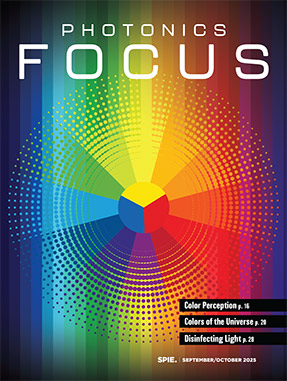
These curiosities of the physical world serve to remind us that our environment is so much more than it seems. The stories that follow explore color, from those within our visual experience and beyond. One feature article explores the curious human neurology of color perception. Another feature story describes the logic astronomers use to colorize grayscale telescope images to help translate scientific data for scientists and excite the imagination of the public. The third feature article examines what is needed to make far-ultraviolet-C lamps—which emit light known to kill harmful microbes like MRSA—affordable for hospitals.
The visible spectrum and its near neighbors form a powerful toolkit for modern technology. Individual wavelengths—red, green, blue—are more than just colors; they’re instruments of healing, communication, and discovery. Like purple’s perceptual trick, or matter’s electromagnetic illusion, color has always been more than meets the eye.

Gwen Weerts, Editor-in-chief