In autumn 1792, John Dalton, most known in the history of science for his foundational role in the development of atomic theory, accidentally caught a glimpse of a “Geranium zonale” flower in candlelight.
“The flower was pink, but it appeared to me an exact sky-blue by day; in candlelight, however, it was astonishingly changed, not having then any blue in it, but being what I called red, a color which forms a striking contrast to blue,” he wrote in a 1794 essay, “Extraordinary Facts Related to the Vision of Colours: With Observations.” He asked friends to also look at the flower in candlelight. “All agreed, that the colour was materially not different from what it was by day-light.”
Dalton speculated, incorrectly but with an “A” for effort, that the vitreous humor in his eyes—and the eyes of his brother whose visual palette was anomalous like his—was tinted blue compared to that of people with normal vision, and so was probably the reason for the “peculiarity” of his perceptual discrepancy.
More than 230 years later, the scientific story of color perception is still in draft phase.
“There’s no shortage of topics in color we don’t yet understand fully,” says University of Pennsylvania vision scientist David Brainard, who has been doing his part to fill in some of the gaps.
What he and many other scientists who have been contributing to the ongoing scientific marathon to explain color perception agree on is that the physical light signals entering our eyes are one thing, but the color that our brains perceive is quite another.
One way to begin grasping this eye-brain tag-team of color perception is to consider how, in people, two very different optical stimuli can elicit a perception of the same yellow color: The monochromatic yellow in a rainbow corresponds to a single band of wavelengths that enter our eyes, yet a polychromatic overlap of two patches of light, which separately appear as red and green and correspond to different sets of wavelengths entering our eyes, will also be perceived by most people as yellow.
It takes a brain to make practical sense of raw sensory signals, including ones that elicit color perception, says Brainard. From a day-to-day survival perspective, perceiving wavelengths of light as color likely helps organisms detect and react to features in the world more readily.
“There’s an awful lot of sophisticated inference that goes on between the reception of signals about the environment by neurons like photoreceptors in eyes, hair cells in ears, and mechanoreceptors in skin, and the actual percepts, the representations of the world that we form,” says Brainard.
Rudy Behnia, a principal investigator at Columbia University’s Mortimer B. Zuckerman Mind Brain Behavior Institute, puts it this way: “Many of us take for granted the rich colors we see every day—the red of a ripe strawberry or the deep brown in a child’s eyes—but those colors do not exist outside of our brains.” As a mind-opening example, Behnia likes to point out in talks that purple, a beloved color to many, is a nonspectral color. This means there is no physical wavelength of light that corresponds to it, the way yellow corresponds to wavelengths of light in the 270–290 nm range. The perceptual experience of purple derives, Behnia explains, from a multiwavelength excitation of two of the three types of light-sensitive cone cells in human retinas.
This physical light—photons carrying specific wavelengths—exists independently outside our brains and starts the process of color perception when it reaches our retinal cone cells. Unlike the Dalton brothers, who had a form of colorblindness due to the lack of one type of cone cell, in most people those cone cells come in three models. These are sensitive, respectively, to relatively long (L), middle (M) and short (S) wavelengths in the visible spectrum of light, whose wavelengths span from about 400 to 700 nm. Multitudes of these three types of cone cells create a cellular mosaic in the retina, which does its own set of neural computations on the mix of cone-cell activity before it sends its optical signals brainward.
When you look at an object that appears red to you, some of the light that illuminated the object reflects into your eyes and some of it is absorbed before that can happen. Moreover, the light source might be bright or dim, and its intensity might change from moment to moment. Meanwhile, the overall optical input from an object or scene to any pinpoint of your retina also changes as you move. Even with all of this raw variability, Brainard says, our brains do a very good job of peeling away these effects to create a steady and reliable impression of the actual colors of objects.

Magnetoencephalography (MEG) scanner. Photo credit: National Institute of Mental Health, National Institutes of Health, Department of Health and Human Services.
One of the major wonders in this context, says senior investigator Bevil Conway of the US National Eye Institute and National Institute of Mental Health, is that we can even experience “object constancy” at all. The term refers to the perceived persistence of objects and properties, such as color, even amidst this whirling flux of raw optical stimuli.
“It’s all abstract until you have the rest of the brain plugged into the retinal input to turn it into something meaningful,” says Conway. “I see retinal data, or retinal images, as little bits of Morse code. It’s a mental model of the visual world and how things relate to each other, which we build during development, that guides our interpretations of the retinal data and how we respond to it.”
It goes as deep as evolution, says Behnia. Whether it’s a person or one of her many fruit-fly subjects who might be perceiving visual input as color, this brain-constructed optical category of information emerged and stuck only because of its evolutionary, survival, and practical benefits. You might peel and eat what looks like a smooth yellow banana but pass on what looks like the shriveled blackened banana next to it, one of her lab colleagues points out.
Some of Behnia’s team’s recent work has focused on uncovering the neural circuitry and computations that enable fruit flies, whose brains are easier to study than human brains, to distinguish hues that are environmentally relevant to them. In human vision, hue denotes the perceived colors associated with specific wavelengths or combinations of light, all of which strip down to electromagnetic oscillations of specific frequencies, none of
which are inherently colorful.
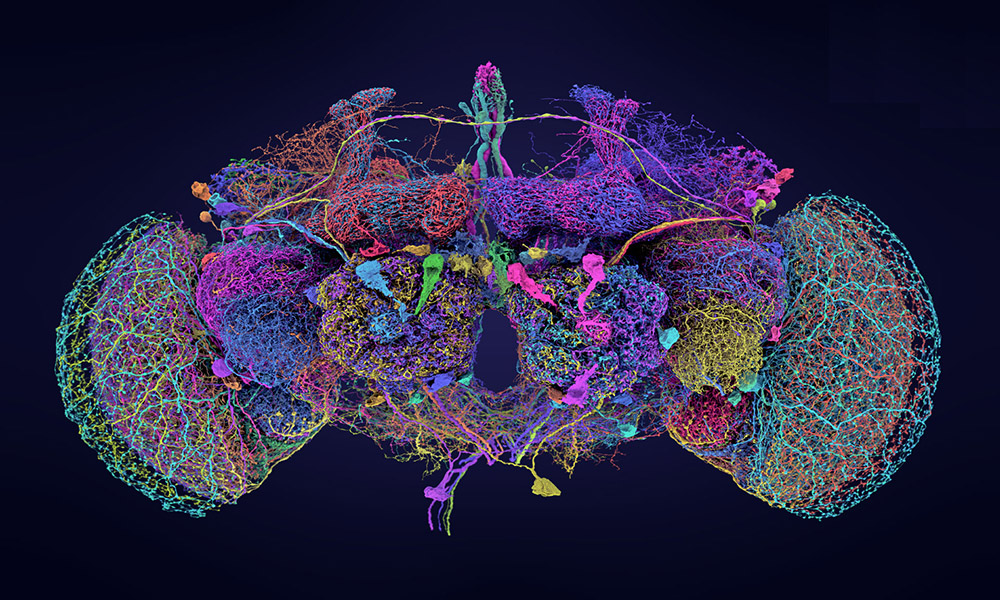
With the help of precise brain maps showing the 130,000 neurons and 50 million connections in each fruit fly’s poppy-seed-sized brain, along with computer models to interpret complex neural activity, Behnia’s team found neural circuits that appear capable of detecting specific hues.
These included hues that people would perceive as violet and other hues that correspond to ultraviolet (UV) wavelengths people cannot see. For flies, the researchers point out, detecting UV hues likely serves them well since many plants have features that reflect in UV patterns.
“Now we know a little more about how a brain’s wiring makes it possible to build a perceptual representation of color,” said Behnia. Her hope is that these hard-won insights about fly-brain color perception pertains to the way people perceive color and, as she will tell you, many other kinds of perception.
Teasing out the myriad details of color perception is a massive project, says Conway. For one thing, so much of the brain is involved. The brain summons as much of itself to color perception as it does for face recognition, which is a lot, he says. The streams of signals carrying color-relevant information that begin in the retina’s cone cells travel to a network of brain regions, including the lateral geniculate nucleus, primary visual cortex, extrastriate cortex, frontal cortex, hippocampus, and superior colliculus. All the while, those signals are participating in neural computations, perhaps similar to those Behnia’s team has uncovered in the fruit fly brain, that underlie the subjective perceptions and experiences of color. It’s also from all of that brain activity that emotional responses, aesthetic judgments, and decisions about how to respond to color information emerge.
One way Conway has been trying to sidestep this complexity and yet still fill in some of the unknowns about color perception is by hooking people up with a helmet-like sensing device that can detect changing magnetic fields in their brains in response to different stimuli. It’s a technique called magnetoencephalography. By showing people different colors, recording their brain’s changing magnetic patterns, and applying a machine-learning technique to identify correlations between the stimuli and the magnetoencephalography data, Conway’s team can now usually identify a hue a person is seeing just by the magnetoencephalography patterns.
“You don’t actually need to know anything about neurons,” he says, noting that these studies do not directly reveal much about the basic biology of color vision. But the data can generate mathematical descriptions and computer models that offer insights into how neurons and brain circuits might function during color perception.
Conway notes that this technique might reveal the different stages of how the brain represents color information, which could tell scientists what to expect when they study individual neurons. “This is quite different from studying neurons and saying things like, ‘How do they respond to color?’ and ‘Is there a neuron whose response predicts that I see red?’”
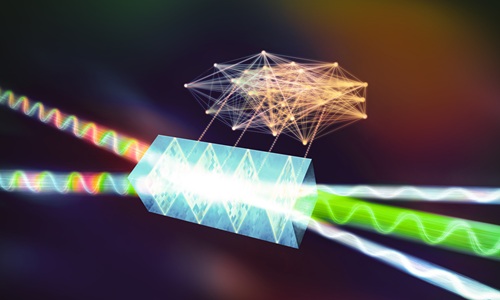
Even so, a research team from the University of California, Berkeley, and the University of Washington has been going in the opposite direction in pursuit of new insight about color perception. In Science Advances, they report using precision lasers to manipulate the biological machinery of light detection and color perception to unprecedented degrees. By stimulating only the retina’s M cone cells, an exclusivity that never happens naturally, they elicited a color perception in human subjects that the researchers describe as “beyond the natural human gamut.” The subjects did not exactly see colors humanity has never experienced, but rather a blue-green color of “unprecedented saturation.”
The researchers suggest this new research platform could “enable diverse new experiments.” Among the possibilities they mention are studies to reprogram retinal cells in ways that could restore full three-color vision to people with color blindness—like John Dalton—who lack one type of light- detecting cell.
What no past, current, or foreseeable research gets anywhere close to explaining, is the subjective experience of color. But that problem is equivalent to one of the biggest of them all: trying to explain how we have conscious perceptions and experience at all. What we call color perception, Conway and others say, is just another evolutionary innovation that empowers some members of the living kingdom to highlight what is worth paying attention to in the environment.
“Spoiler alert,” warns Brainard with a smile. “We don’t understand color perception all the way to the neural events deep in your brain that results in you saying, ‘That one’s red, and that one’s green.’ We don’t have that full understanding. But we do understand some things.” Which sounds like a dozen-word slogan for science itself.
Ivan Amato is a freelance writer, editor, communications consultant, and crystal photomicrographer based in South Orange, New Jersey.