

Plenary Event
Sunday Evening Sustainability Plenary
23 August 2026 • 6:00 PM - 7:25 PM PDT | Conv. Ctr. Room 6A
Session Chair: Stavroula Foteinopoulou, The Univ. of New Mexico (United States)
6:00 PM - 6:05 PM:
Welcome and Opening Remarks
6:05 PM – 6:45 PM:
Energy transfer and conversion in nanoscale gaps
Understanding radiative heat transfer in nanoscale gaps and devices is of great current interest due to the strong potential of nanoscale thermal radiation for creating novel energy conversion devices. In this talk, I will describe ongoing efforts in our group to experimentally elucidate nanoscale radiative heat transfer and leveraging it for developing novel energy conversion technologies. Specifically, I will present our recent experimental work where we have developed and employed novel nano positioning platforms and custom-developed microdevices to perform first systematic experiments that reveal that radiative heat transfer rates in nanometer sized gaps can exceed those set by the blackbody limit by several orders of magnitude. Next, I will discuss how such enhancements in radiative heat transfer rates can enable novel photonic based energy conversion and refrigeration technologies and present experimental data that highlight the promise of these approaches. Finally, I will briefly outline how these technical advances can be leveraged for converting heat to electricity with high efficiency and high power output to develop novel energy conversion technologies that can contribute to a sustainable future. I will close by previewing two emerging directions in the group: direct measurements of Casimir forces in nanoscale gaps and the search for persistent thermal currents that are analogous to electrical supercurrents in superconductors.
Prof. Pramod Reddy received a B. Tech and M. Tech in Mechanical Engineering from the Indian Institute of Technology, Bombay in 2002, and a Ph.D. in Applied Science and Technology from the University of California, Berkeley in 2007. He was a recipient of the NSF CAREER award in 2009, the DARPA Young Faculty Award in 2012, the Young Alumnus Achiever Award from IIT Bombay in 2017 and the University Distinguished Faculty Achievement Award from the University of Michigan in 2020. He is currently a professor in the department of Mechanical Engineering and the department of Materials Science and Engineering at the University of Michigan, Ann Arbor.
6:45 PM – 7:25 PM:
Thermal photonics for the sustainable water and cooling nexus in extreme heat
Accelerating global warming has driven record-high ambient temperatures across major cities worldwide, sharply intensifying cooling demand and straining energy and water infrastructures. Regions already exposed to extreme climates, including tropical and desert countries such as Saudi Arabia, are emerging as critical testbeds for forward-looking strategies to confront the future of global heat stress. Developing cooling technologies that are both energy-efficient and climate-resilient has therefore become a defining scientific challenge.
This talk explores how thermal photonics enables new pathways for heat management through engineered solar absorption, thermal emission, and radiative heat transfer. I will first discuss recent advances in scalable solar-thermal photonic architectures, including low-cost photothermal evaporation systems for sustainable desalination and zero-liquid-discharge water treatment. However, efficient heating alone is insufficient without sustainable cold sources. In the second part, I will present passive radiative cooling strategies that reject heat directly to outer space without energy input, enabling sub-ambient cooling and atmospheric water harvesting. These advances establish thermal photonics as a foundational framework for cooling in an increasingly overheated world.
Dr. Qiaoqiang Gan is a Professor in the Materials Science and Engineering Program and Thrust Lead for Advanced Cooling Technologies at the Center for Renewable Energy and Storage Technologies (CREST), King Abdullah University of Science and Technology. He is a Fellow of Optica and SPIE. He has authored over 130 peer-reviewed publications and holds tens of patents. He currently serves as Editor-in-Chief of IEEE Journal of Selected Topics in Quantum Electronics and as Associate Editor for Journal of Photonics for Energy (SPIE) and PhotoniX (Springer). He previously served as CLEO Subcommittee Chair (2019–2020), Program Chair (2021), and General Chair (2023).
SETUP: Theater style seating.
6:00 PM - 6:05 PM:
Welcome and Opening Remarks
6:05 PM – 6:45 PM:
Energy transfer and conversion in nanoscale gaps
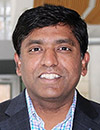 |
Pramod Reddy
Univ. of Michigan (United States) |
Understanding radiative heat transfer in nanoscale gaps and devices is of great current interest due to the strong potential of nanoscale thermal radiation for creating novel energy conversion devices. In this talk, I will describe ongoing efforts in our group to experimentally elucidate nanoscale radiative heat transfer and leveraging it for developing novel energy conversion technologies. Specifically, I will present our recent experimental work where we have developed and employed novel nano positioning platforms and custom-developed microdevices to perform first systematic experiments that reveal that radiative heat transfer rates in nanometer sized gaps can exceed those set by the blackbody limit by several orders of magnitude. Next, I will discuss how such enhancements in radiative heat transfer rates can enable novel photonic based energy conversion and refrigeration technologies and present experimental data that highlight the promise of these approaches. Finally, I will briefly outline how these technical advances can be leveraged for converting heat to electricity with high efficiency and high power output to develop novel energy conversion technologies that can contribute to a sustainable future. I will close by previewing two emerging directions in the group: direct measurements of Casimir forces in nanoscale gaps and the search for persistent thermal currents that are analogous to electrical supercurrents in superconductors.
Prof. Pramod Reddy received a B. Tech and M. Tech in Mechanical Engineering from the Indian Institute of Technology, Bombay in 2002, and a Ph.D. in Applied Science and Technology from the University of California, Berkeley in 2007. He was a recipient of the NSF CAREER award in 2009, the DARPA Young Faculty Award in 2012, the Young Alumnus Achiever Award from IIT Bombay in 2017 and the University Distinguished Faculty Achievement Award from the University of Michigan in 2020. He is currently a professor in the department of Mechanical Engineering and the department of Materials Science and Engineering at the University of Michigan, Ann Arbor.
6:45 PM – 7:25 PM:
Thermal photonics for the sustainable water and cooling nexus in extreme heat
 |
Qiaoqiang Gan
King Abdullah Univ. of Science and Technology (Saudi Arabia) |
Accelerating global warming has driven record-high ambient temperatures across major cities worldwide, sharply intensifying cooling demand and straining energy and water infrastructures. Regions already exposed to extreme climates, including tropical and desert countries such as Saudi Arabia, are emerging as critical testbeds for forward-looking strategies to confront the future of global heat stress. Developing cooling technologies that are both energy-efficient and climate-resilient has therefore become a defining scientific challenge.
This talk explores how thermal photonics enables new pathways for heat management through engineered solar absorption, thermal emission, and radiative heat transfer. I will first discuss recent advances in scalable solar-thermal photonic architectures, including low-cost photothermal evaporation systems for sustainable desalination and zero-liquid-discharge water treatment. However, efficient heating alone is insufficient without sustainable cold sources. In the second part, I will present passive radiative cooling strategies that reject heat directly to outer space without energy input, enabling sub-ambient cooling and atmospheric water harvesting. These advances establish thermal photonics as a foundational framework for cooling in an increasingly overheated world.
Dr. Qiaoqiang Gan is a Professor in the Materials Science and Engineering Program and Thrust Lead for Advanced Cooling Technologies at the Center for Renewable Energy and Storage Technologies (CREST), King Abdullah University of Science and Technology. He is a Fellow of Optica and SPIE. He has authored over 130 peer-reviewed publications and holds tens of patents. He currently serves as Editor-in-Chief of IEEE Journal of Selected Topics in Quantum Electronics and as Associate Editor for Journal of Photonics for Energy (SPIE) and PhotoniX (Springer). He previously served as CLEO Subcommittee Chair (2019–2020), Program Chair (2021), and General Chair (2023).
Event Details
FORMAT: General session with live audience Q&A to follow presentations.SETUP: Theater style seating.