
Each month, experts from across different disciplines and technology application areas present new discoveries and advances in optical polarization and related topics. With a commitment to extensive Q&A sessions, this series has a particular focus on engendering new collaborations and research opportunities for scientists in relevant fields. Read more about the chairs and volunteers behind this webinar series—a group dedicated to optical polarization and related phenomena.
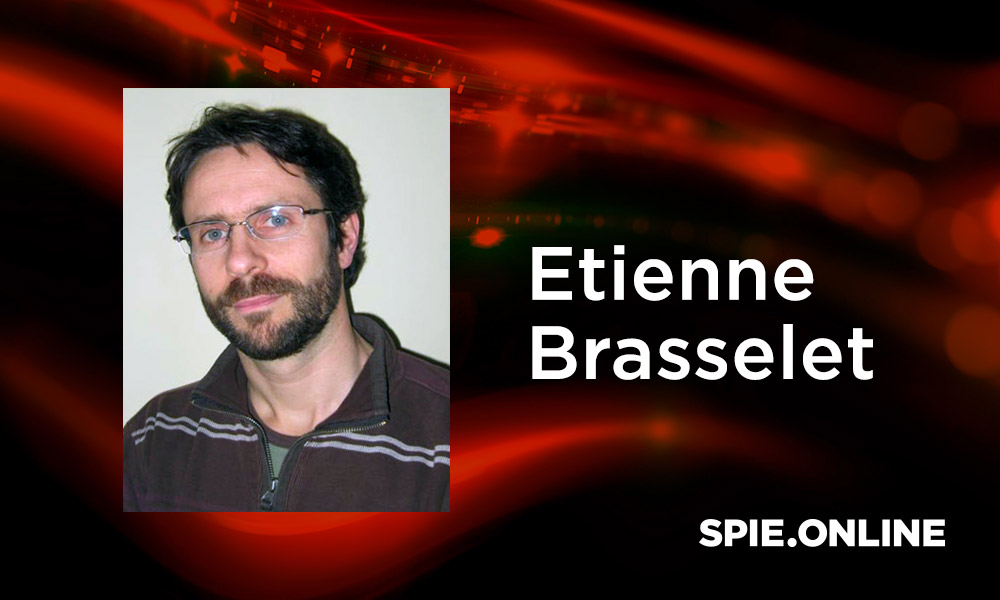
Presenter: Etienne Brasselet
Director of Research at CNRS, University of Bordeaux | France
26 May 2026 | 6:00 AM PT
Webinar Abstract: Liquid crystals underpin key optical technologies, especially displays, where their orientational order is precisely controlled. Beyond this, they can host diverse topological structures, both singular and non-singular, and exhibit strong sensitivity to broken symmetries across multiple scales, enabling agile self-engineered photonic systems. What began as observations of light scattering from defects has evolved into a framework where liquid crystal textures tailor optical field topology in a deterministic and reconfigurable way, which I will overview.
Presenter: Etienne Brasselet
Director of Research at CNRS, University of Bordeaux (France)
Bio: Etienne Brasselet is Director of Research at CNRS, University of Bordeaux, France. His scientific interests cover wave-matter interactions in the framework of multidisciplinary environment including optics, acoustics, and soft matter systems. His research activities mainly focus on situations where structured fields meet structured matter, which makes topology and vector fields at play in various circumstances.
Poincaré webinars are being scheduled and will be added soon.
Select your preferences for updates and newsletters to stay connected with your technical community. If you don't already have an account, sign up for a free SPIE account and enjoy access to research, discoveries in emerging technology, and updates on engineering projects from around the globe.
National Institute of Standards and Technology (NIST)
École Polytechnique
Florida International University
Thomas A. Germer, a physicist in the Surface and Interface Metrology Group, Sensor Science Division, at the National Institute of Standards and Technology (NIST), leads this interdisciplinary series that brings together speakers from across the globe to explore topics derived from Henri Poincaré's work on optical polarization. The interactive investigations demonstrate contemporary applications of polarization techniques in various research areas and how they relate to each other, and are extended, for example, to non-paraxial optics.
"The reason I chose polarization science for this SPIE-hosted webinar series, is that this topic extends across nearly all of photonics," notes Germer. "Optical radiation is a vector field! And while there are conferences scattered around the world specifically related to certain aspects of polarization, they are often tied to specific applications whether those might be materials science, remote sensing, biomedical optics, or astronomy. One of the hopes for this series is that it will allow for energetic and lively discussions. In the end, I really hope to bring the global polarization-focused community together."
Webinar facilitators are Germer, Jessica C. Ramella-Roman of Florida International University, and the École Polytechnique's Tatiana Novikova. The program is supported by an international committee of volunteer leaders: Oriol Arteaga, University of Barcelona (Spain); Sophie Brasselet, Institut Fresnel (France); Nirmalya Ghosh, Indian Institute of Science Education and Research Kolkata (India); Ma Hui, Tsinghua University Shenzhen International Graduate School (China); Igor V. Meglinski, Aston University (United Kingdom); Valery V. Tuchin, Saratov State University (Russian Federation); and Scott Tyo, University of New South Wales (Australia).