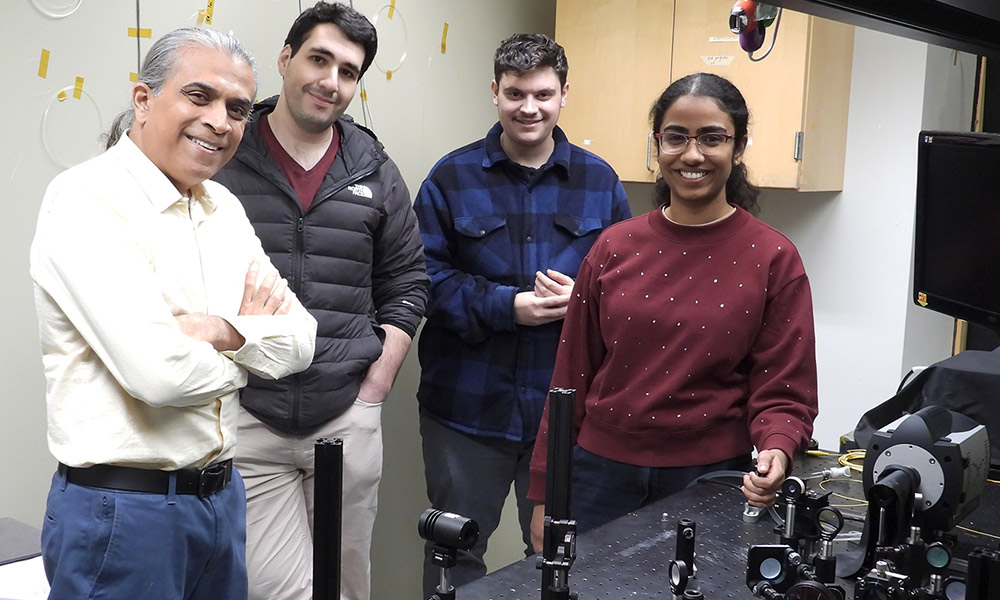
Siddharth Ramachandran, a Distinguished Professor of Engineering at Boston University, started his career at Bell Labs. After a decade in industrial research, he joined Boston University in 2010. His work on the understanding and development of lightwave devices comprising spatial, vectorial, and topological complexity have been applied in the fields of quantum computing, optical networks, brain imaging, and laser-based defense systems. His career achievements include the elucidation of spin-orbit interaction phenomena (the interplay of light’s polarization and its spatial structure), leading to the demonstration of the first polarization-maintaining fibers despite being strictly circularly symmetric. This finding has had profound impact in the development of power-scalable fiber lasers. He is also credited with discovering a “forbidden” regime of light propagation that yields remarkably low loss transmission as well as resistance to mode mixing. This has led to the demonstration of robust propagation of a record 100 modes/channels through a single optical fiber, with game-changing implications for scaling data capacity, as well as for noise-resistant quantum networks. These fundamental discoveries have impacted other areas, such as endoscopic nanoscopy for in-vivo high-resolution microscopy, engineerable chirality for sensing, an expanded toolbox for nonlinear fiber optics enabling high-power all-fiber visible lasers, and high-dimensional quantum-source engineering.
An SPIE Fellow Member since 2019, Ramachandran will be presenting an invited paper at SPIE Photonics West later this month. He has been an active conference chair, co-chair and conference program committee member, as well as presenting frequently at SPIE conferences. He has published his research in SPIE’s Journal of Biomedical Optics and has shared his research widely across other academic journals, mainstream news, and trade journals.
“My own interaction with Siddharth dates from a talk that he gave at the University of Maryland more than a decade ago where he pointed out a simple, but profound distinction between single mode fibers and the multimode fibers that he was investigating,” recalls Curtis R. Menyuk, University of Maryland Baltimore County Professor of Computer Science and Electrical Engineering and Director of the Center for Navigation, Time, and Frequency Research. “I have followed his career with great interest since that time and have watched with admiration his ability to find new, seemingly unrelated applications for the special fibers that he has been investigating. In addition to his outstanding scientific and engineering contributions, Siddharth has been a great contributor to the optics community in general and to SPIE in particular, especially when it comes to encouraging and supporting the next generation of optics and photonics scientists and engineers: he is an outstanding educator whose graduate students have already gone on to a wide variety of careers in research laboratories, industry, and academia.”
Meet the other 2026 SPIE Society Award winners.
Read more about the SPIE G.G. Stokes Award in Optical Polarization.