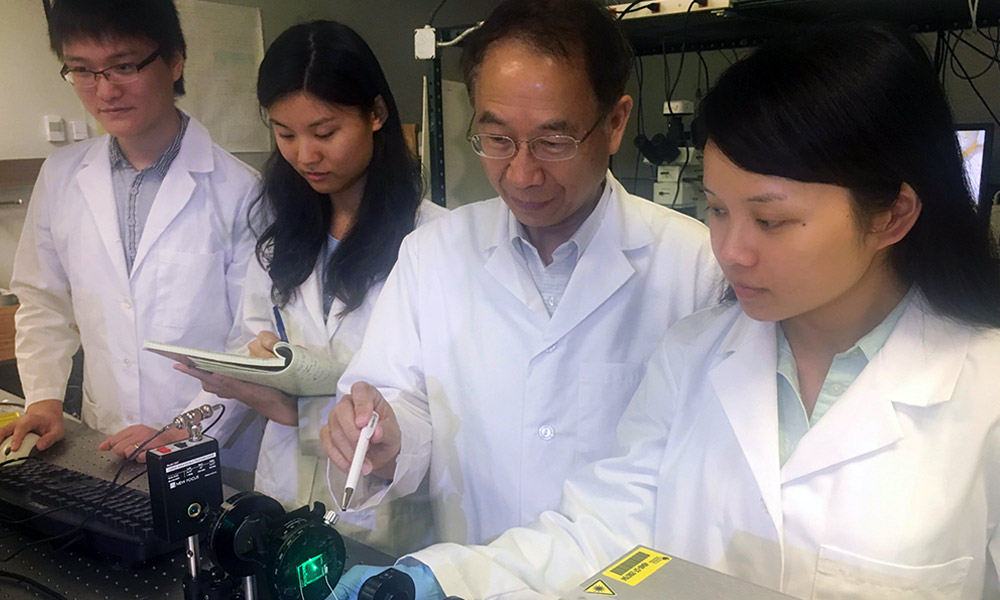
Shin-Tson Wu, a leader in the field of display science and device technology, is a Trustee Chair Professor of Optics and Photonics at the College of Optics and Photonics (CREOL) at the University of Central Florida (UCF). Wu's research focuses on three areas: advanced displays including miniLED, microLED, quantum-dot LCD, and augmented reality and virtual reality displays; adaptive optics for laser beam steering and foveated imaging; and adaptive lenses, such as tunable/switchable focus liquid crystal lenses. Prior to joining UCF in 2001, Wu was at Hughes Research Laboratories for nearly 20 years. Across his nearly four decades of work within industry and academia, he has obtained 101 patents, producing groundbreaking work in the development of new liquid crystal materials, devices, and applications. His prolific inventions, scientific discoveries, and technological development of advanced LCDs and photonic devices have had — and continue to make — a tangible impact on the global display and photonic industries. So far, he has co-authored seven books, 700 journal papers, and 330 conference papers.
Elected to SPIE Fellow Member status in 2007, Wu has been an active Society Member since 1984. He has served on various committees and chaired multiple conferences, and has presented more than 60 papers at SPIE conferences. He is the recipient of the Society for Information Display's (SID) 2011 Slottow-Owaki Prize, the 2008 SPIE G.G. Stokes Award in Optical Polarization, and the 2022 SPIE Maria Goeppert Mayer Award in Photonics, among others. In 2014, he was inducted into the Florida Inventors Hall of Fame.
“I have personally known Professor Wu for about 15 years,” says Global Business Development Manager for AR/VR Michael Wittek of Merck KGaA, Darmstadt, Germany. “We have worked together on the Society for Information Display (SID) program committee, and, for the past several years, I have visited his lab to give seminars almost every year because our research interest overlaps closely. About ten years ago, Professor Wu developed a novel structure of polarization volume grating (PVG) composed of a slanted cholesteric liquid crystal polymer. Such PVG exhibits strong polarization selectivity. For example, the PVG can be designed to transmit right-handed circularly polarized and reflect the opposite polarization at a large diffraction angle. Such a large diffraction angle is critical to guide the incident beam to propagate in the waveguide with total internal reflection. Moreover, PVG exhibits a wider spectral and angular bandwidth compared to existing technologies such as surface relief gratings (SRG) for the input/output coupler of waveguide-based augmented reality glasses. Recently, he also developed a PVG exhibiting a novel polarization conversion effect, instead of Bragg reflection, at large incident angles. By using this optimized PVG as an input coupler for AR glasses, both optical efficiency and eyebox brightness uniformity can be doubled, and the eye glow issue due to light leakage as typically observed in SRGs is significantly suppressed. With this optimized PVG design critical issues for the emerging AI-assisted AR glasses, like low optical efficiency, poor eyebox uniformity, and eye glow, can be overcome. Professor Wu’s scientific discoveries have led to novel improved diffractive optics technologies with widespread applications in AR-waveguides and beyond.”
Meet the other 2026 SPIE Society Award winners.
Read more about the SPIE Dennis Gabor Award in Diffractive Optics.