The past, present, and future of the US military’s operations in space — as shaped by science and technology development — were subjects of two Symposium Plenary presentations at the 2026 SPIE Defense + Security Conference held 26 - 30 April in National Harbor, MD.
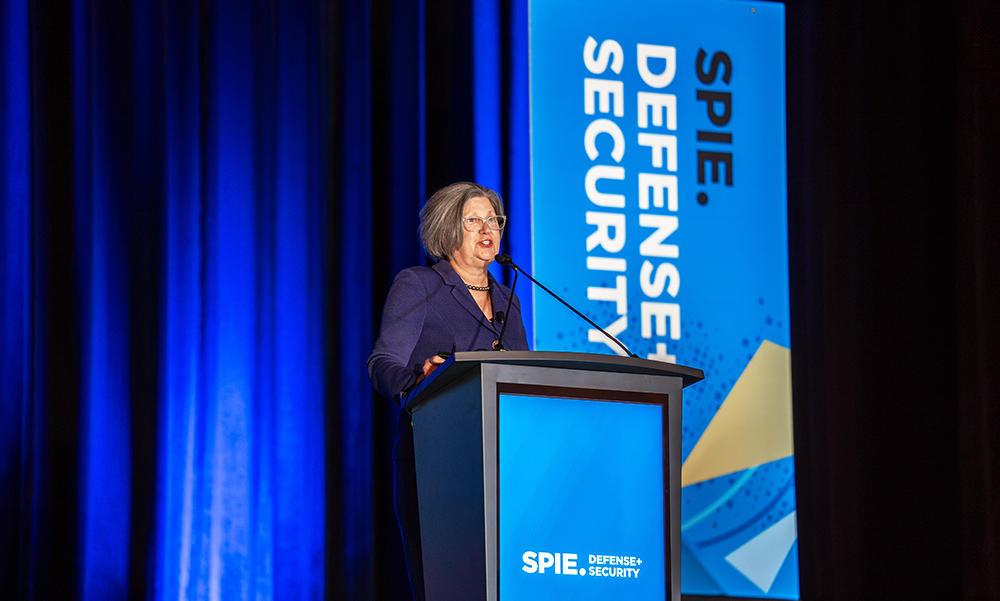
First up was Raj Agrawal, US Air Force military deputy for space, who discussed the role of space in conflict management and decision-making. He stressed the need for US space superiority as a fundamental aspect of US power projection, as well as the importance of human involvement in the process of military engagement.
Agrawal said that when he began his military career during the Cold War, his job was to look at green dots on a screen that would warn of an adversary’s intercontinental ballistic missile launch. “And if there was [a launch] we would have alarms go off around us. We would have 60 seconds to translate what was on our screen into whether or not a missile was indeed incoming. Sixty seconds.” The information would be reported up a human chain of command until it was the decision of the US President whether to return fire.

Raj Agrawal, US Air Force military deputy for space, stressed the need for US space superiority as a fundamental aspect of US power projection, as well as the importance of human involvement in the process of military engagement.
Agrawal emphasized that humans were in the loop “because machines are not always right. And even if they're right, is it the right thing to do to launch a nuclear weapon in response?” He said those are the thought processes of military decision makers as they interface with information fed to them via technology.
“In the military, we either evade or engage. Ideally, we don't have to do either,” Agrawal continued. The US is able to project enough strength that any threat actor wanting to would hesitate, estimating the cost to be too high. “But if we are to engage, we have decisions that we have to make, ideally with credible options.”
Today, the US military’s strategic options and capabilities, including the ability to accurately deliver munitions on target anywhere in the world, are dependent on our command in space. Space superiority, he said, can deliver more information and more options to human decision makers than ever before. “What we're seeking is more options, not ideally escalatory options, but hopefully options to de-escalate. And so those do include the spectrum of military operations.”
Agrawal noted that, in the age of artificial intelligence (AI), it is tempting to think that automation alone is the answer to interpreting all the data at our fingertips, and to make up for the risk of decision latency — taking too long decide military action — that can become a security disadvantage.
“It's not that automation is wrong,” Agrawal said, “it just needs to be in the right places… where we can switch it on or switch it off. Automation may certainly be part of the solution, but it is not the entire solution.”
Following Agrawal’s talk was a presentation by Stacie Williams, chief science officer of the US Space Force (USSF). From a USSF perspective, she said, “today’s science and technology investments are tomorrow's operational superiority. And the question is not whether we will innovate, it's whether we will innovate faster than our adversaries.”
She noted that science and technology investments by the US military began in earnest in the early 1900s with studies of rocketry and powered flight. World War II and the Cold War saw significantly greater investments, including satellite capabilities and supporting human life in space. “Each generation of investment built upon the previous discoveries of the past, creating an exponential acceleration of technology advancement.”
In the 1980s, then President Ronald Reagan ordered the Strategic Defense Initiative (SDI), aka “Star Wars” program, that kicked off significant investment in laser science. Although initially met with resistance by academic researchers, she noted that “the Star Wars investments really built up a lot of the space architecture that we have today.”
Although the original SDI goal of a space-based shield was not realized, Williams said, “it brought a lot of the space domain awareness technologies that we have today. All of those were out of the Star Wars program.” Science and technology investments don’t always go where we think they will go, she continued, “but they always go someplace advantageous, and today those investments have made space vital to our military and civil life.”
She noted, as just one example, that GPS has become so vital to everyday life that its potential disruption by adversaries could wreak havoc via kill satellites and/or the deliberate release of space debris to defeat communications.
“That is something that could be done today, and that is why we have a Space Force,” Williams said. “The Space Force was forged with a clear purpose in mind, and that was to build systems, train the people, and develop the war fighting concepts necessary to contest and control the space domain.”
The US has gone from being nearly the only presence in space, to today’s reality of 15 nations with satellite launch capability, and 88 nations operating satellites in space.
Williams said those realities have meant a shift in thinking about US space strategy, including the idea of “proliferated low-Earth orbit” wherein the US moves away from systems that are “very exquisite, very expensive, to an architecture of lots of satellites, with the motivations of resilience and survivability. If we have a lot more satellites, if we were to lose some of those satellites, operations could still continue, and we would be able to work through the conflict.”
Williams said USSF will continue looking to the academic research community as it seeks to invest in technology areas like digital twins, bio-inspired decision networks, quantum technologies, AI, and more.
“There's lots of things that that we're investing, that we're interested in, that I see will really change our capabilities for the future.”