Alexis Vogt recalls one of her first Melles Griot Optical System’s daily production meetings, expecting it to last no more than 10 minutes. It was enough time to review the previous day’s orders to be shipped. But then a colleague remarked, “Well…Dennis isn’t here.”
The energy of the room shifted from routine to tension-filled, Vogt says. Apparently, without Dennis, production plans would be paused, projects reshuffled, and schedules reworked.
Vogt was puzzled. She soon saw that people planned their own work around Dennis’ vacations, and that whole project timelines were set based on his availability. She wondered, who is Dennis, and why does everything seem to grind to a halt without him?
Eventually, Vogt learned the truth: Dennis, it seems, was a highly valued technician at the company, and a graduate of the optics program at Monroe Community College (MCC) in Rochester, New York.
Dennis didn’t have a four-year degree. He wasn’t a manager. But in a company of 85 people, he was the most important employee on staff.
So, Vogt asked: Why not hire another Dennis?
The answer was immediate—and alarming: “There aren’t any,” her colleagues said.
And Vogt soon discovered that the shortage of optics and photonics technicians was not limited to Melles Griot. The shortage of these key personnel in the optics and photonics industry was—and still is—a global issue, with companies across Europe and North America trying desperately to fill their technician staff needs.
Upon further investigation, Vogt learned that the optics and photonics technician training program at MCC was started in the 1960s, but as iconic camera-maker Kodak, an anchor of the Rochester-area optics industry, fell into decline in the 1990s, the MCC training program likewise fell apart. Nonetheless, without the program, the more than 150 other optics and photonics companies that call Rochester home struggled to find any trained technicians.
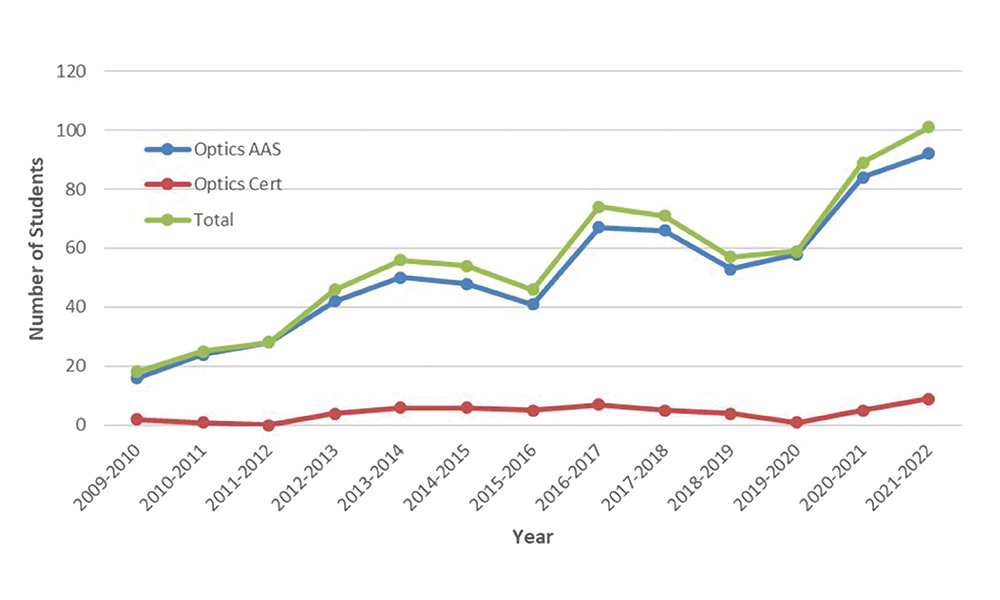
That’s when Vogt made a pivotal decision in her own career. She decided she would take over the program at MCC, even though it was on the brink of closure with only five students.
“I took it over with the intent of strengthening it, growing it, and supplying the workforce for the Rochester region that so desperately needed it. And what shocked me was to learn that these optics technicians are needed all over the country and all over the world,” says Vogt.
Vogt has since significantly expanded the reach of the MCC optics technician training program. Today, nearly 130 students are enrolled, many of them already employed in the optics industry and working full time while completing their studies.
By itself, however, the MCC program is not enough in terms of meeting demand for optics and photonics technicians. To address the growing industry demand, Vogt estimates that programs like the one at MCC, sprinkled across the country, would need to graduate around 550 students each year. But such training programs remain scarce—fewer than 10 dedicated optics technician programs exist across the US.
“There aren’t many of these programs around the United States. I’ve helped other community colleges like Valencia [Florida], Front Range [Colorado], and Sussex County [New Jersey] start optics programs too, but there still aren’t enough of them for that to be widely known,” says Vogt.
One of the major hurdles she faced in restarting MCC’s program was the absence of appropriate teaching materials. But true to her fix-it-yourself spirit, Vogt is leading an effort to launch the SPIE Technicians Series. This new book sub-series, she says, provides educators with the tools and resources needed to establish and grow optics technician training programs at more institutions across the country.
The series, a new branch of the long-standing Tutorial Texts collection by SPIE Press, is designed specifically to support the education and training of optics and photonics technicians. It focuses on delivering foundational, accessible content tailored for those starting or advancing careers in optical manufacturing, testing, assembly, and emerging technologies according to Matthew Jungwirth, manager of technical content & scientific publishing at SPIE.
The technician series provides clear, practical instruction that is enriched with illustrations, examples, and reference data—all of it uniquely structured to meet the learning needs of technicians. The series will cover critical hands-on topics from a technician’s perspective. By combining expert-authored guidance with a tutorial-based format, the authors, including Vogt, aim for it to become an essential resource for technical education, workforce development programs, and individual learners.
“It’s not something that’s 500 pages long, it’s not filled with calculus, it’s not over anyone’s heads—it’s intended to be something that can be readable by many,” says Vogt.
SPIE Press has recently published the inaugural volume in the series: A Master Optician’s Guide to Hand Grinding and Polishing by Peter A. Thelin. Thelin describes hand grinding and polishing as the most basic process for turning raw glass and crystals into a prototype to be copied for production. Such skills are still necessary, Vogt and others say, despite the ubiquity of CNC machines, 3D shaping printers and mills. Hand grinding is still used for advanced technologies that require inflexible fixturing and low-volume optical flats.
Already, two additional volumes in the series are in process: Optoelectronics in Asset Management by Yashwant Sinha, and Practical Optics: Foundations for the Working Technician by Vogt.
“I hope this series is able to help companies, individuals, and academic institutions train more optics technicians,” says Vogt.
Vogt, working with other volunteers and SPIE Press staff, is generating a list of additional topics for the series that will span metrology, physical optics, lithography, and bio-optics, as well as adjacent skills like technical communication and industrial operations.
Vogt says SPIE Press is looking for help in growing this important effort. Assistance could include book authorship, review of book manuscripts, or acting as an advisor to the effort. Interested individuals are encouraged to complete the form found at spie.org/TechSeries.
Jakab Terpstra is a digital marketing coordinator at SPIE, with Matthew Jungwirth, manager of technical content and scientific publishing at SPIE.