The steady stream of tech innovations pouring out of 21st-Century Silicon Valley tends to fog the memory of an earlier period of peak creativity in US science and technology: the decades of the mid-to-late 20th Century, when factories hummed across large swaths of the nation’s interior, churning out a vast array of goods for a newly prosperous citizenry. In every garage was a made-in-America Chrysler/Chevy/Ford—maybe two—and in every Kenmore range inside suburban tract homes simmered a chicken casserole in Corning ware, the first thermal-shock-proof-glass cookware.
For recording memories of family and friends, or for just trying out photography as a hobby, many people turned to a line of cameras made by the Polaroid Corporation in Massachusetts. At their peak, Polaroid’s pathbreaking cameras and “instant” self-developing film technology represented some two-thirds of the US consumer photography market. And not unlike today’s technology giants, Polaroid was the vision, creation, and all-consuming passion of one leader, the driven serial innovator and entrepreneur, Edwin H. Land.
The late Steve Jobs, founder of Apple Inc., regarded Land as a hero and example for his own life. Many founders in Silicon Valley say they, too, find inspiration in Land’s lifetime dedication to science and technology development, providing the world with new products people don’t yet know they need and, once those products appear, can scarcely imagine life without.
Born in 1909 in Bridgeport, Connecticut, to immigrant parents from Eastern Europe, Land’s path in life was not obvious. After high school, he went to Harvard University and there became inspired to make a practical material that would polarize light. Land’s goal was an easy-to-apply film that would cut the blinding glare of automobile headlights.
According to a 1961 Time magazine profile, Land left Harvard after his freshman year bound for New York City to further develop the polarizer material he envisioned. His innovation was to trap millions of micron-sized polarizing crystals in a thin material he dubbed polaroid film. Land thought the automobile industry in Detroit would want to buy his film for application to windshields and headlights. When carmakers proved disinterested, however, Land switched gears.

Polaroid Land camera model 95. Photo credit: Getty Images - Apic.
In 1937, he founded Polaroid Corporation and made his first million dollars by selling polarized lenses for sunglasses, filters, and other products. Legend has it that one day, Land’s young daughter asked why pictures he took with his camera couldn’t be viewed instantly. The inventor couldn’t let go of the idea. As Time noted of the result, Land’s obsession “completely changed photography with his Polaroid Land Camera, which now turns out a finished picture in ten seconds—an invention that skeptics once derided as a passing plaything.”
A series of cameras and film followed the first Land instant camera in 1948, including a film packet that produced both a finished picture and its negative in 15 seconds, and film that produced black and white slides in about 10 seconds. In 1963, Polaroid introduced its game-changing, one-step color film, Polacolor. It was an instant and lucrative hit, and profits from the film (manufactured by Eastman Kodak) fueled development of a series of instant cameras at various price points.
Optical engineer William Plummer, who got to know Land when he was hired at Polaroid in 1969, recalls the founder as a “very interesting guy. He scared a lot of people because he was demanding. I learned early on that if he asked for something and you didn’t quite have it a quick response was ‘Here’s where I’m having problems.’ And he immediately switched into problem solving. And he’d name some other people you should talk to who might know something useful.”
Plummer joined Polaroid to help bring to life Land’s vision for the company’s iconic SX 70 Land camera. Starting in the early 1970s, this folding, single-lens reflex camera included Plummer’s unique viewfinder, among other advances. The camera was a worldwide sensation in the 1970s and ’80s, including with celebrities like artist Andy Warhol and actor and photographer Candice Bergen.
Of the company culture, Time noted, “Over his fast-developing company Land presides like a physics professor engaged with his students in a great adventure. New products at Polaroid are never developed because of market research or questionnaires to customers.”
Land “was personally pretty shy, but he was also a showman,” says Plummer. He says Land would “eat it up in front of 3,000 people at a [Polaroid Corp.] shareholders meeting and deliver and talk about what was new, what he was trying to achieve. He’d hold up something like a camera that wasn’t quite finished yet and talk about it. These meetings were famous.”

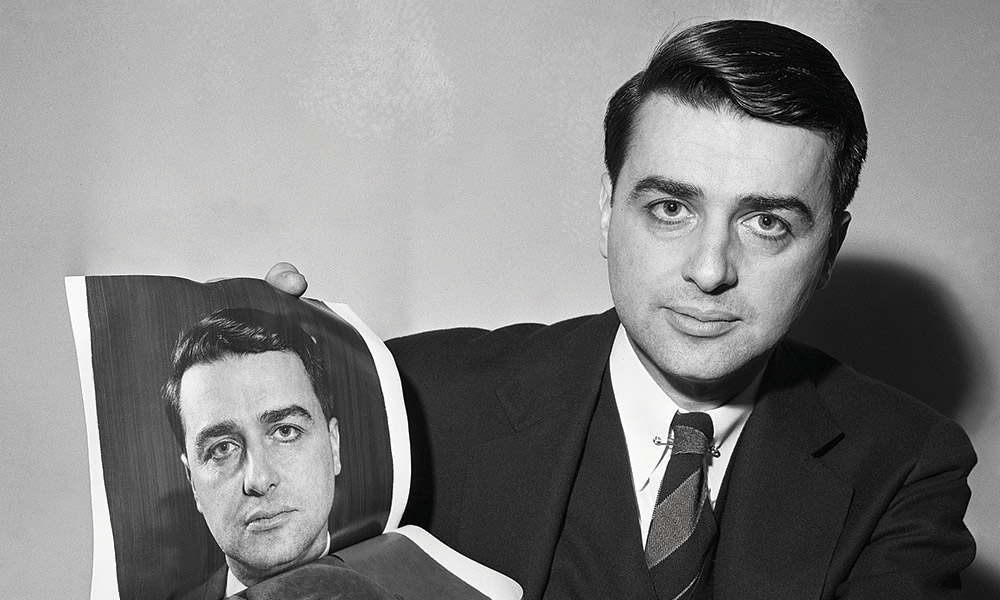
Edwin H. Land, founder and chairman of Polaroid Corporation, holds aloft his “instant” home movie camera, which he introduced at the company’s 40th annual shareholder’s meeting. Photo credit: Bettmann / Contributor.
Outside of work, as Time noted, Land “tenaciously guarded his private life from view. He and his wife (he has two daughters, both at college) live in a big and ancient house on Brattle Street in Cambridge [and] have a summer place in New Hampshire. Land likes to relax with his large hi-fi collection, occasionally plays tennis, [and] is a fast and retentive reader.”
But Land had a secret life, too, the details of which have only recently begun to emerge from the archives of the US intelligence community. It turns out he was intimately involved in every one of the US film-based photo reconnaissance satellite programs—Corona, Gambit, and Hexagon—that started in 1960, as Cold War fears about the nuclear capabilities of the Soviet Union grew and metastasized. According to educator, author, and startup guru Steve Blank, Land was the government’s “most esteemed expert on imaging and spy satellites.”
What’s more, Blank says, Land also championed replacing film-based satellites with digital imaging, pushing CIA spymasters to move forward on the first digital imaging satellite, KH-11 KENNEN (a.k.a. CRYSTAL). By 1977, Blank says, Land “knew more about the application of digital imaging then anyone on the planet.”
Digital imaging would eventually deliver the coup-de-grace to film camera companies like Polaroid and Kodak. Land also invested heavily in a self-developing film called Polavision—just as Betamax and VHS videotaping technology were introduced in the late ’70s. It was a financial disaster for Polaroid. By 1980, Land stepped down from leadership positions at Polaroid and, by 1982, he severed ties completely and sold his remaining shares in the company. In 1991, Land died at home at age 81. His family is said to have destroyed all of his personal records, honoring the great inventor’s wish to leave a legacy of scientific publications and achievements—not a cult of personality.
William G. Schulz is Managing Editor of Photonics Focus.