It’s easy to forget, driving to see relatives or trying to navigate a foreign city, just how much we rely on one faint radio signal from space: GPS. The global positioning system has gone from a military marvel launched by the US Department of Defense (DoD) in 1978, to an essential service pointing the way for everyday life all over the world.
The global positioning system has also become a global workhorse, guiding oil tankers, drones, tractors, ambulances, planes, trains, and trucks from point A to point B, flawlessly. It also time-stamps financial trades, synchronizes power grids, enables ride-hailing services, and can map your dog walk.
GPS satellites orbit some 20,000 km above Earth. Each of more than 30 of the satellites sends out a low-power radio signal that’s about as strong as a light bulb and broadcast across half the planet. Receivers pick up these signals and calculate their position based on time delays. An accurate, reliable clock is one of the unsung heroes of modern life. And it’s thanks to GPS—part of GNSS, the umbrella term for all global navigation satellite systems—that we have that clock.
If there’s a blackout in timing data, even for a few minutes, cascading failures can follow. Trades, for example, can be mis-ordered. Power stations can get out of sync. Control systems can behave erratically. The US Cybersecurity and Infrastructure Security Agency has warned that disruption to positioning, navigation, and timing (PNT) services poses a serious and growing risk.
The GPS system is delicate and vulnerable. Its signals must pass through space weather, urban clutter, competing radio bands, and the rising tide of digital noise. A solar storm, a local jammer, or interference from nearby electronics can degrade its signal of complex global coordinates.
On any given day, satellite navigation signals are also jammed, spoofed, degraded, or lost completely in parts of the world. In the Persian Gulf, parts of Europe, East Asia, and even the US, there are daily interference events in certain hotspots, particularly those near conflict zones. Sometimes they are caused by hostile state actors. Sometimes they’re just accidents, caused by malfunctioning transmitters or poorly configured systems.
Often, interference events of any cause are not noticed until something goes badly wrong for the people and operations reliant on consistent, accurate GPS signals. In 2023, for example, a ferry carrying passengers in the North Sea drifted dangerously off course after spoofed GPS data misled the ship’s crew to believe that they were safely within the correct shipping lane. Manual corrections had to be made, and disaster was narrowly avoided.
In another incident, in 2024, a swarm of drones over the Black Sea, likely carrying out reconnaissance for Ukraine, veered off track during a suspected jamming event. Surveyors, crop harvesters, container ports, and commercial flights have all reported GPS dropouts in recent years. These outages will only continue as counter-GPS technology improves until robust backups and alternative systems are adopted.
Some of the threats to GPS come about simply because of how crowded the radio spectrum has become. Urban areas now hum with signals: 5G, Wi-Fi, Bluetooth, and countless devices competing for bandwidth. GPS receivers in cities must already filter out a blizzard of noise, and that task is only getting harder.
But the greatest vulnerability to reliable GPS signals, particularly in war zones or other areas of global strife, is an increase in attacks that are tantamount to electronic warfare. Jamming a satellite signal is cheap and effective. Spoofing GPS signals by sending the system false location data is more difficult, but not by much. Both acts of sabotage are features in the playbook of numerous hostile groups or governments the world over. But the opposite is also true. National defense can be bolstered by these same GPS vulnerabilities.
So, how can we address the stresses and vulnerabilities to GPS? No such essential, modern system should rest on a single technology. Back-ups—Plan Bs—are necessary. The good news is that alternatives to GPS do exist.
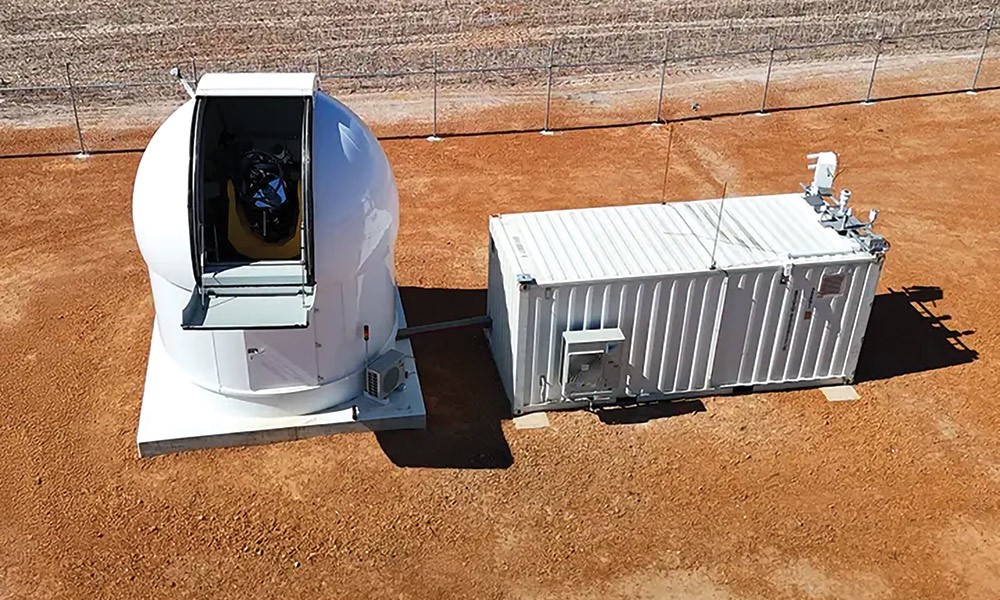
One of the most promising alternatives is optical satellite communication, better known as lasercom. Unlike GPS, which uses radio waves, laser communication uses beams of light to send data. At Cailabs, we build optical ground stations capable even in rough weather of preserving the integrity of the laser link, which is liable to degrade when it passes through the atmosphere. And lasercom has three major advantages that make it a powerful complementary technology.
First, lasercom is hard to jam or spoof. Laser beams are narrow, whereas radio waves spread outwards. To intercept or jam a laser, you need to be directly in the path of a beam that is only 12 m in diameter when it reaches the ground from low-Earth orbit. Lasercom providers talk about their systems’ low probability of interception, but in reality, it’s almost impossible.
Laser beams also transmit far more data than radio signals. Current lasercom systems can send up to one terabit-per-second. For global positioning, that means not just basic navigation fixes, but the ability to simultaneously transmit live video, sensor data, and encrypted command-and-control signals. And because lasercom sits outside the traditional radio spectrum, it is unaffected by the chaos of urban radio clutter or any deliberate jamming in radio frequency bands.
Until recently, lasercom systems were considered exotic, impractical, or too costly. That’s no longer true. Technological advances and miniaturization have brought laser terminals into real-world use. NASA, DoD, the European Space Agency, and several private firms now fly laser payloads on operational satellites. Many are small, agile, and easy to deploy.
One of the technological advances that has brought laser terminals into real-world use is Cailabs’ patented multi-plane light conversion (MPLC) technology, which mitigates atmospheric interference. Cailabs has been connecting regularly with satellites for both commercial constellations and an allied government customer since the spring of 2024, and has been delivering commercial optical ground stations that provide 10 Gbps of satellite connectivity to global customers, with more than 10 currently on contract.
No single solution will replace GPS. But layering different systems creates resilience. In security terms, this is known as defense in depth. If one link fails, others take over. A truly robust PNT framework would combine several different types of technology.
Creating defense in depth is, in part, about understanding the technology options on the table. Recognizing that just about everyone involved in satellite communications is thoroughly familiar with radio frequency (RF) data links, Cailabs has taken the initiative to make engineering training in the application of optical communications available to industry engineers. Understanding the physics, the advantages, the trade-offs of optical versus RF, as well as how to calculate optical link budgets, are all part of this initiative to educate those in the satellite ecosystem on free-space optical communications. Cailabs provides these periodically. Reach out to Cailabs if you would like to learn more about these opportunities.
And this is an urgent matter. Over the past year, global conflict has entered a new phase. The front lines are no longer just trenches and skies. They include undersea cables, data centers, and satellite links. Attacks on infrastructure are common. And because GPS underpins so many systems, it has become a prime target, too.
Governments, defense agencies, and critical industries must plan accordingly. No system, however powerful, should rest on a single point of failure like GPS radio signals. We learned that with energy when Europe’s reliance on Russia for gas was exposed in 2022. We are learning it again with digital security. It’s time we applied the same logic to navigation and timing.
The technology to build resilient systems already exists. What is needed now is investment, integration, and imagination. Optical communications are practicable, reliable, and secure.
Jeff Huggins is president of Cailabs US.