In May, 24-year-old former Texas A&M collegiate football player Brian Williams died from heat stroke after running a half marathon in Irving, Texas. During marathons and half-marathons, a runner’s body temperature can climb three degrees Celsius higher than normal, which can impair the body’s ability to cool down, even those of conditioned athletes like Williams. In fact, exertional heat stroke is one of the leading causes of athlete deaths during marathons.
Long-distance runners often experience highly elevated body temperatures as their bodies burn energy reserves through an inefficient process that generates more heat than energy. Along with cyclists and hikers, they also experience prolonged periods of elevated breathing and heart rate, and are at considerably high risk for dehydration, cramps, and, due to intense and repetitive movements, musculoskeletal injuries.
To help prevent injuries, athletes track health metrics such as heart rate and blood oxygen levels, using wearable devices. However, commercial wearables available today cannot track many other metrics that play important roles in performance and injury risk. For instance, “You want to measure things like lactate to look at energy expenditure, or the amount of sweat and electrolytes in sweat,” says Michael Daniele, an associate professor and biomedical engineer at North Carolina State University.
Being a byproduct of anaerobic metabolism, lactate buildup is an indicator of fatigue. Lactate monitoring could help athletes avoid overexertion and learn how their metabolism responds to exercise and, in turn, optimize their nutrition and hydration. A growing body of research shows that many other metabolites are consequential to athletic performance.
“Our body is like a soft machine,” says Nanshu Lu, a biomechanical engineer and professor of engineering at the University of Texas at Austin. “It’s radiating data continuously and personally, but distributed across the body.” Generating a comprehensive picture of health and fitness, therefore, necessitates tracking multiple biophysical and biochemical signals.
But measuring more health metrics would require either wearing multiple wearables or cramming many sensing modules into one device. While the former would be inconvenient, the latter would mean increased susceptibility to signal interference from each other and from the environment. Having multiple modules also raises the power requirements of wearables and makes it challenging to fit them into compact and flexible form factors.
Optical materials, however, offer considerable advantages over non-optical sensors. They can pick up multiple signals, such as two different wavelengths of light, simultaneously, and are immune to electromagnetic interference. These materials detect changes in the behavior of light after it interacts with tissues, serving as a proxy for underlying physiological changes. The materials also have interesting mechanical, thermal, and chemical properties. They can sense mechanical forces, temperature changes, and, when functionalized with other entities like enzymes, reactions with metabolites.
Many commercially available wearables measure health metrics optically. For instance, smartwatches and fitness trackers measure heartbeat with photoplethysmography (PPG). The technology involves emitting a light signal into the wrist and, using a photo detector, detecting the reflected light, which changes with the amount of blood it interacts with over the course of each heartbeat. By using two colors of light, each particular to oxygenated and deoxygenated forms of hemoglobin, it can also measure blood oxygen levels.
But PPG relies on semiconductor diodes, the rigidity of which restricts form factor and allows measurement from only one point. “If you want good electrical recording from the body, you need to make the sensors very conformal to the skin,” says Shideh Ameri, associate professor of electrical and computer engineering at Queen’s University. Even if the sensing modules are extremely soft and thin, she adds, the electronic circuit itself is made of silicon and is brittle.
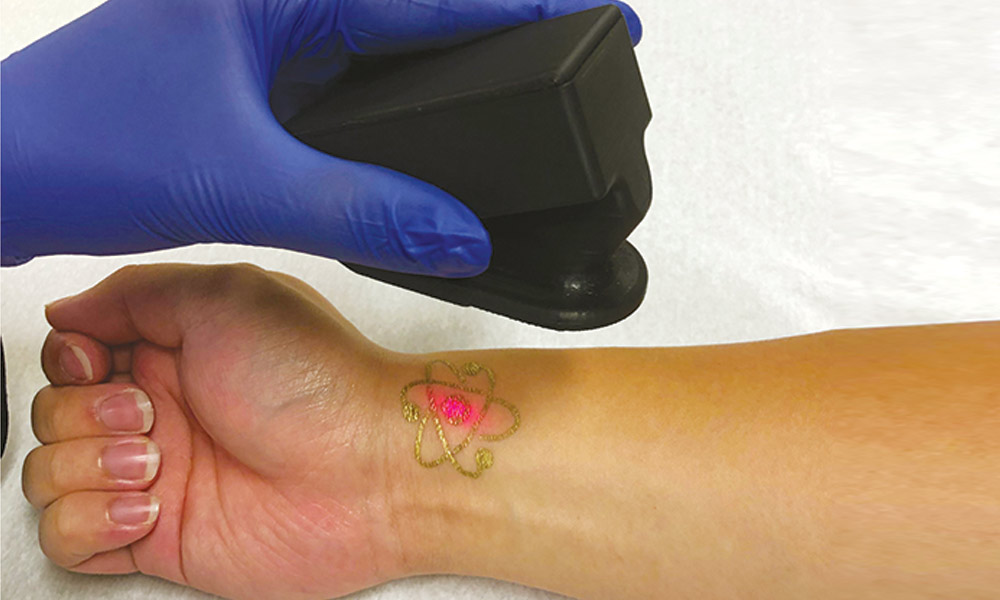
On the contrary, many optical materials, such as elastomers or hydrogels, have the stretchability to be made into flexible wearables. One such approach is optical tattoos made from flexible polymers with high light-transmission. “The optical tattoo is a reflective, conformal layer that we place on the skin,” explains Ameri. It can work with both optical and non-optical sensing modalities, last for weeks, and is easy to peel off.

Comparison of electrocardiogram (ECG) and seismocardiogram (SCG) captured by the e-tattoo attached at various chest locations. Photo credit: Nanshu Lu.
When a handheld device shines a laser on an optical tattoo, it generates a speckled light pattern in the space above it. “If you want pulse rate, you put the tattoo on the wrist, and if you want the ECG [electrocardiography], you put it on the chest,” says Ameri. Physiological changes beneath the tattoo are detected in the movements of the speckle pattern. Analyzing pattern shifts in response to multiple physiological parameters allows sensing multiple signals with the same tattoo.
An optical tattoo can also feature multiple sensing modalities. Lu and colleagues developed an optical chest tattoo that provides an extremely detailed picture of cardiorespiratory activity. It combines electrical sensing of ECG and PPG optical sensing with mechanical sensing of chest vibrations, known as seismocardiography, in a trimodal wearable. While seismocardiography permits noninvasive monitoring of athletes’ breathing and cardiac patterns, the trimodal wearable goes further. The three measurements can be combined to derive the amount of blood pumped by each heartbeat, as well as determine blood pressure, both indicators of cardiovascular performance and endurance.
For accurate optical sensing, the light must reliably transmit into the tissue. If there is a gap between the skin and the sensor, a lot of the light gets reflected by the skin instead of penetrating into the tissue. Optical tattoos don’t suffer from this limitation, but other wearables, like patches and wristbands, do. Moreover, Lu adds, “If there is any relative movement between the skin and the sensor, the friction is going to generate charge and, possibly, interfere with the measurement.”
Implanted biosensors address this limitation by injecting phosphorescent materials under the skin. These sensors feature enzymes that react with the oxygen-sensitive phosphors and biomarkers like uric acid and lactic acid, markers of fatigue and oxidative stress. The implanted materials absorb photons and re-emit photons at different wavelengths. The photons that escape the surface of the skin carry information on the levels of the analyte of interest. For now, these are not as practical as tattoos or patches and are better suited for metabolites that can be detected in the interstitial fluid. For other wearables, the development of more intimate skin-sensor interfaces is needed to reduce the gap.
The gap poses another problem: Sweat can accumulate there and cause less light to reach the sensor. “It introduces a medium between a wearable and a person’s skin that might affect the coupling of the light as it will create more scattering,” says Daniele. Interface materials that channel sweat away while keeping the contact stable are under development.
The characteristics of human skin also impact the accuracy of wearable measurements. The skin’s composition differs at different locations on the body. Moreover, the way light enters human skin varies significantly based on thickness, pigmentation, and hydration, among other factors. These, in turn, are impacted by age, gender, and ethnicity. Wearables, therefore, need to be calibrated for different skin types. AI-based skin models could also improve our understanding of how light interacts with tissues and, thus, lead to better optical sensing of different markers.
A person’s skin could change even during the course of a sports activity, such as when they move from a hot to a cold environment. For athletes engaged in sustained exercise, environmental changes, such as those that might occur across different geographic locations during a run, affect health metrics like body heat and hydration level and how accurately those conditions can be measured.
As the body heats up during exercise, the heat flux from the body can impact the readout of optical measurements. “The temperature is a critical factor in calibrating photonic sensors, and their response will change based on temperature,” says Daniele.
Sweat, gaps between skin and sensors, and body heat present major challenges to the accuracy of wearables. It depends on how much light gets into the body and how much light is lost on its way back to the sensors. Balancing efficient light transmission while minimizing signal interference remains a challenge for wearables using multiple wavelengths to measure different biomarkers.
For a wearable measuring multiple analytes, each reflecting light at a particular wavelength, it can be hard to estimate the strengths of the different signals in the light received by the sensor. “Or if they’re fluorescing in nearby wavelengths, there’s crosstalk amongst the signals,” says Daniele. This is especially true for measuring on the skin, as environmental stimuli and movement of the skin add to the difficulty of signal isolation.

Characteristics of human skin can impact the accuracy of wearables. Photo credit: Biointerface Lab.
These challenges are compounded by the fact that even the most conforming wearables can shift during use, introducing motion artifacts that distort optical measurements. “If we have extreme movement, motion artifacts will surely show up in optical measurements,” says Daniele. To address these variables, researchers are designing multimodal sensors that can measure and correct for noise caused by movement and environmental changes.
Beyond compensating for noise in the measurement of analytes, tracking motion could also be of value. Maintaining accurate form during exercise is critical to making the most of it. Flexible optical sensors placed on muscles can capture how athletes move in real time. These provide detailed insights on angle, frequency of movements, and strength exerted, which could be used to assess performance and develop personalized training plans.
Likewise, environmental factors such as temperature and humidity impact the accuracy of wearable measurements. Incorporating sensors to monitor these variables helps correct for external noise, ensuring more reliable physiological data.
As wearables strive to deliver more precise and comprehensive health data, overcoming these sources of noise and ambiguity becomes increasingly important. This is where innovative signal processing strategies and artificial intelligence (AI) come into play, enabling devices to untangle complex data streams and extract meaningful insights. Techniques like spatial multiplexing, wherein different areas of the wearable collect distinct signals, can reduce ambiguity in their measurements. Researchers are also working on AI algorithms to deconstruct complex multimodal data into individual signals.
But the potential of AI in wearable technology goes far beyond simply separating signals. Imagine if, instead of just tracking isolated metrics, wearables could synthesize data from multiple sources to reveal deeper insights into an athlete’s health. Instead of relying on a few health metrics, sensor fusion algorithms integrate data on different vitals and metabolites to create digital markers of health. For example, by combining heart rate data with an AI algorithm, wearables can detect ventricular pressure, changes in blood oxygen, and a whole range of other cardiovascular metrics.
As wearables become more sophisticated—integrating advanced AI models and collecting ever-more complex data—their power requirements also increase. Meeting these demands without sacrificing comfort or flexibility is a major challenge for designers. In recent years, advances in miniaturization technologies have shrunk battery sizes to sub-milliliter scale. However, their energy densities remain poor. While still in early development, optical nanomaterials could pave the way to batteries that combine high energy density and flexibility required for wearables in the future. Optical tattoos or implanted biosensors, on the other hand, do not consume power, but require a handheld device or smartphone to measure the signals.
Researchers are also developing wearables that harvest energy from body fluids. Sweat-powered batteries convert electrochemical energy stored in electrolytes into electricity. Other approaches to developing self-powered optical wearables involve miniature batteries that can capture energy from sunlight or the movement of the user.
Despite their potential in improving training and competitive performance, discomfort and inaccurate measurements limit the wider adoption of many wearables. Material innovations that make sensor surfaces mimic the skin and close the skin-sensor gap could improve the usability of wearable devices. In parallel, emerging optical materials, such as quantum dots, metallic plasmonic nanoparticles, and optical polymers, could increase the accuracy of future wearables by enhancing the sensitivity of biomarker detection.
Since the sensitivity of optical measurements depends on skin types, these wearables should be validated on data from diverse participant cohorts to ensure they are reliable for everyone. Multimodal data from wearables could benefit non-athletes too. Instead of an annual physical examination, users could get a complete and continuous assessment of their health.
For athletes, multimodal sensing provides novel insights for better performance. While a lot of focus in athlete monitoring is on different aspects of form and biometrics that directly correlate with it, hormones like cortisol and adrenaline could play important roles too. “I think it’s very interesting to think about hormonal responses during sports because that might control the mental aspects of performance,” says Daniele.
Even more importantly, multimodal wearables could keep athletes safer. As cities get hotter, athletes are at brutal risk of heat stroke and other heat-related injuries. At the World Athletics Championships in Tokyo this year, 22 of 88 participants in the marathon did not finish because it was too hot. Instead of relying on heart rate variability or hydration levels alone, coupling them with electrolyte and lactate measurements could better warn athletes before they hit the wall.
Sachin Rawat is a freelance science writer based in Bangalore, India.