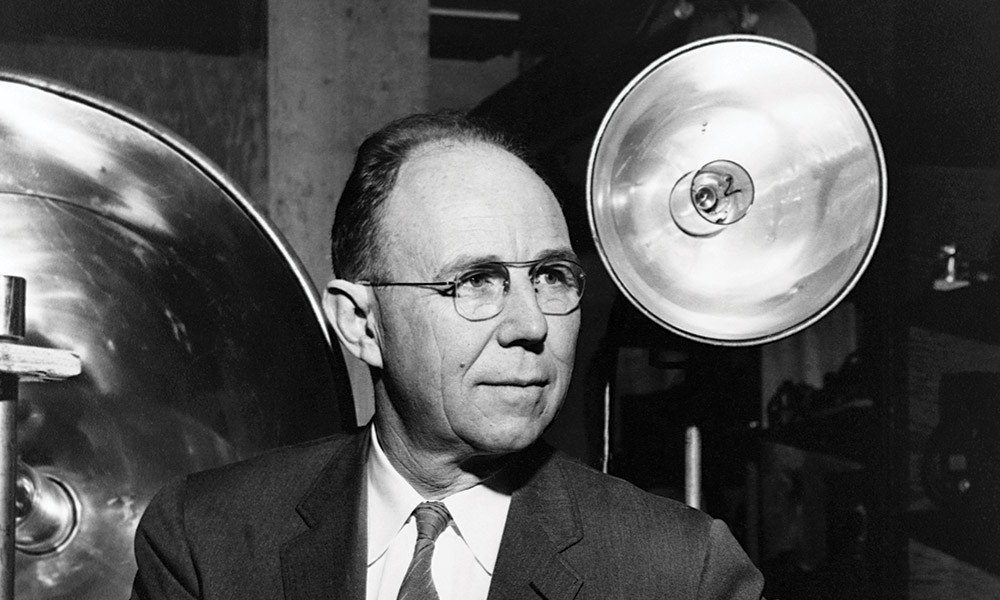
Harold Eugene “Doc” Edgerton was not a photographer, he was a time trapper, freezing the briefest moments in nature. He captured bullets piercing apples, the crown of a milk drop, and hummingbirds frozen in midflight. The same principles and techniques that he developed to make those images possible helped physicists witness the first microseconds of atomic detonations, marine researchers locate shipwrecks and archaeological sites underwater, and the military recover a lost hydrogen bomb from the Mediterranean Sea. Across laboratories, sports arenas, and classrooms, Edgerton’s inventions expanded the limits of what humans could observe, proving that a single flash of light could illuminate the entire field of science.
Edgerton, nicknamed Papa Flash, was born in Fremont, Nebraska, in 1903. As a teenager, he became interested in photography and even built his own darkroom. A summer job at Nebraska Power & Light sparked a fascination with the generation of electricity, which would fuel his lifelong passion for engineering. He earned a bachelor’s degree in electrical engineering from the University of Nebraska in 1925, and a master’s degree in 1927 from the Massachusetts Institute of Technology (MIT), where he joined the faculty and, in 1931, earned a PhD.
That’s when Edgerton’s work on freeze-motion photography began in earnest. He developed the electronic stroboscope, which, by synchronizing bursts of light with fast-moving subjects, captured events that unfold in mere microseconds. The setup could freeze previously unseen moments in time—an astonishing feat that would win Edgerton international acclaim. Edgerton’s innovations—using ultra-short light pulses in place of mechanical shutters, synchronizing flashes with periodic motion, and amplifying light through xenon-filled tubes and capacitors-—form the foundation of modern high-speed imaging systems used today in laboratories, manufacturing facilities, sports science, and wildlife research.
Edgerton kept experimenting with stroboscopic lighting, developing the high-powered repeatable flash device that he would patent in 1949. Between 1933 and 1966, he applied for 45 patents for strobe and electrical engineering devices, establishing himself as one of the most inventive figures of his time.
In 1933, Edgerton’s photographs were put on display for the first time at the Royal Photographic Society in London; he was also included in the first exhibition of photography at the Museum of Modern Art in New York City in 1937. His publications, including Flash! Seeing the Unseen by Ultra High-Speed Photography (1939), Electronic Flash, Strobe (1969), Moments of Vision: The Stroboscopic Revolution in Photography (1979), and Sonar Images (1986), influenced both the scientific community and the broader cultural significance of photography. His images expanded on the locomotion studies of early photography pioneers Eadweard Muybridge and Étienne-Jules Marey.
During World War II, Edgerton’s techniques became strategically important to Allied powers’ leadership. His high-speed flashes made it possible to take clear nighttime aerial reconnaissance photographs, used to track Axis power troop movements and logistics hubs, significantly improving the accuracy of military intelligence for the Allies. After the war, with some of his students, he co-founded EG&G Inc. The company was contracted by the US Atomic Energy Commission to design precision timing and imaging systems for use in nuclear testing. Developed in 1949, Edgerton’s Rapatronic (rapid action electronic) camera captured the first microseconds of atomic bomb detonations, giving scientists new insights into nuclear physics.

Nuclear explosion captured by Edgerton’s Rapatronic camera.
After the war, Edgerton turned his attention to ocean exploration and underwater imaging while collaborating with famed explorer Jacques-Yves Cousteau. Edgerton developed underwater strobe and sonar systems for scientific research and the military to illuminate ocean waters and map the seafloor. His instruments helped locate shipwrecks and archaeological sites. However, his greatest contribution to humanity may have been development of the side-scan sonar.
In 1966, a US Air Force B-52 Bomber collided midair with a KC-135 tanker during aerial refueling. The B-52 was carrying four hydrogen bombs, three of which were recovered shortly after the accident, having falling on land. The fourth bomb, however, fell into the Mediterranean Sea and disappeared. By combing the area repeatedly with Edgerton’s side-scan sonar technology, military officials were able to distinguish anomalies on the seafloor and eventually find the missing hydrogen bomb at a depth of nearly 2,900 feet. What is now called the Palomares Incident might have been remembered for a much different reason if not for the work of Edgerton and colleagues at EG&G Inc.
Edgerton was a dedicated inventor but also had a passion for educating the next generation. At MIT, his lab became a hub of experimentation and innovation where students could explore hands-on applications of optics and electronics. Many of his students went on to become leading figures in imaging and engineering, carrying forward his philosophy that curiosity and experimentation are central to scientific progress. His contributions were recognized with a US National Medal of Science in 1973, the SPIE Gold Medal in 1981, and, in 1987, the Infinity Award for Lifetime Achievement from the International Center of Photography.
The legacy of Edgerton’s work is still evident today. Among those inspired by Papa Flash was Mike Matter, founder of Sanstreak Corp., who, starting in 2013, designed and manufactured the edgertronic series of high-speed video cameras named in tribute to Edgerton. They offered high frame rates and resolution for research, education, and artistic applications. Edgertronic cameras combine advanced optics, high-speed electronics, and embedded software to capture thousands of frames per second with high resolution. They allow scientists, engineers, and athletes to study movement ranging from biomechanics and robotics, to materials testing and fluid dynamics.
Today, edgertronic cameras and Rapsodo ball-flight monitors are two high-speed systems used by Major League Baseball teams to help athletes optimize performance. They provide highly detailed videos and analytics behind the explosive and demanding movements of athletes playing at the highest levels, allowing players and coaches to make subtle adjustments to mechanics for improved on-field results. The technology can track spin rate, spin efficiency, spin angle, horizontal and vertical movement, and pitch velocity, giving teams precise data to enhance performance and production.
Through both his own inventions and the technologies he inspired, Edgerton demonstrated that high-speed imaging can be a powerful tool to see a world of motion that zips by too quickly to be perceived by humans. He lived a life focused on building an understanding of the world we live in, and his influence continues to resonate in laboratories, classrooms, and studios around the world. In recognition of his contributions, SPIE presents the Harold E. Edgerton Award in High-Speed Optics, honoring outstanding achievements in the development or application of optical and photonic techniques for studying rapid physical phenomena.
Jakab Terpstra is a digital marketing coordinator at SPIE.