Before a disruptive shutdown of the US federal government began on 1 October, optics and photonics industry players gathered in Washington, DC, on 18 September for the fourth annual SPIE Photonics Industry Summit. The day-long summit featured a variety of US federal government executives who spoke about their programs and the importance of connecting science, technology, and public policy.
Industry representatives who introduced speakers and panel discussions included Joseph Spilman of Optimax; Lukas Gruber, Leonardo; Matt Sydor, Sydor Optics; Robert Warren, Hamamatsu; and Tom Tongue, Toptica.
A congressional reception on Capitol Hill was held on the eve of the summit. Attendees had an opportunity to speak directly with legislators, network and advocate on behalf of the photonics industry, and gain visibility on topics related to the success of their businesses. Legislators in attendance included Rep. Juan Ciscomani (R-AZ); Rep. Donald Norcross (D-NJ); Sen. Andy Kim (D-NJ); Sen. Steve Daines (R-MT); Rep. Claudia Tenney (R-NY); and Rep. Josh Gottheimer (D-NJ)
In his keynote address, Optics and Photonics Caucus Co-Chair Rep. Joe Morelle (D-NY) noted that the nation is globally engaged in a contest of ideas, but particularly with the People’s Republic of China. To be victorious, he said, “the United States government has got to helm a national effort to stay at the leading edge of technology advancement, and that most certainly includes optics and photonics.”
Unfortunately, Morelle continued, federal investment in science and technology has not been keeping pace, and this year, unless legislators intervene and restore funding, many science agencies are facing steep budget cuts. At press time, it was unclear whether even more draconian cuts would be made to science agencies by the White House Office of Management and Budget as a direct result of the shutdown.
“It’s easy to stop innovation,” Morelle noted. “It’s much harder to restart it because you’ll lose the critical infrastructure, which is not only physical infrastructure but human infrastructure—human capital.”
SPIE CEO Kent Rochford introduced the summit’s first speaker, Emily R. Kinser, program director at the Advanced Research Projects Agency-Energy (ARPA-E), which is part of the Department of Energy. Kinser said the US holds a very strong leadership position in photonics technology, which came about “not overnight [but] by decades of leadership and investment.” ARPA-E wants to contribute to that ongoing leadership, she said, through investments in disruptive technology aimed at areas such as, resilient infrastructure, power electronics, data infrastructure, and energy-related emissions.
Kinser explained that ARPA-E strikes cooperative agreements across the innovation ecosystem, including startups, large companies, universities, and national laboratories. The projects typically last three years, and the agency emphasizes the importance of engagement and accountability toward research milestones.
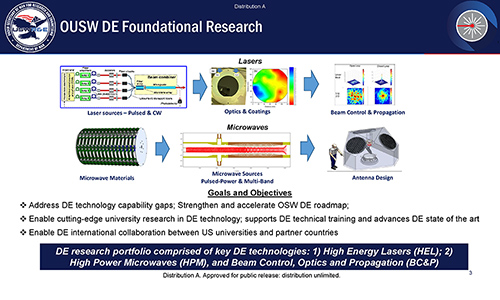
The US Army’s Keith Alan Krapels, director of the technical center of the US Army Space and Missile Defense Command, discussed some of the challenges of US missile defense strategies—currently based on kinetic interceptors—as well as directed energy weapons (DEW) and high-power microwave systems. Today, “we’re shooting down $100,000 targets with $10-million interceptors,” he noted. Barriers to transition, he said, include scaling up laser sources, increased photonics engineering expertise, as well as improvements in sensing and countermeasures.
To build a stronger engineering community of practice for directed energy weapons systems, Krapels recommends creating a comprehensive engineering handbook that would capture best practices and lessons learned from existing prototypes, as well as cross-industry collaborations for engineers to share knowledge and experiences. He says the federal government should also consider tax incentives for companies to invest in DEW and microwave systems.
SPIE Fellow Mark Clampin, acting deputy associate administrator of NASA’s [National Aeronautics and Space Administration] Science Mission Directorate, provided research updates from the agency. “Optics have been critical to everything we’ve done over the history of NASA science and will continue to be as important if not more important as we go forward,” he said.
Clampin highlighted Earth science achievements at NASA, including recent tsunami detection by the experimental GUARDIAN (GNSS Upper Atmospheric Real-time Disaster Information and Alert Network) system under development at the agency’s Jet Propulsion Laboratory. After an 8.8-magnitude earthquake in July off Russia’s Kamchatka Peninsula, GUARDIAN confirmed signs of a tsunami about 30 to 40 minutes before waves made landfall in Hawaii and sites across the Pacific. “This is really important work that benefits the nation,” he said.
On the healthcare front, SPIE Fellow Bruce Tromberg, director of the National Institute of Biomedical Imaging and Bioengineering (NIBIB) at the National Institutes of Health (NIH), noted that, of NIBIB’s $2 billion in grant funding for fiscal year 2024, 67% involved optics and photonics, supporting innovative technologies like focused ultrasound and optical coherence tomography. Many projects, Tromberg continued, are at the intersection of imaging with artificial intelligence (AI) and computing.
Other speakers at the event included Chaitan Baru of the National Science Foundation’s (NSF) Directorate for Technology, Innovation, and Partnerships (TIP). As the newest NSF directorate, he said TIP aims to accelerate the movement of research ideas into societal impact. Programs are focused on use-inspired and translational research within key technology focus areas.
What’s more, “It’s actually the only directorate that’s been codified by Congress because TIP was created as an act of Congress through the Chips and Science Act,” Baru said. “We are actually the ‘science’ part of the Chips and Science Act.”
Indeed, NSF has supported the Network for Microelectronics Education program, a federal effort to develop, connect, and multiply workforce development activities throughout the nation to meet the needs of the semiconductor industry.
Jeffrey Wright, technical program manager for emerging technologies at the Department of Defense (DoD), Defense Innovation Unit (DIU), says the unit’s mission is to accelerate the adoption of commercial technology, emphasizing speed and scale. As such, DIU has three main pillars: synchronizing warfighter needs with commercial capabilities, creating a streamlined process for commercial engagement, and catalyzing a unified ecosystem.
Finally, Matthew Borman of the Akin law firm gave attendees an update on US export control law and regulations. He emphasized that within government there exist differing schools of thought on chip exports. Some policymakers favor selling to China to continue its dependence on US technology, whereas others harbor concerns about enabling China to use the technology against the US.
For companies who want to get ahead of any relevant export controls for their products, Akin suggested using a Department of Commerce hotline established to assist.
William G. Schulz is the Managing Editor of Photonics Focus.