A career in optics and photonics can be as dazzling as the light we study—full of discovery, innovation, and impact. But the pursuit of success can also feel relentless. There’s always another grant to write, another paper to submit, another metric to measure ourselves against.
Too often, the joy of science gets buried under the pressure to achieve. The danger isn’t just stress—it’s burnout, a slow drift away from the very passion that once fueled us.
What I’ve learned—and what I now share with students—is that success in STEM is not only about output, recognition, or external validation. True and sustainable success comes from within: Living and working in harmony with our core values.
Values are not abstract ideals. They are the compass that can guide us through uncertainty, ground us when external pressures mount, and remind us why we chose this path in the first place.
For me, one of the most formative experiences was the tenure process. The tenure-track is one of the most challenging and defining milestones in academia.
Like many assistant professors, I placed enormous pressure on myself to succeed. My attention turned outward: Am I achieving enough? Am I ever going to secure external funding? That constant external focus was exhausting, and it left me feeling disconnected from the joy of discovery that first brought me to science.
And then came the pandemic. The challenges of isolation, disrupted research, and uncertainty pushed me to my lowest point. It was in that space that I realized something had to change.
If I truly wanted to continue this career, which I deeply love, I needed to find a more sustainable way to live it. That was when values became more than words on paper. They became my lifeline.
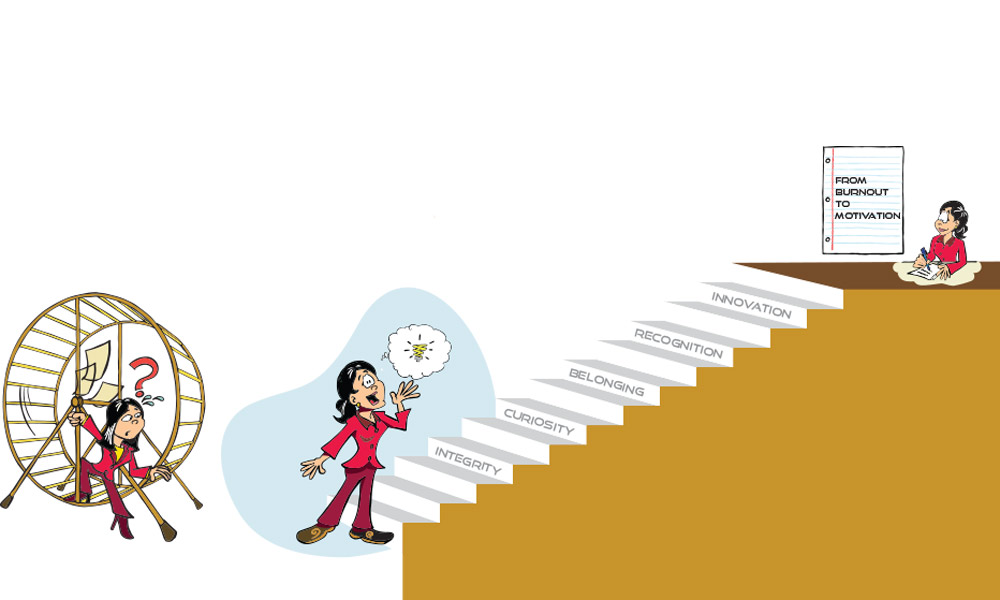
By grounding myself in integrity with purpose—doing science with rigor and responsibility while never losing sight of why it matters; respectful collaboration—building relationships rooted in fairness, diversity, and shared success; and joyful curiosity—the childlike wonder that makes discovery exciting—I reconnected with why I chose this field in the first place.
I stopped running on the hamster wheel of external expectations and began walking—at my own pace, in my own direction. That shift didn’t just carry me through tenure. It helped me see research directions that aligned with my values and gave me the language to explain why my work matters. It also gave me clarity in decision-making—whether to take on a project because it inspired my curiosity, or to say no when something didn’t align with my values. Most importantly, it reignited my motivation and joy in science.
This personal lesson has grown into something I now share with students and colleagues around the world. At SPIE conferences and beyond, I lead workshops that invite students to discover—or rediscover—their core values.
The process is simple but transformative. Students begin by choosing from a list of values—words like integrity, curiosity, belonging, recognition, or innovation. Then, they group these words into themes that matter most to them and narrow them down to their core three values.
We encourage students to reflect:
By the end of the exercise, students hold a personalized “compass” that not only clarifies their identity but also empowers them to make intentional choices in their academic and professional journeys.
Once students have named their values, the question becomes: How do these values guide real decisions? From choosing an advisor to asking questions in interviews, values can become a compass for navigating opportunities with clarity and confidence.
For example, besides their research interests, when considering graduate programs, students can ask themselves: Does this research subject align with what I value the most?
I encourage students to remember that job interviews go both ways. Just as institutions evaluate candidates, candidates can evaluate institutions. Knowing your values gives you confidence to ask meaningful questions, for example:
These aren’t abstract reflections. They are practical tools. A clear sense of values can prevent misalignment, reduce burnout, and help scientists find environments where they can truly thrive.
One of the most beautiful outcomes of living in alignment with values is how it strengthens relationships.
In my own career, I’ve been fortunate to mentor brilliant students who share many of my values. For example, one of my mentees and I both value integrity, authenticity, and curiosity. This shared foundation makes our collaboration not only productive but also deeply fulfilling.
When mentor and mentee align on values, trust grows naturally. Challenges become opportunities for growth. Collaboration becomes joyful rather than transactional. And both people can contribute fully and show up as their true selves.
The lesson I carry—and the one I hope others will take away—is this: Success in optics, or any STEM field, is not only about achievement. It is about alignment.
When we chase only external markers of success, burnout waits around the corner. But when we live and work in alignment with our values, we create careers that are not only successful but also sustainable, joyful, and meaningful.
This is the shift I experienced in my own journey—from burnout to motivation. It’s the message I now bring to my students, my peers, and my community. And it’s a reminder for all of us: Your values are your power. Your power shapes your path. And that path can lead not only to success, but also to fulfillment.
Rosario Porras-Aguilar is an associate professor in the Department of Physics and Optical Science at the University of North Carolina, Charlotte. She is the 2025 recipient of the SPIE Diversity Outreach Award.