As I write, the NCAA College basketball tournament, lovingly referred to as March Madness, is being played in the US, and as I’ve enthusiastically cheered (and lamented) my favorite teams, I’ve become hyperaware of some of my own unconscious biases. The variety in how the star players look—short, tall, thin, muscular—surprised me. Then, when the announcer said, “Three points! Team X is certainly lucky to have recruited a star player from [country Y]!” I caught myself thinking “Y? Since when do good college ball players come from there?” That’s some biased thinking!
We carry an array of bias baggage with us everywhere we go, and mostly it’s pretty harmless stuff. When we bring it into important decision-making moments, though, our biases can undermine what we are trying to achieve and create an environment with unfair advantages and disadvantages. If the recruiter had passed over that basketball player because “good players don’t come from Y,” it could have cost the team the win.
I’m sure we all have stories where we’ve seen a potentially excellent candidate be overlooked because of bias. A job applicant not making the interview cut after a conversation about their last name and their accent. A committee member saying “hiring an assistant professor is like proposing marriage” when discussing the (only) female candidate. A medal not awarded to an awesome nominee because excellence in the arts isn’t measured by citations. Discomfort in the boardroom when the proportion of women exceeds 50%.
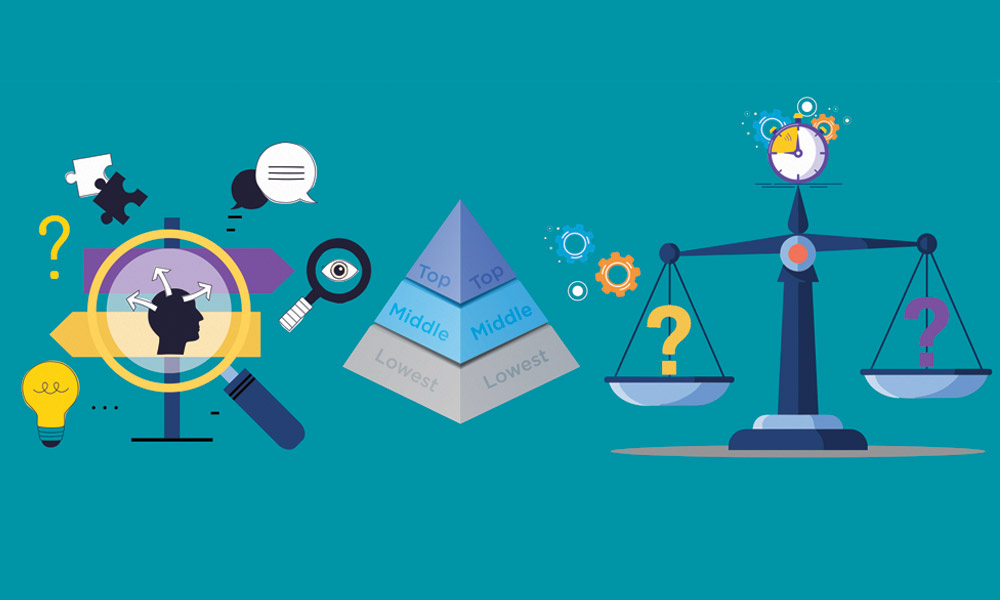
These examples are obvious. But it’s surprising how little bias it takes to achieve dominance of one group at the top of an organization or nominating committee. A computer simulation published in American Psychologist in 1996 of an 8-level organization with a typical pyramid structure showed that a bias towards men of only 1% of the variance in employee ratings led to 65% of the top positions filled by men. Such a slight bias in favor of one group over another is well within the wiggle-room of decision making with a subjective component. It’s also why the uneven playing field is so hard to level.
Against that challenge, what can we do about it? I have chaired or served on dozens of juries, hiring and promotion committees, grant evaluation panels, and award, medal, and fellowship panels for national and international universities, societies, companies, and other organizations. I’ve collected a few practical tips-and-tricks designed to undermine the effects of underlying bias in panel decisions about who makes the shortlist and who wins.
At the heart of these tips is making the unconscious bias conscious. While we cannot always change what ideas pop into our heads, we absolutely can change how we act. First, though, we must be aware of those ideas, the quiet little voices that influence our key decisions. It doesn’t take much time, and it allows us to focus attention where it belongs, upon the excellence we are tasked with assessing.
The great thing about actively fighting bias in decision- making is the better we do it today, the sooner we won’t have to do it anymore. After all, these days very few people are surprised that a 5’8” woman can be an excellent basketball player, as exciting to watch as her team cruises to the Final Four.
Cather Simpson is professor of physics and chemical sciences at the University of Auckland, CEO of Orbis Diagnostics, and SPIE President-Elect.