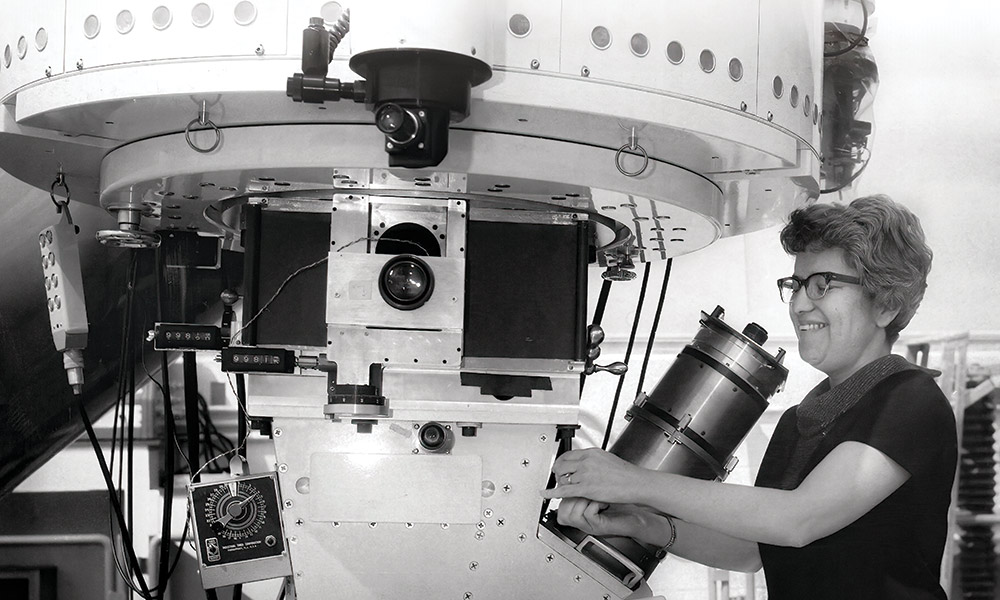
“There is no problem in science that can be solved by a man that cannot be solved by a woman.… Worldwide, half of all brains are in women,” wrote astronomer Vera C. Rubin in her 1996 collection of essays, Bright Galaxies, Dark Matter. Despite facing significant barriers as a woman in science, Rubin became one of the most respected astronomers of her time and a role model for future generations.
Rubin’s observations in the 1960s and ’70s provided some of the strongest evidence for the existence of dark matter, an invisible substance that makes up most of the universe’s mass but does not emit light. Her contributions reshaped modern cosmology and opened new questions about the structure of the universe.
Rubin died in 2016 at the age of 88. In recognition of her enduring impact, the Large Synoptic Survey Telescope (LSST) was officially renamed the Vera C. Rubin Observatory in 2019, making it the first national observatory named for a female astronomer. Located on Cerro Pachón in northern Chile, the observatory is designed to transform how scientists observe the night sky by capturing enormous amounts of data about the universe every night. The observatory’s first major project, the legacy survey of space and time, will repeatedly scan the entire southern sky, creating a 10-year “movie” of the universe, focusing on dark matter, dark energy, and solar system objects.
Building the Rubin Observatory’s groundbreaking telescope and camera required overcoming extraordinary engineering challenges. Rubin chronicled similar uphill battles in her 2011 autobiography, An Interesting Voyage, describing some of her early struggles to be accepted in the almost entirely male world of astronomy: being turned down for graduate studies at Princeton which, at the time, didn’t accept female graduate students in astronomy; being the first woman allowed into the Palomar Observatory in California, where no women’s bathroom was available; and the unfortunately not-so-unusual experience of having her work ignored or rejected based on her gender.
“I became an astronomer because I could not imagine living on Earth and not trying to understand how the universe works,” Rubin once wrote. “My scientific career has revolved around observing the motions of stars within galaxies and the motions of galaxies within the Universe. In 1965, if you were very lucky and interested in using telescopes, you could walk into a research laboratory that was building instruments that reduced exposure times by a factor of 10 and end up making remarkable discoveries. Women generally required more luck and perseverance than men did. It helped to have supportive parents and a supportive husband.”
A key figure in bringing the Rubin Observatory to life is Sandrine Thomas, deputy director for construction of the Rubin for AURA/NSF, and project scientist for the telescope and site. Leading a team of more than 250 experts, Thomas has helped guide the project through some of its most complex technical hurdles.
Thomas says she appreciates that Rubin’s tireless advocacy for women in science is one of the reasons she’s there today. “I feel honored to work for the Rubin Observatory. Vera Rubin was an incredibly inspiring woman, and I am grateful for all she did to make it possible for people like me to work at an observatory—not only as an astronomer, but also as an engineer. The Rubin Observatory Project has been incredibly welcoming, fostering the growth of talented staff and encouraging everyone to deliver their best. This spirit reminds me of Vera C. Rubin’s own personality.”
As any engineer would, Thomas turns her accolades to the observatory’s unique mirror design and its massive camera. “Unlike conventional telescopes, Rubin’s primary and tertiary mirrors are fabricated from a single piece of glass shaped into two distinct curves,” says Thomas. “The observatory’s digital camera—about the size of a small car—is the largest ever built for astronomy. Together, these innovations allow the telescope to capture extremely wide, detailed images of the sky at remarkable speed.”
Designing the camera posed particular challenges. Its detectors must be cooled to approximately –100 degrees Celsius using a refrigeration system that minimizes vibration and eliminates the risk of damaging the mirror in the event of a leak. Compounding the difficulty, the cooling system operates while the camera sits roughly 20 m above the refrigerant source. At the same time, every component of the observatory must be aligned with extraordinary precision—down to millimeters and, in some cases, microns.
“The Rubin Observatory’s telescope and camera provide an enormous field of view of 10 square degrees (about 45 times the area of the full moon), which is roughly 100 times larger than the field of view typical for large telescopes of similar size,” says Željko Ivezić, head of the legacy survey project. “Because of this wide field of view, the Rubin Observatory can scan the sky hundreds of times faster and will complete the project in 10 years rather than the 1,000 years it would take other telescopes.”
Simulations indicate that the legacy survey dataset should be sufficiently powerful to distinguish between two leading hypotheses for explaining the accelerating expansion of the universe: the mysterious and poorly understood component called dark energy, or modifications to the general theory of relativity that describes gravity on cosmological scales. A conclusive answer to this question would be transformative for modern physics.
Both Thomas and Ivezić expect great things from the Rubin Observatory, as do astronomers around the world. “Every major sky survey has resulted in unexpected discoveries, and we hope the same will be true for the [legacy survey],” says Ivezić. “The unprecedented mapping of gravitational lensing will provide deeper insights into the nature of dark matter and dark energy and may also reveal many unanticipated results.”
Astronomers at the Rubin Observatory expect to dramatically expand our cosmic catalog—discovering billions of new stars and galaxies and unlocking secrets about how galaxies form and evolve over time. But perhaps most thrilling is the promise of the unexpected. “History shows that the biggest breakthroughs often come from surprises—phenomena we haven’t even imagined yet,” says Thomas. “Whether it’s a new type of astronomical object, an unexplained cosmic event, or a clue to physics beyond our current understanding, Rubin’s vast and detailed survey of the universe could reveal wonders we can’t yet predict. That’s the magic of exploration: the unknown unknowns that redefine what we know about the cosmos.”
In many ways, the observatory’s mission continues Rubin’s legacy—seeking to uncover the unseen and deepen our understanding of the cosmos. Rubin’s recognition for her work included having her name attached to the American Astronomical Society Vera Rubin Early Career Prize, the Vera Rubin Ridge on Mars, and asteroid 5726 Rubin. She was awarded the National Medal of Science in 1993, “for her pioneering research programs in observational cosmology which demonstrated that much of the matter in the universe is dark, and for significant contributions to the realization that the universe is more complex and more mysterious than had been imagined.”
While Rubin appreciated these accolades, she maintained a balanced perspective on what they did—and did not—represent. She often advised, “Don’t let anyone keep you down for silly reasons such as who you are. And don’t worry about prizes and fame. The real prize is finding something new out there.”
The Rubin Observatory is designed to continue that legacy of “finding something new.”
Karen Thomas is a freelance science writer and editor.
SIDEBAR: The active optics system
The Simonyi Survey Telescope at the Vera C. Rubin Observatory is equipped with elements that allow continuous adjustments to the position of the optics and the shapes of the mirrors, ensuring the best possible image quality. This type of system is called active optics. While other large telescopes (greater than 4 m) also feature such systems, they are typically much simpler and operate only in open loop, focusing solely on the primary mirror. The Simonyi Survey Telescope’s active optics system includes an open-loop model, which primarily compensates for gravity-induced sag, as well as a closedloop system, which corrects for additional misalignments and perturbations, such as temperature changes. The closed loop is achieved using wavefront sensors at the edge of the camera’s focal plane. These sensors calculate the necessary corrections for the mirrors and hexapods (which support the camera and secondary mirror) about every 40 seconds. This ensures that astronomers consistently achieve the best possible image quality at all times, fulfilling the telescope’s scientific objectives.