Glass is the invisible backbone of the photonics world. It is the material of choice for lenses, prisms, coverings, and other components, enabling sustainability enhancing technologies like LEDs, solar panels, and wind turbines. The sustainability angle was a reason why the United Nations designated 2022 the International Year of Glass.
However, glass itself presents sustainability pluses and minuses. On the positive side, glass is endlessly recyclable and materials to make it are readily available. On the negative side, glass making is energy intensive and collecting glass for recycling and reuse is difficult. An industry-wide effort seeks to address both issues, thereby improving optics and photonics sustainability.
The sustainability challenge begins in the glass-making furnace. Keeping molten glass from solidifying requires a temperature of up to 1,700 degrees centigrade, maintained 24 hours a day, 365 days a year. Currently, the heat for that perpetual inferno comes from natural gas, pumping CO2 directly into the atmosphere. In a November 2022 Glass Alliance Europe presentation, Heinz Kaiser of specialty glass maker Schott outlined this challenge and discussed solutions.
Promising natural gas replacement technologies include a fully electric melting tank or a hybrid melting tank. Both approaches use electricity from a noncarbon-emitting source. The hybrid tank uses electricity for 20 to 80% heating, with the rest of the energy needed supplied by natural gas, biogas, or hydrogen. While going full electric is the best option, it likely will not work for all types of glass, Kaiser noted. Thus, the ability of hydrogen to produce glass needed testing.
Pushing hydrogen use to its maximum, Schott reported in April 2024 that it had produced optical glass, one of the most challenging types to manufacture, using only hydrogen at its Mainz, Germany plant. “The test with 100% hydrogen is pioneering work for the specialty glass industry,” said project manager Lenka Deneke at the time.
While Schott’s test results were promising, the company noted an issue delaying industrial use: A lack of green hydrogen or hydrogen produced without carbon emissions. Today, 80% of industrial hydrogen derives from natural gas via a process that releases CO2. Green hydrogen is made by using renewable energy or another form of carbon-free energy to, for example, split water molecules into oxygen and hydrogen.
The availability problem with green hydrogen arises in part from limited infrastructure to deliver hydrogen to end users. While natural gas pipelines are common, hydrogen pipelines are not. The situation is changing, though. Germany, Japan, and other countries are committing to building hydrogen pipelines as well as ship and other transportation infrastructure, according to panelists at a July 2025 conference organized by the Green Hydrogen Coalition. Germany has constructed 400 km of pipeline, reported Falk Bömeke of the German Federal Ministry for Economic Affairs and Energy. Germany plans to build 9,000 km of hydrogen pipeline by 2032.
The technology to make green hydrogen works, but the economics are currently broken. Green hydrogen is costly to make—leading to a price often four times or more than that of fossil fuels. However, Janice Lin, president of the Green Hydrogen Coalition, sees a familiar trajectory: The plummeting cost of solar panels over the last decade offers a blueprint for how hydrogen could scale.
“Once they started making millions of these things, they became really cheap, so that today that form of electricity is the lowest marginal cost,” she says. Lin predicts that something similar will happen with green hydrogen due to government incentives and investment along with technological innovation. If that forecast of falling prices for green hydrogen is accurate, then the making of glass may become much more sustainable.

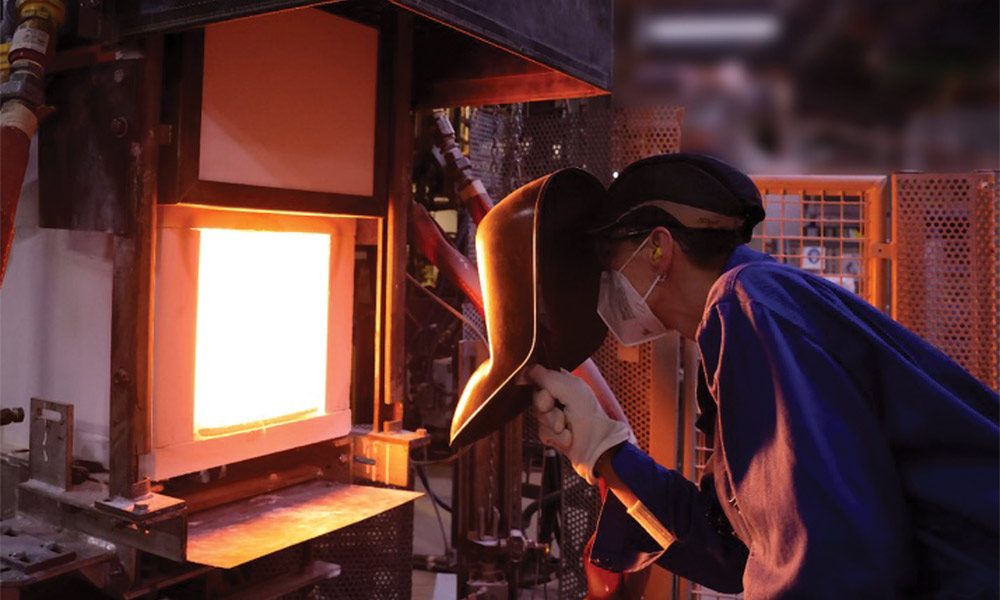
Inspection of a glass bar made in a melting chamber using 100% hydrogen fuel. Photo credit: Schott.
Switching energy sources for glass production is not the end of the changes needed to make sustainable optics. Optics suppliers mill, machine, and polish glass before coating it to create lenses, mirrors, prisms, covers, and other components. These are mounted into fixtures using adhesives and other means, with the entire assembly going into a system. Sometimes, the optics are a tiny but important part of a much larger project. For example, a 95-cent Barlow lens from Edmund Optics was used in the Westinghouse color camera that broadcast the 1969 Apollo 11 moon landing.
What would be ideal from a sustainability point of view is a circular economy, one where materials found in optics are reused. It’s possible to do that with glass, as demonstrated by greater than 80% recycling in some industries. However, the optics recycling rate is much lower, in part because the glass is only a portion of the product.
The photonics industry also faces a tough physics problem because you can’t just toss a coated lens into a recycling bin. The very coatings that perfect optics can make them difficult to recycle. For example, Edmund Optics has pilot programs pilot programs in Asia in which collected waste glass is crushed and repurposed into products like road medians and asphalt. So, it doesn’t end up in other glass products, as is the case with bottles.
Recently, the glass industry reported strides in the recycling arena. In November 2025, Schott announced success in recycling glass-ceramic cooktops on an industrial scale. Like optical glass and other specialty glass, glass-ceramic cooktops require melting at higher temperatures and must meet stricter quality requirements than bottle or window glass.
Regarding reuse of optical components, coatings again pose a problem because of their delicate nature. “Laser optics, those are the ones that I feel are the most difficult because they have very specific coatings,” says Estefanía Cervantes, global sustainability manager of Edmund Optics.
Despite the challenges, optics are refurbished today. For instance, large telescopes are made of segmented mirrors, notes Jannick Rolland, a University of Rochester professor and director of the Center for Freeform Optics. The coating on those optics plays a critical role in performance of the segments. Typically, there are spare segments, and when the support staff dismount a segment for any reason, they put a spare in its place. Then they recoat the removed segment and place it among the spares.
“They do it all on a schedule,” Rolland says of this process, which could be a template for how to extend the lifespan of other optics products.
Cervantes, though, points out that optical components are often small, specialized, and used in many different applications. Thus, it’s challenging to devise a process to reclaim and collect them. The issue of getting optics back for reuse will require the industry to develop a collaborative solution.
The reason is clear from the Edmund Optics product line. Most of what the company makes are components. In the case of the moon landing camera, for example, Edmund Optics supplied a lens that went into a camera, which in turn was part of an assembly that eventually ended up in a spacecraft. So, who is responsible for bringing optics back for recycling or refurbishment? Is it the end user, the final manufacturer, or somebody else?
What’s needed is more research and industry collaboration, according to Cervantes. This would involve such topics as reuse/refurbishment models, coating removal, and collection pathways, starting with high-volume or high-value use cases, like the telescope mirrors, and working down to lower-volume and lower-value applications. Cervantes says efforts to hash out what’s needed are just beginning.
One approach to improved sustainability is using a greater percentage of renewable energy. Doing so is a goal of Edmund Optics, Cervantes points out.
Given the nature of optics applications and the supply chain that supports them, the best answer for improved sustainability right now might be to look somewhere else other than a full circular economy. Thus, Cervantes advocates making products better to minimize resource use and to improve sustainability.
“What I do think is key—and where we can make real progress—is durability. Making products that last longer and stay in use longer is a big lever,” she says.
The challenge, though, lies not in only making products last longer. Ideally, they will also be more easily reused and refurbished. Doing so will lead to products that can eventually transition to a circular economy.
Industries dependent on glass, optics, and photonics are taking a similar approach. For instance, today solar panel recycling is limited. So, the US Department of Energy Solar Energy Technologies Office (SETO) is working on ways to make it easier to disassemble solar panels by funding research and development into sealants that can be dissolved without damaging panel materials. That and other changes will make recycling easier. Also, panels today last about 30 years. SETO is working towards a 50-year lifespan. An increase in average module lifespan of 2-3 years could save 2-3 million metric tons of solar panel waste by 2050, according to SETO.
Finally, a third pathway to more sustainable optics involves fundamental design and material changes. This approach could leverage the evolving field of freeform optics.
To understand freeform optics, start with standard optics, the technology used in today’s microscopes, telescopes, lasers, and elsewhere. For example, a standard optics converging or convex lens is thicker in the middle than at the edges. It bends light inward, focusing it and enabling magnification. Even though it’s a 3D object, a convex lens can be depicted on a 2D page because it has rotational symmetry. So, you could spin a 2D cross section represented on a page around an axis and get the 3D lens.

2D raytrace of the five-mirror freeform viewfinder design superimposed on a 3D model system housing. Photo credit: University of Rochester.
Standard optics have literally shaped our view of the world, but they are constrained by rotational symmetry. Freeform optics break these rules, allowing designers to bend light without traditional lens tubes—a shift that saves materials and opens the door to sustainable mirror-based systems.
“We wanted to make compact optics mostly for augmented and virtual reality,” Rolland says in explaining the development of freeform optics. She adds that freeform optics are not rotationally symmetric. This helps when it comes to building mirrors that take the place of lenses.
One problem with standard optics mirrors is that they reflect light back along their optical axis, creating a conflict with the light coming into the mirror. With freeform optics, it’s possible to go off-axis and avoid this issue. In papers published in December 2024 and November 2025, researchers described how they used freeform optics to build objectives for microscopes, a task traditionally handled almost exclusively by lenses. Using reflected light eliminated the problem of chromatic dispersion, the tendency of light traveling through a lens to spread out according to wavelength and thereby blur focus.
But freeform optics can do more than boost the performance of optics and make them more compact. It can also help sustainability, Rolland notes. This possibility arises due to using mirrors instead of lenses. Glass makers use trace amounts of rare earths and other additives to get the right optical performance. Mirrors don’t need that sort of material engineering. Mirrors must be in the right shape and have the right mechanical properties. Their optical properties come from the reflective coating. Thus, a mirror can be made of less expensive and more sustainable glass. It could even be constructed using some more environmentally friendly material. Furthermore, mirrors can be refurbished, another sustainability advantage.
In discussing freeform optics and its future, Rolland notes that tools exist now to help with design. For space and other applications where size is paramount, the technology is already widely used as it creates optics that are perhaps five times smaller than standard optics. For other applications, greater familiarity, along with better performance and improved sustainability, may lead developers and users to freeform optics.
These changes to optics manufacturing, recycling/reuse, and design share a trait: collaboration instead of competition. As Edmund Optics’ Cervantes notes, We’re all trying to find answers,” she says, “because none of us can do it alone.”
Hank Hogan is a freelance science and technology writer.