Global annual revenues from the production of optics and photonics core components reached $381B in 2024, according to the SPIE 2026 Optics and Photonics Global Industry Report. These core optics and photonics components underpin a global market for photonics-enabled products projected to exceed $2.7 trillion in 2025, underscoring the strength and importance of the photonics industry.
According to the industry analysis, accelerating innovation coupled with incredibly diverse markets has pushed the growth of photonics technology revenues to consistently outpace gains in global gross domestic product (GDP). Since 2012, the photonics components industry has grown at a rate more than twice that of global GDP.
The report draws on the Society’s industry expertise, world-class database, and global footprint, which uniquely position SPIE for its analysis and understanding of the photonics industry. For more than a decade, the report has tracked metrics like the number of companies, distribution of global revenues, jobs based on company headquarters, and more, painting a picture of solid growth in the photonics industry.

“While compiling the data for the report, it’s always inspiring, and a bit surprising, to see the impact of the optics and photonics industry,” says Hanlon. “Once again, the SPIE Global Industry Report confirms the vital role our industry plays in the global economic engine. Light-based technologies and products underpin so much of the global economy, and we hope this report will help illustrate and communicate that impact with real data.”
As defined in this 12th edition of the Industry Report, core photonics components underpin all light-enabled products and services like smartphones, computers, laser-based instruments for industrial and medical applications, cloud computing, streaming content services, and e-commerce. Estimates of the total monetary value of all light-enabled products and related services comprise almost 20% (about $20 trillion) of worldwide economic output. Other key findings of the report include:

SPIE tracked and evaluated 5,417 companies that produced core photonics components in 2024, 86% of which are small to medium enterprises (SMEs).
“Although most of these companies are SMEs, the larger entities generate the largest fraction of total photonics revenues, which is consistent with many other industries. In fact, about 5.8% of all photonics companies, including such household names as Samsung, Corning, Nikon, and Carl Zeiss, generated more than 87% of global photonics revenues in 2024,” SPIE reports.
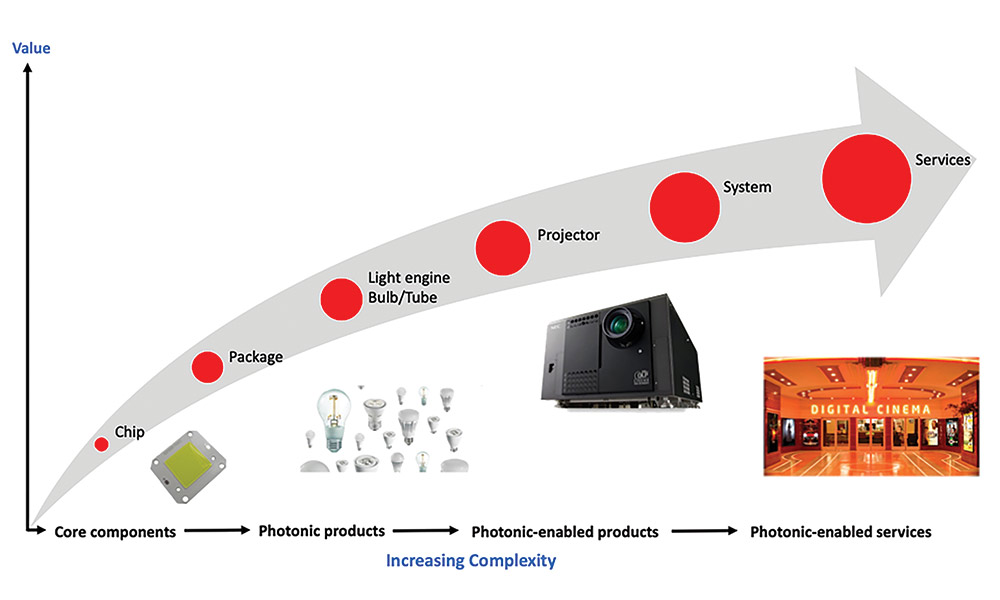
The report considers the entire photonics value chain. The chain “starts with raw materials like glass and semiconductor substrates and progresses through optical components and subsystems to photonics products and photonics-enabled products such as smart phones, autonomous vehicles, lighting systems, quantum computers, and AR/VR vision systems,” the report says.
In all, the global photonics industry has experienced more than a decade of consistent growth despite headwinds like chip shortages, regional conflicts, rising costs, and a global pandemic. “The industry continued to show modest expansion followed by substantial growth through 2024. Sustained demand across the diverse end-use markets enabled by photonics such as defense, communications, renewable energy, and displays has combined with emerging technologies to maintain a robust photonics ecosystem,” the report notes.
William G. Schulz is the Managing Editor of Photonics Focus.