The tremors began on Monday, 13 September 2021.
For six days, the residents and tourists on the Canary Island of La Palma in Spain felt the ground shifting around them, unease growing more palpable each day. On Sunday, 19 September, shortly after 3:13p.m. local time, the Tajogaite Volcano erupted. Parents gathered what they could and fled their homes with their children in tow, knowing they might have nothingwhen they returned. Tourists haphazardly packed their suitcases and evacuated. Farmers frantically raced to save herds of goats and cows, and crops of avocados and bananas, risking their lives to salvage what they could of decades of work. Lava poured over farmlands and falling ash blanketed schools and homes. Surrounding the air around La Palma was a fine mist of hydrochloric acid and fine glass particles caused by a chemical reaction when molten lava from the eruption reached the saltwater of the Atlantic Ocean.
By Monday, 13 December, 85 days after it began, the eruption finally came to an end.
Having destroyed hundreds of homes, 45 miles of roads, and more than 900 acres of land, the Tajogaite eruption was La Palma’s longest in recorded history. More than 6,000 people, including 400 tourists, were evacuated before the eruption started claiming the land. Incredibly, only one life was lost, the result of breathing the event’s toxic gases.
Years of forethought and a plan that was already in place prevented a further, devastating loss of life. The work of the Canary Islands Volcanological Institute (INVOLCAN) and the efforts put into the Canary Island Volcanic Emergency Planpaid off. Leading up to the eruption, INVOLCAN was tracking an increase in seismic activity, which they shared with the local government and community. Through a grapevine of emergency text messages, social media posts, and door-to-door notifications by police and civil guards, people on the island were prepared and ready to run when the evacuation order was given. Although the loss of land and property on La Palma was catastrophic, INVOLCAN saw proof that they could stay ahead of monitoring volcanic activity and have safeguards in place.
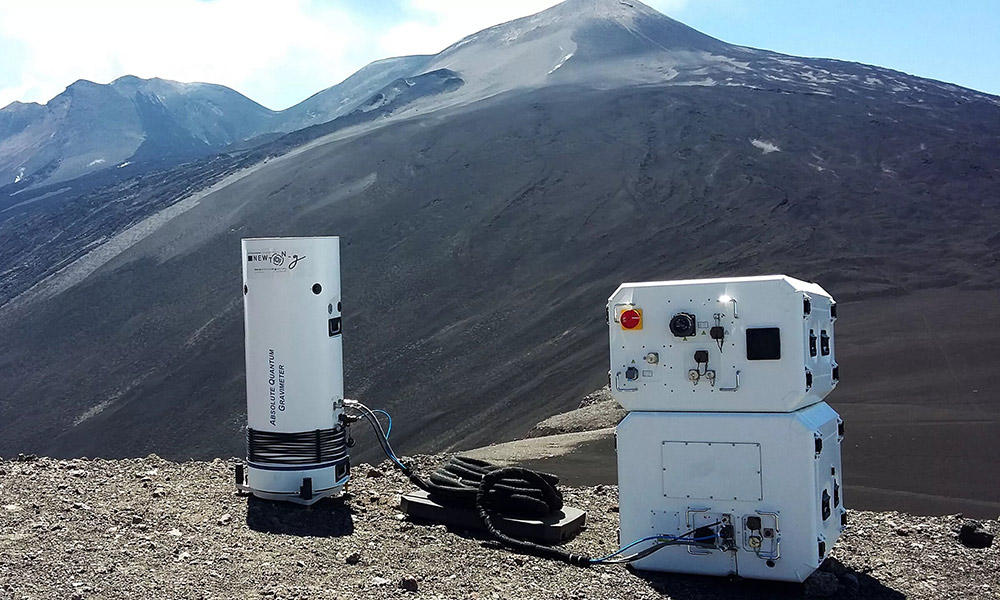
Active volcanoes tower above residents on four of the seven main islands in the Canary Islands archipelago, including Tenerife, the largest and most populated of the islands. It is home to nearly 1 million people and is a vacation hotspot for nearly 7 million tourists each year. On Tenerife sits Teide, Europe’s highest volcano that looms at12,188 ft. Since 2016, this island has experienced a slow increase in volcanic instability, shown by surging seismic activity and gas emissions. Taking what they learned from La Palma, INVOLCAN turned their focus to Tenerife and a new technology that had been successfully tested in 2020 on Italy’s Mount Etna. INVOLCAN reached out to the photonics and quantum technologies company, Exail, to learn about their Absolute Quantum Gravimeter (AQG).
With more than 2,000 employees worldwide, Exail specializes in cutting-edge robotics, maritime, navigation, and aerospace and photonics technologies, specifically for hostile environments. The firm’s AQG cools and traps a cloud of rubidium atoms with lasers. It then performs a matter-wave interferometry sequence on the cloud to precisely measure its acceleration while free-falling under the effect of gravity. In so doing, the instrument measures minute changes in the local gravitational field caused by subtle movements of underground magma and gas. This precise, real-time data on volcanic and seismic activity can provide authorities with information to act early and save lives.

An INVOLCAN team being trained on Exail’s quantum gravimeters. Photo credit: INVOLCAN.
A goal in development of the AQG was to ensure ease ofuse.Looking like a distant relative of R2D2, from the Star Wars franchise, the white, cylindrical instrument stands about four feet high and two feet wide. Thanks to its precision, there is no need for recalibration, allowing geophysicists to seamlessly collect data over minutes, months, and years. Easily transported, the AQG can be deployed anywhere on the planet. The instrument can be remotely operated to provide continuous absolute gravity measurements. In volcano monitoring, such data can tell scientists when there is a subtle change in subsurface mass, such as an infinitesimally small rise of magma inside a chamber. It also pinpoints whether a change in mass inside the volcano is due to gas expansion, a less immediate threat, or magma, indicating a pending eruption.
“The gravimeter has a robust, user-friendly design,” says Vincent Ménoret, co-leader of the Exail Quantum Instruments team, who has been working on the AQG for 15 years.“[We wanted] to ensure accessibility, even for nonspecialists. For example, in the case of INVOLCAN, the users are geophysicists and people used to [taking] measurements on the field, but they do not have specific knowledge in optics or quantum physics.”
The AQG has no moving mechanical parts, maintenance requirements, or other impediments to data collection that can affect conventional gravimeters. Also, unlike conventional gravimeters, which only measure gravity variations, AQGs measure absolute values of local gravity. The free-fall of laser-cooled atoms in the AQG is monitored, and the acceleration of gravity thus determined. Designed to withstand severe environmental challenges, such as mountain slopes at risk of lava flows and the air is filled with poison gases, AQGs uphold performance and precision.
Three AQGs have been successfully tested on Tenerife. INVOLCAN will now install them in three distinct locations on the volcano, essentially creatinga map of volcanic and seismic activity that complements data from existing geophysical instruments. Exailwill support INVOLCAN throughout deployment of the AQGs and their integration into the institute’s monitoring framework.
Quantum gravity sensors like AQGs can be used for any application in which mapping minute shifts in matter below ground is valuable. For example, Exailhopes to see the technology used for hydrology and seismology, as well as civil engineering projects in which detecting voids, sink holes, tunnels, and the like would be important.
Exail has built more than 25 AQGs—and installed 12 in Europe, Japan, China, the US, and, more recently, Greenland—withmain applications being hydrology, volcano monitoring, and geodesy (measurements of Earth’s shape, gravitational field, and orientation in space).
“Something I find very gratifying is seeing the first instruments leaving our labs and being adopted by end-users. They have started to build a community, and this is very nice after many years of hard work to build a good instrument,” says Ménoret.
Lindsey McGuirk is the SPIE Public Relations Manager.