On 15 October 1997, NASA/ESA’s Cassini–Huygens space craft began its mission to Saturn, a journey that would last more than six years. The goal was a long-term study of Saturn and its ring system, with a special focus on investigating the atmosphere and surface of Titan, Saturn’s largest moon. Titan had been a focus of investigation since its discovery in 1655, when Christiaan Huygens pointed a new and improved telescope towards the planet, determined to discover more about the planet that had so puzzled astronomers of his day.
Huygens was born in 1629 in The Hague, to a wealthy and well-connected family that served the Netherlands’ monarchy. His father was a diplomat who maintained a close relationship with leading thinkers of the time, including René Descartes. In youth, Huygens showed promise in mathematics and drawing. In 1645, he entered the University of Leiden to study mathematics and law and then continued his studies at the College of Breda.
After university, he began making his own telescopes, assisted by his brother Constantijn. The brothers not only built the instruments, but developed a theory of the telescope. Huygens discovered the law of refraction to derive the focal distance of lenses and introduced new methods for grinding and polishing. These improvements allowed him to optimize telescope performance, increasing resolving power and reducing optical imperfections. The work placed him at the forefront of 17th Century optical engineering and demonstrated how advances in fabrication could directly enable scientific discovery.
In 1655, when Huygens turned one of his improved telescopes toward Saturn with the intention of studying the planet’s strange appearance, astronomers were puzzled by the ringed planet, which at different times appeared to change shape or to have moons, ears, or handles. With his instrument, Huygens determined that Saturn possesses a large moon, Titan, and he began to tackle the deeper mystery of the planet’s changing shape.
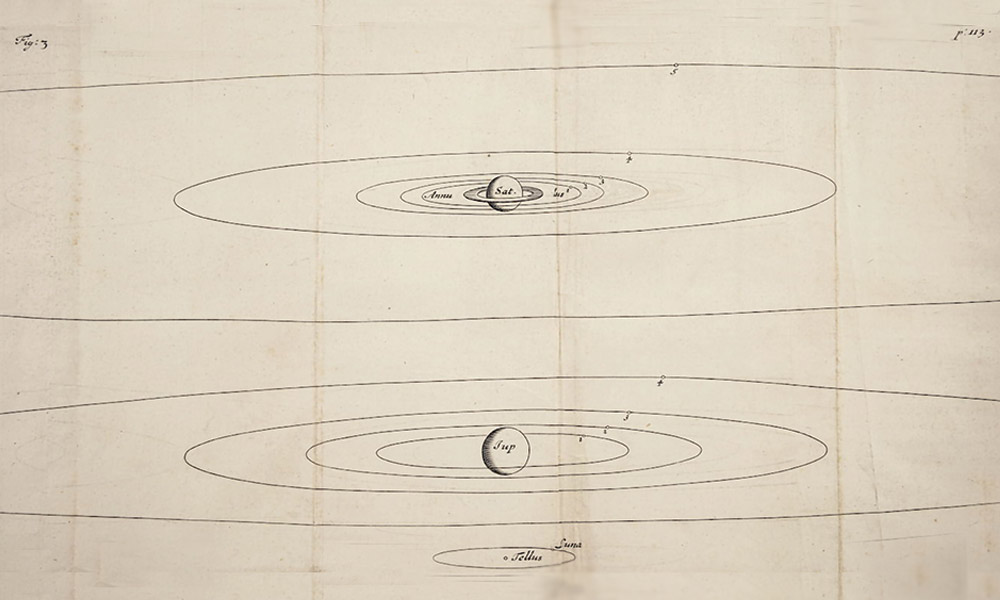
He hypothesized that Saturn was surrounded by a ring tilted with respect to the ecliptic. This, he reasoned, would explain why Saturn’s appearance changed over time as the viewing angle from Earth shifted. When his book on the subject, Systema Saturnium, was published in 1659, he fully described Saturn’s thin, flat ring. It included diagrams showing how the tilted ring could produce the illusion of various shapes, such as the handles previously described by colleagues. But Huygens didn’t simply look at Saturn’s ring with a better telescope. His use of modeling and geometry served as proof that, viewing edge-on from Earth, the rings became invisible to telescopes of the day.
With several major discoveries already to his credit, Huygens, in 1666, became a founding member of the Académie Royale des Sciences in Paris. He produced much of his most influential work there, benefiting from the support and collaborative environment of one of Europe’s most important scientific centers. Huygens began investigating a problem that had long fascinated scientists: how light moves. At a time when many believed light traveled as streams of particles, he proposed a radically different idea—that light travels in waves.

Christiaan Huygens. Photo credit: Public Domain Image Archive.
Huygen’s insight became his most enduring contribution to photonics via publication of his Treatise on Light in 1690. The treatise formulated what is known today as Huygens’ principle: that every point on a wavefront acts as a source of secondary waves, and a new wavefront is formed by the envelope of these waves. He provided elegant explanations of reflection and refraction and established a wave-based framework for understanding the movement of light.
With the help of handmade lenses and geometric reasoning, he established a foundation for wave optics that continues to underpin modern photonics. Huygens’ wave-based view of light remains central to how scientists and engineers analyze and control today’s optical systems.
Huygens’ wave theory stood in contrast to Isaac Newton’s particle-based theory of light. When Newton published his paper, New Theory of Light and Colors in 1672, Huygens was already an established and respected scientist, while Newton was a young man eager for his approval. At first, Huygens was unimpressed and even frustrated, realizing that some of his own work might be eclipsed by Newton’s.
Rienk Vermij, professor of the History of Science and director of the Center for Medieval and Renaissance Studies at the University of Oklahoma, explains, “Only gradually, [Huygens] came to realize the full implications of Newton’s work, including the fact that his own work on remedying spherical aberration was practically useless. Apparently, he was [annoyed] and he allowed the indirect communication with Newton to end. Years later, after Newton had published his Principia [in 1687], contact was resumed. This time, Huygens was sincerely impressed and he even made a trip to England to meet Newton personally. Unfortunately, there are no records of their conversations, but apparently, they got along well.”
Newton’s reputation and influence meant that his particle theory of light dominated scientific thinking for much of the following century. It would take more than 100 years, and the experimental work on interference and diffraction in the 19th Century, before Huygens’ wave theory gained broad acceptance and became the foundation of modern optics. Although a celebrated scientist in his time, Huygens preferred a solitary life, which limited his influence on the broader scientific community. He died in 1695, having produced work in scope and impact that scholars today rank second only to Newton’s.
More than three centuries later, Huygens’ legacy continues to shape modern science. His wavefront principle underlies techniques used in interferometry, holography, beam propagation modeling, and optical system simulation. In advanced fields such as nanophotonics and metasurfaces, researchers apply Huygens-inspired concepts to control the phase, amplitude, and direction of light. What began as a geometric construction drawn in the 17th Century now informs computational design tools and strategies used in cutting-edge optical devices.
When the National Aeronautics and Space Administration and the European Space Agency launched the Cassini–Huygens mission to Saturn and Titan in 1997, the Titan lander was named in his honor. On 14 January 2005, the Huygens probe descended through Titan’s thick atmosphere and transmitted the first images and data from that moon’s frozen surface. The mission brought humanity into direct contact with the very world that Huygens first identified with a hand-built telescope 350 years earlier.
Christiaan Huygens demonstrated that advances in optics and measurement often emerge from the tight coupling of modeling, instrumentation, and practical problem-solving. By improving lenses and rethinking the fundamental nature of light, he helped establish a framework that still guides how scientists and engineers manipulate and measure light. His legacy is not confined to historical texts, it lives on in the optical systems, photonic devices, and astronomical missions that continue to expand the limits of human observation.
Jakab Terpstra is a digital marketing coordinator at SPIE.