Despite the focus of scientific funding today largely being on the applications of new scientific discoveries and associated return on investment, many good scientists just do science for fun—driven by curiosity and the thrill of discovery. And these scientists are having the most fun when they land on a completely fresh and untapped area of science, an iceberg hiding near-limitless opportunities for ground-breaking discovery below the surface.
For a small group of physicists, their iceberg is the optical skyrmion. It already holds promise in next-generation optical communications, high-resolution imaging, optical logic and computation, and many more applications—and it could lead to discoveries and technologies scientists have yet to conceive.
But what exactly is a skyrmion? The concept didn’t start out in optics, but rather in particle physics. First proposed by Tony Skyrme in 1961, skyrmions were devised as an alternative way of describing nucleons in the atomic nucleus. Instead of the prevailing notion of protons and neutrons being particles, Skyrme instead pictured them as stable, localized knot-like disturbances within a continuous quantum field.
The arrangements of these knot-like disturbances were described by a single number, the Skyrme number. This Skyrme number is what’s known as a topological invariant—a number that cannot change continuously, making it stable to any deformation. By linking the Skyrme number to the number of particles (baryons like protons and neutrons) in a nucleus, Skyrme offered a novel explanation for why matter is so stable and why nucleons don’t simply decay—something fundamental that was not understood at that time.
However, this description fell out of favor when a more complete and foundational picture of matter emerged with the Standard Model of particle physics in the 1970s. After this, interest in the skyrmion largely waned, until similar structures in magnetic materials were first predicted in 1989, and then observed for the first time in 2009.
Magnetic skyrmions are nanoscale regions in magnetic materials where electron spin orientation changes in a vortex-like manner. In other words, the spins point in one direction (e.g. up) in the center, and then gradually rotate in a continuous, swirling pattern until they return to the material’s uniform magnetic ground state (the boundary of the skyrmion) over a distance of just a few nanometers.
As potential bits to store information in computer memory and logic devices, this arrangement offers three key advantages. First, their topologically derived stability makes them even more robust than current magneto-resistive random-access memory. Second, their tiny few-nanometer size allows ultra-high-density storage. And third, their fast and efficient movement accelerates access times while lowering power consumption. As a result, research continues apace to make skyrmion-based memory a reality.
But in 2018, a completely unexpected skyrmionic curveball was thrown by the photonics community: the optical skyrmion. Guy Bartal, of Technion–Israel Institute of Technology, and colleagues published a paper in Science showing how they had generated an optical skyrmion lattice using evanescent waves, specifically surface plasmon polaritons (SPPs). SPPs are electromagnetic surface waves that propagate along the interface between a metal (gold) and dielectric (air). These waves were arranged in a hexagonal pattern to interfere, producing a skyrmion at the center of each unit cell in the array. As these optical skyrmions were localized and stable field configurations in space, they later became known as field skyrmions.

A five-fold quasicrystal formed by skyrmions and merons (skyrmions form hexagonal lattices, merons form square lattices, anything else will have combination of skyrmions and merons). Photo credit: Henry Putley.
What was the purpose of creating these optical field skyrmions? “The real answer is we do it for fun,” said Bartal at a 2022 workshop on nanoscale analytics. “But we do need sometimes to justify it, and there are actually some good reasons to motivate this work.” He explained that one motivation is that other types of skyrmions are not always controllable and are often formed only at very low temperatures, whereas optical skyrmions can be made on demand at room temperature, making them easier to work with. Another motivation is that light-matter interactions can induce skyrmions in other materials, making them potential generators of magnetic skyrmions. His final motivation was that photonic systems are fundamentally different to others (unlike electronic systems, for example, light is massless, chargeless, and immune to electromagnetic interference), meaning optical skyrmions held promise for discovering new phenomena.
Around the same time Bartal and colleagues were discovering field skyrmions, a group led by Anatoly Zayats at King’s College London, was experimenting with SPPs, too. “We noticed a strange thing: This surface plasmon polariton has a link between the electric field and propagation direction—you cannot change propagation direction without changing how the electric field rotates in this surface wave,” he recalls.
By constructing a waveguide on a surface that curves the SPPs around a circle, Zayats and colleagues found that the light’s orbital angular momentum coupled to spin angular momentum to create a non-uniform, swirling pattern. “Comparing our structures with magnetic skyrmions, we saw similar properties; not just similar photonic spin distribution structure but also similar robustness,” explains Zayats. “The structures that we created and characterized—photonic spin patterns that are stable in space—these days are called photonic spin skyrmions, because spin defines how the electromagnetic field rotates.”
Zayats has touched on possible future applications of these spin skyrmions, exploring their potential as a basis for developing a new type of extremely high- resolution imaging. In conventional imaging systems, diffraction always limits resolution. For example, visible light’s diffraction limit is about 300 nm. But diffraction does not influence the skyrmion’s structure, the spin distribution, which varies on deep-subwavelength scales. Zayats and colleagues demonstrated the potential of spin skyrmions for imaging by building a scanning probe microscope capable of measuring the spin structure of the optical beams down to 10 nm distance, equivalent to 1/60 of the wavelength of the light used. Such super resolution microscopy could be particularly useful for ultraprecise detection of magnetic skyrmions.
Despite the strides he has made in this and other applications, Zayats’ interest largely remains focused on understanding skyrmions and expanding the zoo of topological states of light. Like Bartal, Zayats is playing around with skyrmions “for fun,” and making new discoveries along the way. For instance, he and his colleagues have explored the connection between spin skyrmions and field skyrmions, in the process generating a structure called an optical meron that could be described as half a skyrmion. More recently, through further experimentation, Zayats’ team has built a “very interesting” structure that generates a mixture of skyrmions and merons.

Merons form when light interacts with an anisotropic metamaterial. By controlling polarization of the incoming beam one can move the merons. Photo credit: Vittorio Aita.
Though fascinating, these skyrmions and related states are either bound to a surface (field skyrmions) or contained within a waveguide (spin skyrmions). They don’t take advantage of light’s defining property: its unequalled speed. A type of skyrmion that does was discovered not long after Bartal and Zayat’s groundbreaking discoveries through “happy serendipity” by a team at the University of Glasgow, led by Stephen Barnett and Sonja Frank-Arnold. “One of our students—Sijia Gao—was presenting her results on structured light polarization patterns, and she showed these interesting things,” enthuses Barnett. “Because I’d been doing some unrelated work on magnetism, I recognized them as being skyrmions.”
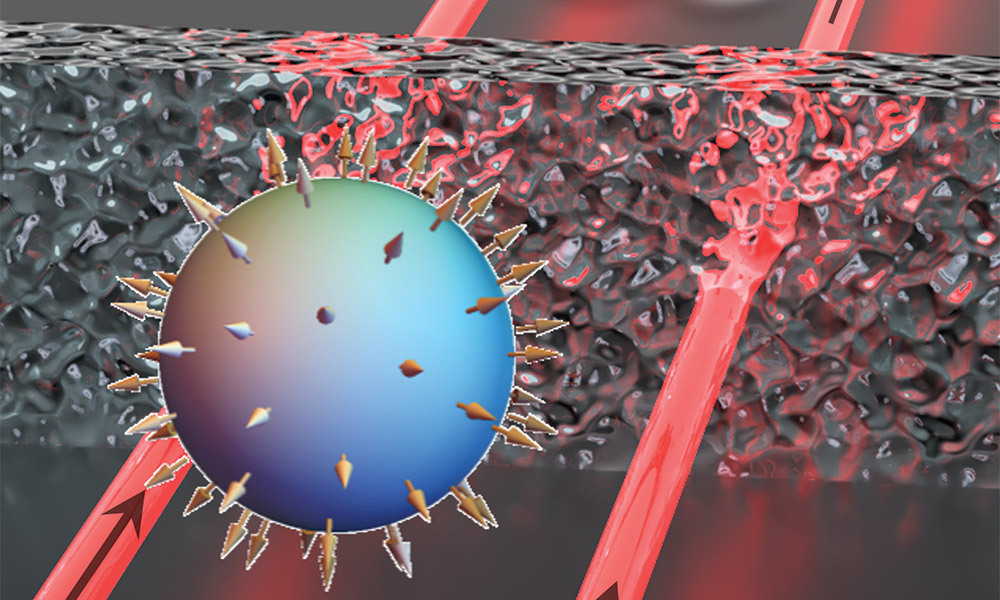
In fact, what Gao and Barnett had discovered was a way to unshackle skyrmions from any waveguides or material surfaces, bringing some of the potential applications of optical skyrmions, such as optical communication and all-optical logic and computation, into view. Stokes skyrmions, as they are now commonly called, are the topological, swirling pattern encoded in the polarization states of a freely propagating light beam. These skyrmions are defined using the Poincaré sphere, a three-dimensional map of all possible polarization states of light. To qualify as a Stokes skyrmion, a cross-section of the light beam must contain every possible polarization state—essentially painting the entire Poincaré sphere. The Skyrme number is then defined by how many layers of paint you can apply to the sphere. Critically, it is the boundary formed by the outer edge of the beam, where polarization becomes uniform, that frames the complex polarization pattern within and allows it to be mapped to the entire Poincaré sphere a discrete, whole number of times, giving these skyrmions their topological toughness.
Specific Skyrme numbers and skyrmion structures, commonly called textures, can be produced easily in real time. “We have these devices called spatial light modulators, where you can really engineer the phase profile of your beam, and we can do the same for polarization now as well with a micromirror device,” explains Claire Cisowski from the Glasgow group. “This is just an array of a lot of very small mirrors that can tilt in one direction or another, allowing you to change the polarization profile of your beam, and even put all the polarization states inside one profile.”
This means the Glasgow team can rapidly experiment with different Stokes skyrmions, which is fortunate because they have a lot of questions they want to answer. “We have, I think, passed the stage where we don’t understand what the properties of these skyrmions are,” says Cisowski. “Now, the biggest questions we have are, are they actually stable, and what makes them advantageous compared to other beams of light?” Barnett is similarly bursting with questions: “Can we get light and magnetic structures to talk to each other? And more fundamentally, what happens when skyrmionic and related beams encounter matter?” he asks.
The latter question in particular is critical for any application where skyrmions are propagating through a medium, from all-optical computing and communication to microscopy and sensing. To begin to answer it, the researchers are firing skyrmionic beams at cold atoms inside a gas. “With these experiments, we can start thinking about imprinting a skyrmion magnetization on the gas,” Barnett continues. “I don’t know where that would lead, but if you’re using these magnetic skyrmions for memory, you might just write them directly with your laser beam—that would be kind of fun.”
Up to this point, the optical skyrmions discussed have been classical, described by the continuous properties of a light beam. Andrew Forbes of the University of the Witwatersrand, asked whether the same fascinating optical phenomena existed at the much smaller scale of individual photons, where quantum mechanics dictates how light behaves. He got his answer in 2022 and published the results in 2024.
“We engineered skyrmions directly from entanglement,” he explains, referring to the uniquely quantum property where two or more particles behave as one, regardless of the distance separating them. “If you have two photons that are entangled, what we showed is that each photon by itself has got no topology at all, but the topology sits in the entanglement between the photons.” In other words, a quantum skyrmion does not exist in physical space but is a shared property of two spatially separated photons.
What makes Forbes’ entangled quantum skyrmions—and the very recently reported generation of single-photon skyrmionic states by Ying Yu, Jin Liu, and co-workers from three universities in China—particularly exciting is their potential in catalyzing the quantum technologies revolution. The greatest challenge in many quantum technologies is maintaining quantum states. The slightest disturbance can cause decoherence. But quantum skyrmions are inherently stable; topologically protected from their environment. This resilience makes them ideal candidates for qubits in future quantum computers. When coupled with their light-speed transmission and potential to encode information in an enormous topological alphabet (A, B, C, etcetera, encoded in escalating Skyrme numbers), quantum skyrmions offer similar advantages for quantum communication—a way to transmit information with unprecedented capacity and security.
Yet for all this promise, Forbes is not getting ahead of himself. Magnetic skyrmions are real, physical entities. They are stable due to possessing fundamentally strong energy barriers that make it difficult to go from one integer Skyrme number to the next. In contrast, quantum optical skyrmions are less than a shadow of a physical object, with no discernible energy barrier to their name.
“Because of this, you should not assume that these skyrmions are going to be stable,” muses Forbes. “But much to my surprise, in all the channels [different setups and media] that we’ve checked so far, it seems that topology is preserved. It’s almost a miracle. I’m amazed.”
Confirming their resilience is just one step on a long road to using quantum skyrmions in quantum computers or quantum communication. To make such applications a reality, work must shift from fundamental discovery to applied engineering. With today’s small scientific community largely engrossed in experimenting and musing, and making new discoveries about skyrmions, applications like these remain a distant dream. To truly catalyze the quantum revolution, this tiny photonic playground will need to be transformed into a sprawling metropolis of innovation.
Benjamin Skuse is a science and technology writer with a passion for physics and mathematics whose work has appeared in major popular science outlets.