For most of human history, our ability to understand the world has depended on what we could see with our eyes. The invention of the optical microscope, the telescope, and later, the spectrometer, expanded that vision into the microscopic, the cosmic, and the chemical. Today, we are entering another transformation in perception: The rise of spectral intelligence. By fusing hyperspectral imaging with artificial intelligence we can now detect, classify, and quantify materials based on their molecular signatures in real time.
Hyperspectral sensors do not simply record red, green, and blue like a traditional camera. They measure hundreds of narrow wavelength bands, each corresponding to unique interactions between light and matter. When these spectra are interpreted correctly, they reveal composition, structure, and even physical state. What was once invisible became measurable.
The challenge, however, has never been in capturing the light. It has been in interpreting it. Each pixel in a hyperspectral image can contain the mixed spectral fingerprints of multiple materials. For decades, scientists relied on manual analysis or simple algorithms to separate these signals. The results were slow, noisy, and heavily dependent on human expertise. Advances in AI and subpixel analysis pioneered by organizations such as Metaspectral now allow machines to perform this complex task autonomously and at scale, converting raw spectral data into chemical understanding in milliseconds.
Spectral intelligence is proving to be a critical tool in addressing two of humanity’s most urgent challenges: climate change and waste.
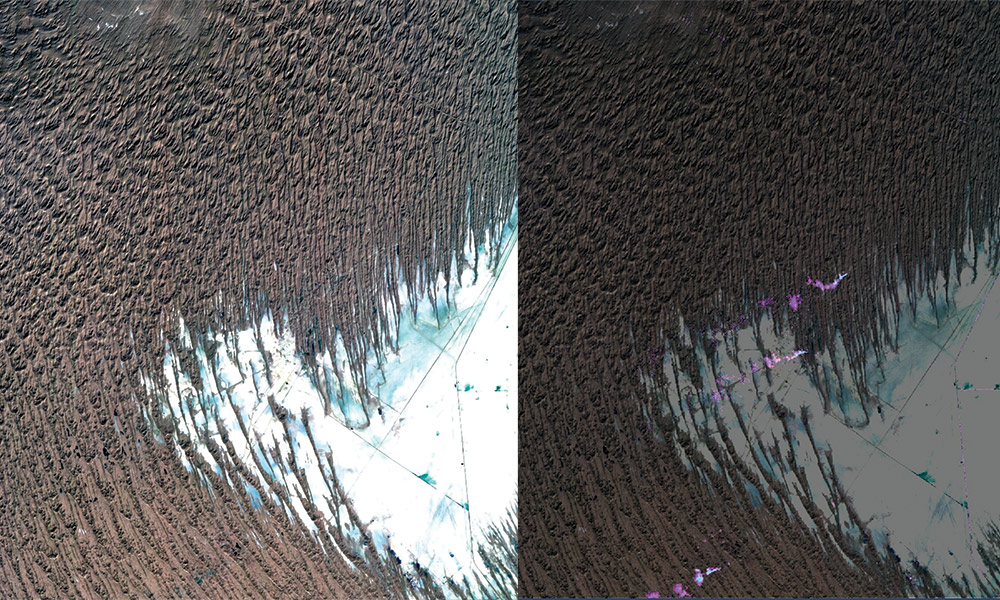
In methane monitoring, hyperspectral sensors mounted on aircraft and satellites can detect the distinct absorption features of methane across shortwave infrared bands. When paired with AI models trained on atmospheric and radiative transfer data, these systems can identify and quantify leaks with a precision previously achievable only through costly onsite inspections. Early detection translates directly into emissions reductions, regulatory compliance, and verified climate accounting.
Metaspectral, for example, has demonstrated how these same principles can extend from orbit to industry. By applying its real-time spectral analysis platform to both satellite and ground-based systems, the company has shown that methane emissions and other greenhouse gases can be detected and localized within hours rather than weeks. This capability bridges the gap between optical sensing and actionable climate intelligence.
On Earth’s surface, similar principles are being applied to recycling and resource recovery. Plastics sorting has long been limited by the inability to identify dark polymers, polymer blends, thin films, or multilayered packaging that confound near-infrared sensors. AI-driven spectral analysis now enables real-time classification of these difficult materials, even allowing recyclers to separate food-grade from non-food-grade plastics, for instance, and improve the purity of recycled output. Metaspectral’s deployments in industrial facilities illustrate how combining optical data with machine learning can dramatically increase recovery rates for materials once destined for landfill. The same approach can be extended to complex waste streams such as automotive shredder residue, electronic scrap, or construction materials.
Even in agriculture and natural resource management, spectral intelligence provides a new form of environmental awareness. By analyzing soil, vegetation, and water spectra, it becomes possible to estimate nutrient content, soil carbon, and crop health nondestructively and continuously. In each of these cases, optical sensing turns sustainability from a set of intentions into measurable, verifiable action.
As spectral AI systems grow more autonomous and pervasive, the issue of trust becomes central. When a machine determines that a facility is emitting methane, that a shipment of plastic waste is noncompliant, or that a crop is under stress, the decision can carry financial and regulatory consequences. The underlying models must therefore be explainable, transparent, and auditable.
Traditional hyperspectral analysis methods such as matched filters or adaptive cosine estimators produced results that scientists could interpret. Deep neural networks, by contrast, may achieve higher accuracy but operate as black boxes. They extract patterns from data that even their creators cannot fully explain. This opacity poses risks when spectral intelligence systems are used to enforce environmental standards or inform defense and security operations.
Building trust requires a commitment to explainable AI. Techniques such as attention mapping, saliency analysis, and spectral attribution can reveal which wavelengths or features influenced a model’s decision. Combining these with established physical models ensures that the results remain scientifically grounded. Metaspectral is investing heavily in this hybrid approach, ensuring that the conclusions drawn from hyperspectral data remain interpretable and scientifically defensible. In short, AI should not replace physics but rather augment it.
Equally important is the quality of the data itself. Hyperspectral systems are notoriously sensitive to illumination, atmospheric conditions, and calibration drift. A trustworthy AI model must therefore account for uncertainty, quantify confidence, and be trained on diverse, high-fidelity datasets. Without such rigor, even the most sophisticated algorithms risk producing visually convincing but scientifically unreliable outputs.
The practical deployment of spectral intelligence depends not only on algorithms but also on engineering. Real-time analysis requires ultra-efficient data compression and edge processing to handle the immense bandwidth generated by hyperspectral sensors. Emerging implementations achieve gigabit-per-second throughput at power levels low enough for deployment on satellites, drones, or industrial sorters.
Metaspectral’s work in this area demonstrates how optical data can be analyzed directly at the edge, enabling detection and classification in real time without relying on cloud infrastructure. This type of hardware-software co-design has made it possible to deploy spectral AI systems in extreme environments ranging from space missions to waste-sorting plants.
This miniaturization and acceleration of the optical-AI stack is expanding access to spectral intelligence. In space, it allows near-real-time detection of methane emissions or harmful algal blooms. In factories, it enables closed-loop feedback for sorting and quality control. Across industries, the same principle applies: Transform raw spectral data into actionable insight at the speed of relevance.
If seeing is believing, then spectral intelligence introduces a new kind of vision that looks beneath surfaces and across spectra invisible to the human eye. With such power comes responsibility. The integration of AI into optical sensing challenges us to think carefully about how we collect, process, and act on data about the world.
Transparency and accountability must therefore evolve alongside capability. The scientific community, industry, and policymakers will need to establish standards for data provenance, model validation, and interpretability. These frameworks will ensure that spectral intelligence serves as a trusted instrument for sustainability rather than a source of confusion or misuse. Metaspectral is helping to pioneer these best practices by designing our systems with traceable data pipelines and explainable outputs that support both scientific and regulatory scrutiny.
Optics and photonics have always been about expanding the boundaries of perception. As AI becomes the interpreter of light, we stand at the threshold of a new era where every photon carries not just color but meaning. Hyperspectral sensing, combined with transparent AI, can help humanity see and manage the true state of its environment, from carbon in the air to polymers on the conveyor belt.
In doing so, we are not merely observing the world more clearly; we are learning to take responsibility for it. The spectrum, once invisible, is now our most powerful tool for sustainability and trust in an increasingly data-driven planet.
Francis Doumet is the CEO and Co-Founder of Metaspectral, a company specializing in AI-powered hyperspectral data analysis (www.metaspectral.com).