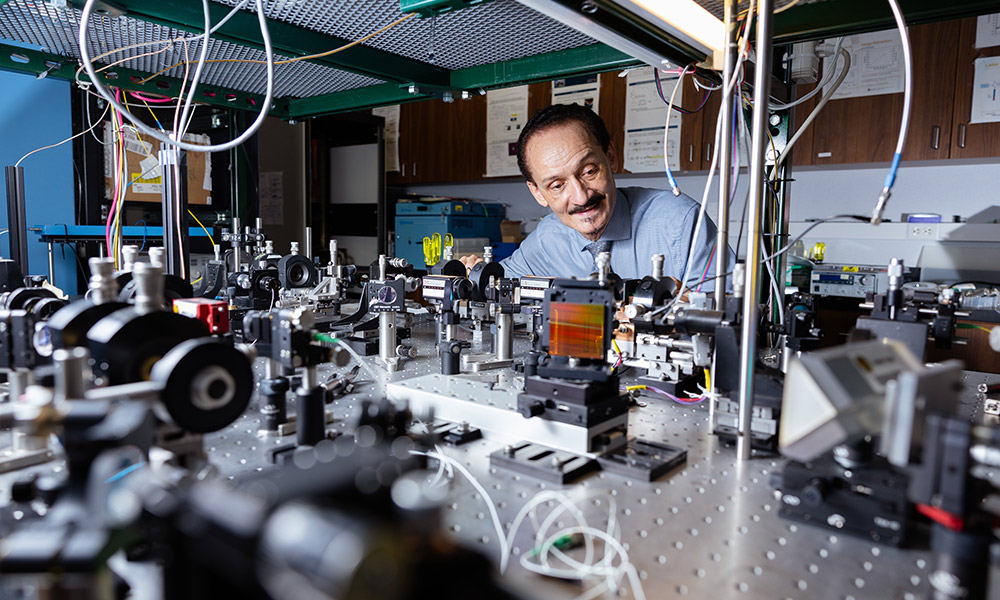
Peter Delfyett is widely recognized as a leading figure in ultrafast optics, an innovator whose research has fundamentally advanced our understanding of high-speed photonics and whose work continues to drive real-world impact in communications, manufacturing, and defense. Currently at the University of Central Florida’s College of Optics and Photonics (CREOL), Delfyett is the director of the Townes Laser Institute as well as Pegasus Professor and University Trustee Chair Professor with appointments in the College of Optics and Photonics, electrical engineering, and physics departments. Delfyett’s early breakthroughs in producing ultrashort, high-peak-power pulses from semiconductor diode lasers and his development of ultralow noise, mode-locked laser sources, have shaped the field of high-speed optics. His technical contributions laid the groundwork for new classes of compact, energy-efficient ultrafast lasers, with direct applications in signal processing, high-speed optical clocking, and precision instrumentation. In 2003, Delfyett co-founded Raydiance, based on his patented laser technologies, particularly his extreme chirped pulse amplification (X-CPA) platform. Underpinned by his innovations, Raydiance secured over $100 million in venture capital, delivered transformative ultrafast laser systems for micromachining, and helped establish a new segment in industrial femtosecond laser processing.
An SPIE Fellow Member, Delfyett has chaired sessions at and helped organize numerous SPIE conferences, and has served on SPIE’s Engineering, Science, and Technology Policy Committee. He has also held leadership roles in nearly every major professional society in the field of optics and photonics, serving as president of the National Society of Black Physicists, the chair of the APS Division of Laser Science, a board member of Optica and the IEEE Photonics Society, and editor-in-chief of the IEEE Journal of Selected Topics in Quantum Electronics.
“I have had the pleasure of knowing Peter throughout essentially his entire career, encountering him first when he was at Bellcore and I was at Bell Labs in the late 1980s,” says Stanford University’s W.M. Keck Foundation Professor of Electrical Engineering Emeritus David A.B. Miller. “From the beginning, it was clear to me that he was an inspiring individual, with unbounded enthusiasm and the ability to communicate that to the technical community and to students, all while being a modest person committed to the general good. When these personal qualities are added to his remarkable technical capabilities and achievements in ultrafast lasers and optics, we find an individual with a unique and far-reaching impact on our community. His technical work in ultrafast lasers and related fields has, of course, been outstanding; more than many other researchers, he has not only made strong basic contributions but has also advanced the field in tangible ways. Peter’s practicality and creativity show also in his large patent output and the practical exploitation of his ideas and techniques in many companies, and his talks at conferences are always a highlight. Across his career, he has made a remarkable set of contributions to the work of professional societies, including particularly strong contributions to SPIE through his work on conference program committees. In pretty much every way, I consider Peter Delfyett an extraordinary colleague.”
Meet the other 2026 SPIE Society Award winners.
Read more about the SPIE Harold E. Edgerton Award in High-Speed Optics.