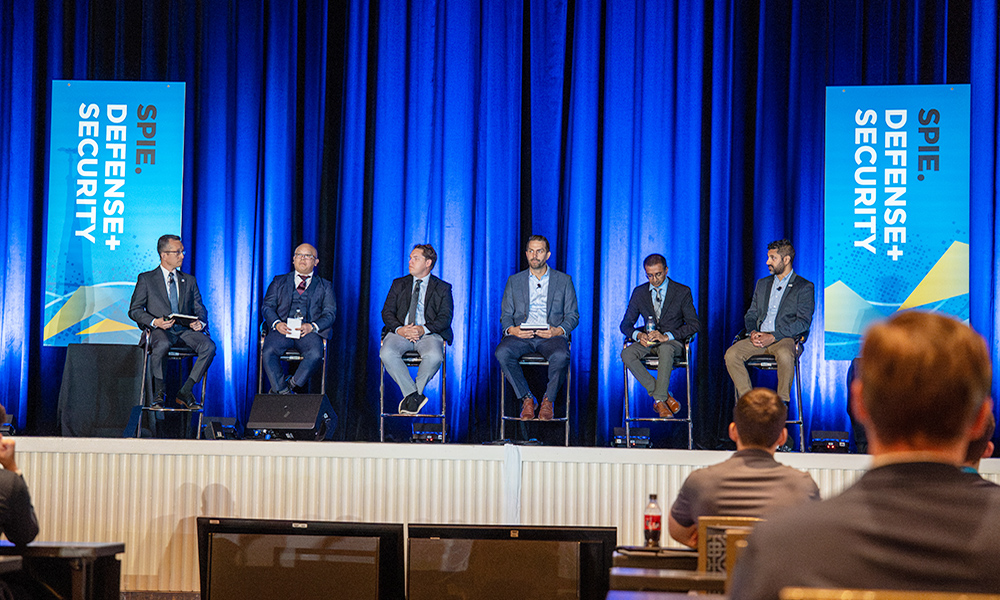
The world has awakened to the reality of unmanned systems — aka drones — that can readily be deployed by adversaries, and that exist across a diverse range of platform, sensor, sensing, command and control, autonomy, and attack technologies. Countering such unmanned systems was the subject of a lively panel discussion at SPIE Defense + Security, held from 26 to 30 April in National Harbor, Maryland.
Panel moderator Houston Cantwell, senior resident fellow at the Mitchell Institute for Aerospace Studies, emphasized the critical nature of the issue and the need for whole-of-government solutions that involve academia and industry. “And the threat, if you look at the news, is real,” he said. “I look at what the drones are doing both in Iran as well as in Ukraine and I am just flabbergasted at the technology and the advance…. They’re using networks that we never thought they would be able to use.”
For example, he said, Ukraine is using cell phone networks to launch drones deep into Russia “and Russia’s only way to stop those attacks is to turn off their cell phone networks for hours at a time. Here, in the United States, we are not exempt from this threat.”
Panelist An (Mike) Tran, director of prototyping in the Office of the Deputy Assistant Secretary of War for Prototyping and Experimentation, said “the problems and challenges that [Cantwell] just mentioned are exactly the things that we're going after.” He said he sees three imminent threats from drone technology: First, is the cost/exchange ratio. “We can't afford to shoot $2 million missiles or interceptors at $2,000 drones.” Second, he said, is the tempo of incoming threats. “When the threats are coming in at multi-angle, day after day after day, that is where we struggle, and we've seen that in operation Epic Fury. The third area that I see is the adaptability of our adversaries. And we're not moving at that rapidly, at that pace.”
Cantwell asked panelist and directed energy (DE) expert Mark F. Spencer, a professor of optical sciences at the University of Arizona, if there is a role for DE in countering unmanned systems.
“The volume of threats that we face in current conflicts necessitate directed energy,” said Spencer. “So, is it the end all be all that solves every single problem? No, but it is another arrow in the quiver…. a robust arrow, because, yes, the systems right now, they cost a pretty penny up front, but it's dollars-per-shot.”
Of counter drone systems like DE, panelist Chris Schwalm of BAE Systems, said, “We're dealing with a threat environment that is really hard to replicate, especially in real world, especially with complex environments. Results from our test sites oftentimes don't replicate or have the same results that we're seeing when [counter unmanned systems] are fully deployed. So instead, we're deploying systems, we're adjusting after the fact. This is where things like modeling and digital twin operational environments, high fidelity simulations, complex training scenarios…these allow us to really focus on operator readiness. They allow us to make better and more informed investment decisions.”
Cantwell asked panelist Ganesh Balakrishnan, a professor of electrical and computer engineering at the University of New Mexico about how to recruit and train researchers in DE and other counter unmanned systems and asymmetric threats on the battlefield.
Balakrishnan replied: “the gap between today and tomorrow is shrinking very fast, so people in universities, people training right now, may have to use that skill set much sooner than in the past. The drones, in particular, have been so commoditized that we are struggling to equally commoditize the defense against drones. You go from solutions for off-the-shelf drones, to fiber optic drones [and then] to 3d printed drones.… to work across such a large spectrum of threats is incredibly hard, and the workforce has to reflect that diversity in technology as well.”
Balakrishnan called for a trusted system in which a pipeline of students are ready to be placed and put to work at a moment's notice. “It's a fast pace,” he said of the unmanned systems environment. “And we have to adapt. I think that's the only way we are going to flip the asymmetry and get a hold of things.”

Panelist Imraan A. Faruque, of the Johns Hopkins University Applied Physics Laboratory, also discussed the role of universities in developing counter-unmanned systems technologies, including involving students and educators from tribal colleges in places like Oklahoma where the Defense Department runs field test sites. He spoke, too, of the value of meetings like SPIE Defense + Security to gain “exposure to the newest information.”
He added a recommendation to attend experimentation events run by the Department. “What does it look like when you're in an artillery environment? What are the types of things that will be fielded against you? Take a look at those experimentation events, because that’s what gets you in front of the real systems.”