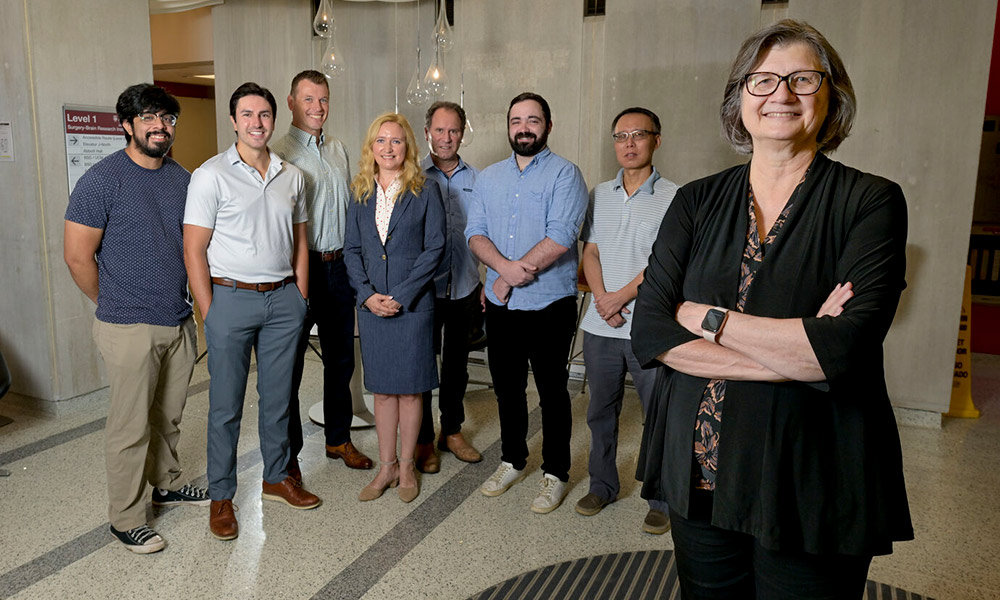
Maryellen Giger, the A.N. Pritzker Distinguished Service Professor of Radiology at the University of Chicago, is a recognized pioneer in the fields of computer-aid detection (CADe), and computer-aided diagnosis (CADx). A long-standing leader in the fields of digital-image formation, computer-aided diagnosis, quantitative imaging, radiomics, and radiogenomics, Giger is one of a handful of scientists who shaped the field of computer-aided diagnostics in medical imaging in the mid-1980s: the work of these scientists at the University of Chicago has grown into a multi-billion-dollar industry. She has successfully translated her work into the clinic, co-founding QuantX, the first FDA-cleared, machine-learning-driven system to aid in cancer diagnosis which, in 2019, was named one of TIME magazine's inventions of the year. Giger was also an early contributor to the development of image analysis/AI and radiomics in the assessment of disease risk and omics-imaging correlations. She envisioned and supported the democratization of AI in imaging through the creation of the National Institute of Biomedical and Bioengineering’s Medical Imaging and Data Resource Center (MIDRC), a resource of more than 150,000 publicly available data sets for AI investigators.
An SPIE Fellow Member since 2014, Giger began attending SPIE Medical Imaging conferences as a student in the 1980s. She was one of the founding chairs of the Computer-Aided Diagnosis Conference at SPIE Medical Imaging and, in 2001, she began volunteer work as an SPIE instructor and then as a conference program committee member, chairing her first conference in 2007. In 2014, she served as the founding editor-in-chief of the SPIE Journal of Medical Imaging. In addition, she has served on multiple SPIE committees, was a member of the SPIE Board of Directors from 2012-2014, and served on the Society's Executive Committee between 2016-2019, serving as President of the Society in 2018. In 2021, she received the SPIE Directors’ Award, and in 2022, was the recipient of the SPIE Harrison H. Barrett Award in Medical Imaging. She is also a former president of the American Association of Physicists in Medicine (AAPM) and was a member of the National Institute of Biomedical Imaging and Bioengineering Advisory Council of the National Institutes of Health. Giger is a member of the National Academy of Engineering, a recipient of the AAPM William D. Coolidge Gold Medal, a recipient of the Radiological Society of North America (RSNA) Honored Educator Award, as well as an RSNA Outstanding Researcher Award. In 2013, Giger was named by the International Congress on Medical Physics as one of the 50 medical physicists with the most impact on the field in the last 50 years.
In 2008, Giger was featured in the SPIE Women in Optics publication. “The exciting part [of what I do] is performing research with my students and staff in my lab, including graduate students working toward their PhD, medical students, undergraduate students, and high school students,” she said at that time, a statement that remains true to the successes she is honored for today. “I enjoy tremendously passing on to a student the excitement and methods of conducting independent research. It is very rewarding to see a graduate student receive their PhD degree and later become my colleague. It is also rewarding to have the results of my research translated and commercialized to ultimately help others.”
“Maryellen represents the epitome of excellence and pioneering leadership in the fields of optics and photonics as applied to medical imaging,” says Google AR Director and 2023 SPIE President Bernard Kress. “Her extraordinary contributions have not only shaped the landscape of medical physics but have profoundly impacted patient care globally. On a more personal note, my decades-long professional relationship with her has been invaluable. She has been a true example of dedication and leadership within SPIE, and her influence has significantly shaped my own contributions to the Society. Maryellen’s service to the scientific community, particularly to SPIE and the broader optics and photonics community, is as impactful as her research.”