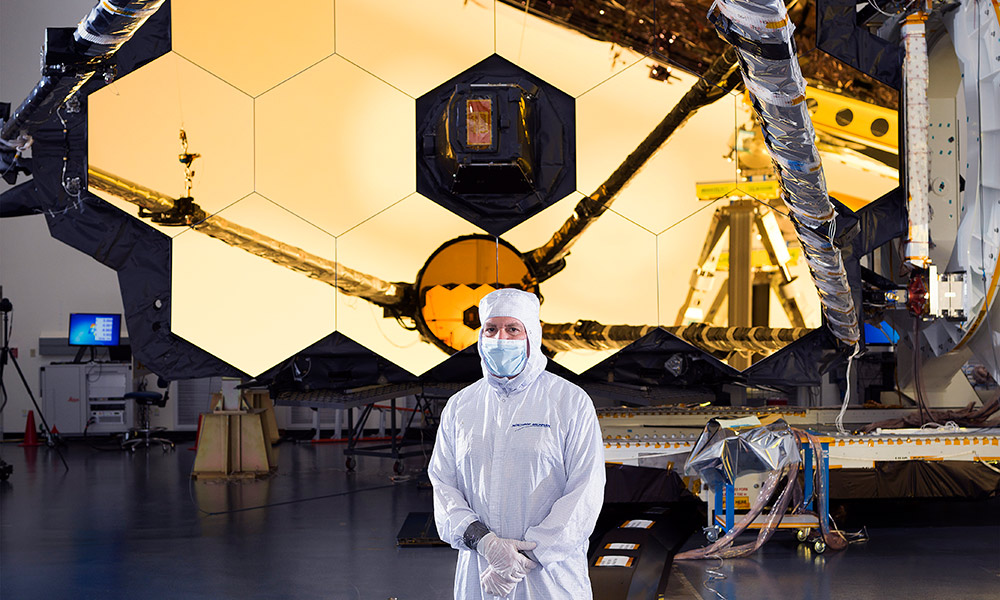
The ability of NASA’s Lee Feinberg to visualize, plan, and execute critical and highly technical aspects of the James Webb Space Telescope (JWST) mission enabled the success of the world’s largest, most powerful space telescope. As Optical Telescope Element Manager for the JWST, one of Feinberg’s key responsibilities was developing the primary mirror, a novel design comprised of 18 hexagonal-shaped mirrors, weighing 10 times less than the Hubble primary mirror, but designed to function effectively at -400 degrees Fahrenheit with optical performance rivaling the Hubble telescope which operates at room temperature. With JWST’s success, the innovative hexagonal shape used in the mirror has now become a well-recognized icon representing innovation and new technology. Along the mirror development journey, his team developed numerous innovative ways to test segmented mirrors, including new types of test equipment that generated numerous spinoffs. The medical industry has even adapted one of these new test technologies into laser eye surgeries to map the curvature of the human eye more precisely. Feinberg’s organizational and leadership abilities were equally impactful: due to the criticality of JWST’s optical performance, Feinberg formed a panel of the world's leading experts in telescope testing and design to provide independent assessments throughout the development process. The team he established – chaired by Professors Duncan Moore and James Wyant, two major leaders in optics – provided important insights into how to test the telescope and key optical elements, as well as how to optimize performance. This approach was not a NASA norm, but is now being adopted by others trying to push new boundaries.
An SPIE Fellow Member, Feinberg has served as associate editor of the Journal of Astronomical Telescopes, Instruments, and Systems. In 2018, at SPIE Astronomical Telescopes + Instrumentation, Feinberg gave a plenary talk regarding the engineering history of the JWST. He is a frequent presenter at SPIE conferences and prolific contributor to SPIE proceedings, having authored or co-authored over 90 publications with SPIE.
“The James Webb Space Telescope stands on the shoulders of giants, spanning four hundred years of telescope building, from Galileo to Newton, Hale to Nelson's 10m segmented Keck Telescopes, the architects of the Hubble Space Telescope, and now to Lee Feinberg who has led the JWST Optics Team to build the world’s largest and most precise space optical system,” says President of the Association for Universities for Research in Astronomy Matt Mountain. “The history of telescope building has culminated in the 6.5m gold-coated optical system of JWST. Without Lee, we would not have 18 of the world’s most advanced cryogenic mirrors assembled into the largest space telescope, poised to revolutionize space astronomy. But Lee isn’t satisfied with 'just' JWST: having developed and mastered the approach to scalable, segmented space telescopes, he is now building on these new technologies to envision a telescope of even larger diameter – the 'life-finding telescope' known as the Habitable Worlds Observatory. This space telescope has the potential to change the course of human history. This is why today Lee Feinberg is considered a leader in space optical technology: he has laid the foundations for future revolutions in space imaging technologies, and crucially, space science.”
Meet the other 2026 SPIE Society Award winners.
Read more about the SPIE George W. Goddard Award in Space and Airborne Optics.