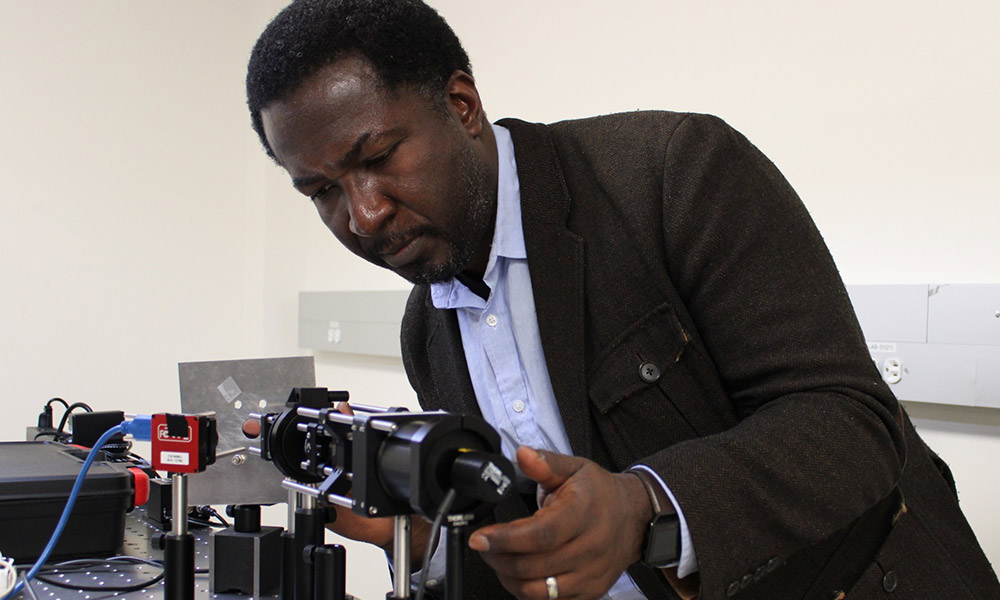
Kimani Toussaint, Senior Associate Dean for Research and Strategic Initiatives, the Thomas J. Watson Senior Professor of Science, and director of the Brown Center for Digital Health at Brown University’s School of Engineering, is a pioneer in the area of quantitative second-harmonic generation (Q-SHG) microscopy for analysis of collagenous fibrous tissues, a technique which permits label-free, three-dimensional quantification of the structural organization of collagen fibers at cellular scales in tissues. Furthermore, Q-SHG microscopy, based on the use of spatial-frequency analysis (Fourier-transform-based methods), has been applied to various tissue types, including bone, ligament, and cervical microstructures. He is also an innovator in nano-optics as an early leader in the development of multifunctional gold bowtie nanoantenna arrays (BNAs). Toussaint has shown that these plasmonic structures could be used for optical tweezing of single and multiple particles, nanometer and micron-sized, and both metal and dielectric, all with significantly low input power densities. In addition, he invented high-aspect-ratio, pillar-supported plasmonic nanoantenna arrays to record, store, and process information in the optical near field. These structures were also shown to facilitate table-top fabrication of ultra-thin, planar optical components. His work in plasmonics has appeared in several high-impact journals, and he’s been an active contributor to polarization-based wavefront engineering.
An SPIE Fellow Member, Toussaint’s contributions to diversity include critical work in medical diagnostics. Since the onset of covid-19, Toussaint has been applying his expertise in optics to developing a pulse oximeter that works equitably across all skin tones. His work in this area has been the subject of numerous interviews and reports, significantly raising public awareness on this issue as well as on the importance of diversity and inclusion in the development of medical diagnostic technologies. He is also a longtime advocate for promoting diversity in the field of optics and the mentoring of underrepresented students and postdoctoral researchers: members of his research group represent four different continents, more than 50% are female, and approximately 30% identify as Black. His diversity efforts extend to his work in academic journals as well: he is a guest editor for the special issue, “Skin Tone in Biophotonics,” for the SPIE journal Biophotonics Discovery, and has also contributed as to SPIE’s Journal of Biomedical Optics and Journal of Nanophotonics.
“I have known Kimani since the fall of 2007,” says Lynford Goddard, the Edward C. Jordan Professor of Electrical and Computer Engineering and associate dean for Diversity, Equity, and Inclusion at the University of Illinois Urbana-Champaign’s Grainger College of Engineering. “We joined the University of Illinois as assistant professors in different departments that year and I still follow his research and outreach efforts. One of the things that I admire most about Kimani is how he integrates and promotes diversity, equity, inclusion, access, and social good in his optics research, his teaching, and mentoring of students, his professional service, and his outreach. During the covid pandemic, he worked towards eliminating inequities in medical diagnostic instrumentation, specifically racial bias in pulse oximeters. This specific problem is important in ensuring life-saving interventions are made for individuals from historically marginalized populations. The work he has done to raise national awareness of the issue as well as his efforts to develop a solution have both been extremely impactful contributions.”