Irving Bigio’s technical accomplishments span both foundational theory and groundbreaking applied innovation. He originated the formalism for elastic scattering spectroscopy (ESS), defining the sub-diffuse regime of reflectance and elucidating the role of the scattering phase function and polarization in light-tissue interactions. His studies in tissue-mimicking phantoms and excised biological tissues provided critical validation and biophysical insight that underpinned a new generation of optical diagnostics.
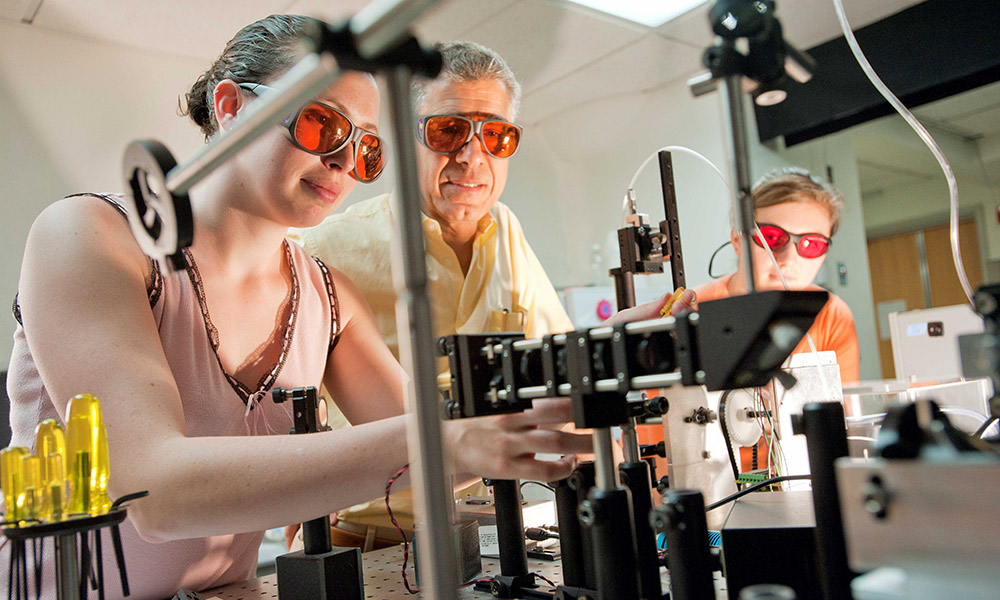
Building on these foundations, Bigio, a professor of biomedical engineering at Boston University, led the development of clinically robust ESS instruments and fiber-optic probes, engineered for real-time, point-of-care use. These devices have been successfully deployed in translational studies across multiple medical domains including gastrointestinal endoscopy, urological surgery, breast and oral cancer diagnostics, and dermatology. His innovations have enabled label-free, noninvasive optical biopsies capable of detecting dysplasia, malignancy, and inflammatory states with high accuracy and clinical utility.
Bigio’s lab also introduced the method of optical pharmacokinetics, based on the discovery of an isosbestic point in source-detector separation. This breakthrough allowed for quantitative, real-time measurement of drug concentrations in vivo, independent of tissue scattering, which until then, was a key challenge in optical measurements. This method was demonstrated in both preclinical and clinical settings, influencing the development of optical strategies for evaluating chemotherapeutic delivery and blood-brain barrier permeability.
Most notably, instrumentation developed in his lab served as the prototype for a skin-cancer diagnostic device recently cleared by the FDA, the first AI-powered optical spectroscopy tool to receive such approval. His work has influenced not only the design of optical technologies but also the regulatory frameworks for their adoption, helping to define new paradigms for digital and AI-augmented medicine.
As an SPIE Fellow Member, Bigio has played a visionary role in the growth of the SPIE biomedical optics community. In the 1990s, he served as conference chair for both the Optical Biopsy and the Tissue Optics and Photonics series at SPIE BiOS, leading the meetings in 1996, 1997, and 1999. These early conferences were instrumental in establishing BiOS as a premier venue for biomedical optics, particularly in translational areas such as optical biopsy and in vivo diagnostics. He has served on editorial boards of SPIE journals, contributed extensively to SPIE proceedings and publications, and been an invited speaker at numerous SPIE events. In 2020, Bigio was, together with Sergio Fantini, honored with the Joseph W. Goodman Book Writing Award for their 2016 book, Quantitative Biomedical Optics: Theory, Methods, and Applications.
“I have known Irving for more than 30 years as a colleague and friend with many shared interests in biophotonics and biomedical optics, particularly in light scattering, tissue optics, and cancer detection,” says NIH’s National Institute of Biomedical Imaging and Bioengineering Director Bruce Tromberg. “Irving is an innovative thinker, dedicated mentor and generous colleague, and his pioneering research in light scattering has had an enormous impact on both the development and clinical translation of biomedical optics technologies throughout the world.”
Meet the other 2026 SPIE Society Award winners.
Read more about the SPIE Britton Chance Biomedical Optics Award.