“Science without culture can become too narrow, and culture without science can miss opportunities to shape the future.” – Pontsho Maruping, Managing Director of the South African Radio Astronomy Observatory
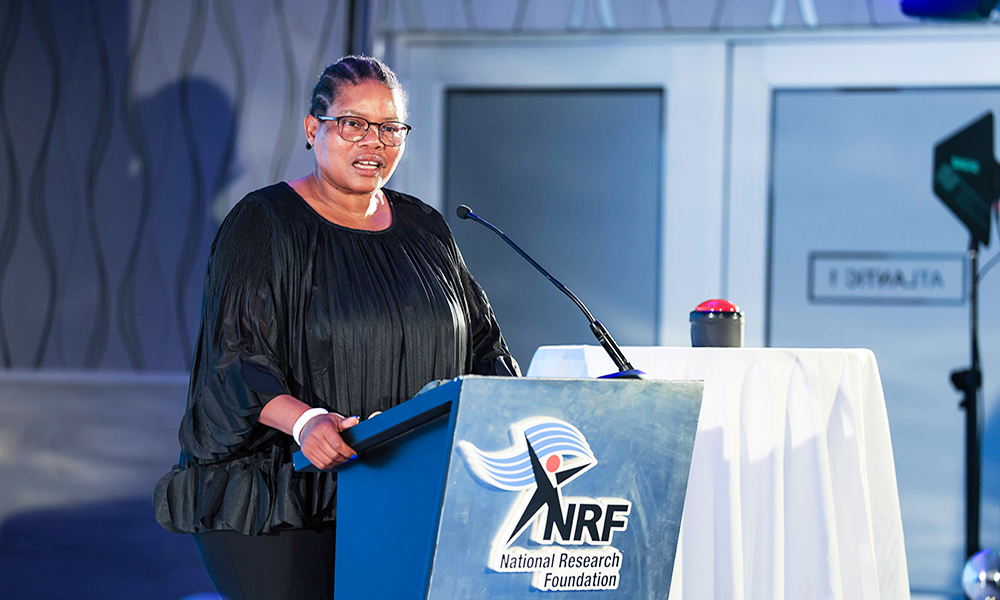
Pontsho Maruping is the Managing Director of the South African Radio Astronomy Observatory (SARAO), a facility of the National Research Foundation. She leads the organisation operating MeerKAT and coordinating South Africa’s contributions to SKA. Her work spans major science infrastructure delivery, observatory operations, governance, and long-term stakeholder partnerships which link technical performance with practical pathways for host communities to participate through skills development, local enterprise opportunities, and shared benefit. Drawing on SARAO’s experience building and operating MeerKAT and participating in construction of the SKA, she will be discussing, "Big Telescopes, Real Communities: Maintaining a “social licence to operate” through MeerKAT to SKA" at her plenary talk at Astronomical Telescopes + Instrumentation on 7 July 2026.
Your plenary will address “social licence to operate.” For people not in the optics world, explain what that means to you and how that applies to the construction of the Square Kilometre Array (SKA) and operating MeerKAT (Karoo Array Telescope).
Social licence to operate means earning trust. It is not only about having formal approval or meeting regulatory requirements. MeerKAT and the SKA are not being built in an empty landscape. They are located in communities with histories, livelihoods, expectations and concerns. The Karoo in South Africa is not just a site for radio astronomy; it is home to people. That has to shape the way we operate.
For MeerKAT and the SKA, social licence is about accountability as much as engagement. It requires us to listen carefully, communicate honestly, respect local knowledge, create opportunities where we can, and be clear about what we can and cannot do.
In the end, trust has to be earned at several levels: with the communities who host the infrastructure, with government and SKAO member countries who invest in it, with the scientists and partners who use it, and with South Africans who should see themselves reflected in the value and impact of these national assets.
Tell me about a specific community partnership success story you have been involved with. How trust was developed and what was the outcome?
It starts with listening. In large science projects, it is easy to arrive with plans and technical language. But trust begins when people feel their context is understood. If something is possible, say so. If it is not, explain why. Respect means recognizing that expertise sits in many places with communities, partners, colleagues, local leaders, and technical teams. Trust is also built by showing up, especially when the conversations are difficult.
What do you think is one of the biggest challenges people face when working toward a common goal?
Often, people agree on the broad goal but have different expectations of what success means. For scientists, success may be discovery. For engineers, it may be innovative solutions. For communities, it may be jobs, skills, local opportunity, or being treated with dignity. The challenge is not only coordination. It is alignment. People need to understand the purpose, the constraints, the trade-offs, and how decisions are made.
You worked at the Department for Arts, Culture, Science and Technology, which was established by Nelson Mandela in 1914. It has since been divided into the Department of Arts and Culture and the Department of Science and Technology. Do you think there was a benefit to having arts and culture integrated into science and technology?
Yes, especially in the early years of democracy. Science and technology are technical, but they are also deeply human. They are about curiosity, imagination, identity, and how society shapes its future. A dedicated science and technology department has clear benefits, especially for policy, funding, and infrastructure, but we should not lose the connection. Science without culture can become too narrow, and culture without science can miss opportunities to shape the future.
Do you have advice for researchers and scientists who have yet to present at an SPIE event, but hope to?
Do not wait until everything feels perfect. If you have done careful work and others can learn from it, you have something worth sharing. SPIE audiences value the real story behind the work: the problem, the design choices, the trade-offs, and the lessons learned.
Also, use the conference fully. Attend other sessions, ask questions, introduce yourself, create networks and follow up. This conference is a place to become part of a community.
You are passionate about women being involved in STEM. Have you seen a shift in the role or treatment of women in STEM since you first became involved?
There are far more women visible in STEM today than when I first became involved. There is also a much stronger understanding now that representation matters, not only because it is fair, but because it changes what young people believe is possible for themselves.
At SARAO, we have seen this through our Human Capital Development program, where transformation has been a deliberate priority. More young women are entering the radio astronomy, engineering, data science and technical skills pipeline. Our Head of Engineering is a woman, and the recent appointment of a woman as SKAO-MID Deputy Telescope Director is another important example. These appointments show that women are not only participating in STEM, they are leading complex technical environments.
At the same time, I would not want to suggest that the work is complete. Women are more present, but they do not always experience the system as fully inclusive. Many still have to work harder to have their competence recognized.
Imagine you are talking to a group of 12-year-old girls who are hesitant to become scientists because they mostly see men in science. What would you say to them to offer encouragement to pursue fields in STEM?
I would say: STEM needs you. You do not have to look like the people you mostly see in textbooks or on television. If you are curious, if you ask questions, if you like solving problems, then STEM is your home. Do not confuse discouragement with truth. Sometimes people limit girls not because girls lack ability, but because society has not caught up with their potential.
Take maths and science seriously, ask for help, and do not let someone else’s limited imagination decide your future.