This year’s SPIE Defense + Security in National Harbor, Maryland included an inaugural conference on directed energy technologies. Spanning four days of the 26 - 30 April meeting, the purpose of this conference was to create an international forum to discuss ongoing developments in directed energy (DE) technology across a wide range of topics, and to bring together practitioners and stakeholders from governments, academic institutions, and industry. Through the talks, poster sessions, and meet and greet opportunities, attendees could expect to receive a well-rounded understanding of DE technology, including where critical research investments are being made and where they are headed for the future.
“It’s encouraging to see strong participation from across regions, reflecting broad international engagement,” said SPIE Director for Technology Outreach John Yoon. “The event provides a valuable forum for bringing the global defense and security community together.”
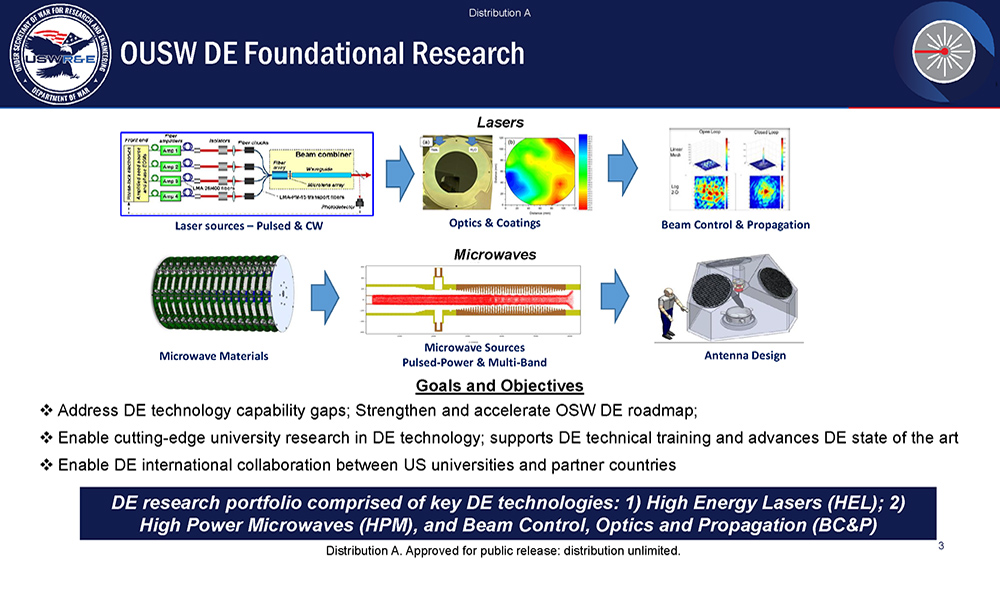
The first day of the conference kicked off with an overview of the US Joint Directed Energy Transition Office (JDETO) at the Defense Department presented by Christopher Wilson, program manager for the Directed Energy Center of Excellence. The focus of the office, he said, is working with university partners on foundational research that addresses gaps in the JDETO roadmap for laser and high-power microwave (HPM) technologies. Such research includes laser sources, optical coatings, and control propagation for both laser and microwave technologies.
The roadmap itself, Wilson said, focuses on accelerating testing and fielding of systems, with an emphasis on the need for expediting development and strengthening the DE industrial base. He noted JDETO’s collaboration across the US military, including the Army Research Office, the Office of Naval Research, and the Air Force Office of Scientific Research (AFOSR) whose research portfolio includes projects on high-power lasers, fundamental electromagnetic interactions, and more.
In a later talk, AFOSR Program Officer Joel Bixler noted that his office has a mission to “discover, shape, champion, and transition high risk basic research that will profoundly impact the future.” For DE, he said the focus is on “controlling nonlinear, multiscale Multiphysics phenomena that create high energy density.” He said most of that focus on DE is from source development in a laser. “The primary areas where I’m looking to support work are both high energy or high-power lasers,” including fundamental electromagnetic interactions of both lasers or radio frequency systems with materials.
Wilson and Bixler both highlighted the role of international collaborations, the UK and Australia among the most notable, to foster science and technology advancements in the DE arena. Following Wilson’s talk, for example, was a presentation on the UK Directed Energy Weapons Programme, including its Dragon Fire laser weapon system, by UK Ministry of Defense Program Director Amy Clark. She described a “very ambitious mandate” on DE weapons from the UK government “to the level that they can become a sustained in-service military capability.”
Clark said the war in Ukraine has provided a stark example of the need for DE weapons capabilities as a low-cost alternative to missiles. “No longer can we afford to tackle the cheap with the expensive,” she said of drone swarm attacks, for example. “We need to respond with asymmetry in our defensive capabilities. This [drone] threat will only continue to grow in complexity with larger swarms made more effective through AI. Within the UK, our program for directed energy is fundamentally focused on not only the threat but the pace of the threat.”
Later in the day were talks on DE workforce development programs at both the University of Arizona and the University of North Carolina at Charlotte, and a talk on development of high-energy laser systems in the Czech Republic that included industrial partners Lockheed Martin and Boeing. One system built there achieved energy levels of 146 joules and 801 kilojoules in 10 milliseconds.
The final talk on the first day of the conference was with Gerald P. Uyeno of Raytheon, about the company’s high energy laser technology. He highlighted key developments — starting with the invention of the laser — from the 1960s onward, including today’s short range air defense (SHORAD) system for the US Army, a 50 kw class laser for countering drones, and Raytheon’s high energy laser weapons system (HELWS) for surface to air missile defense.
Uyeno noted that one of the first laser weapon platforms, the chemically driven Airborne Laser of the 1980s/90s, cast a shadow of doubt on laser weapons for some time because of its expense, bulk, and difficult beam steering. But developments in the 1990s, such as semiconductor laser diodes and cladding pump firing lasers, began to put those doubts in the rearview mirror. He said today’s systems are meeting the performance requirements of safety, rapid performance, and transportability as well as interoperability with other systems. A result of the decades of laser weapon development, he said, is a “well-formulated approach to be able to simultaneously achieve the energy on target and also minimize the total cost of operation, development, and operation in theater.”