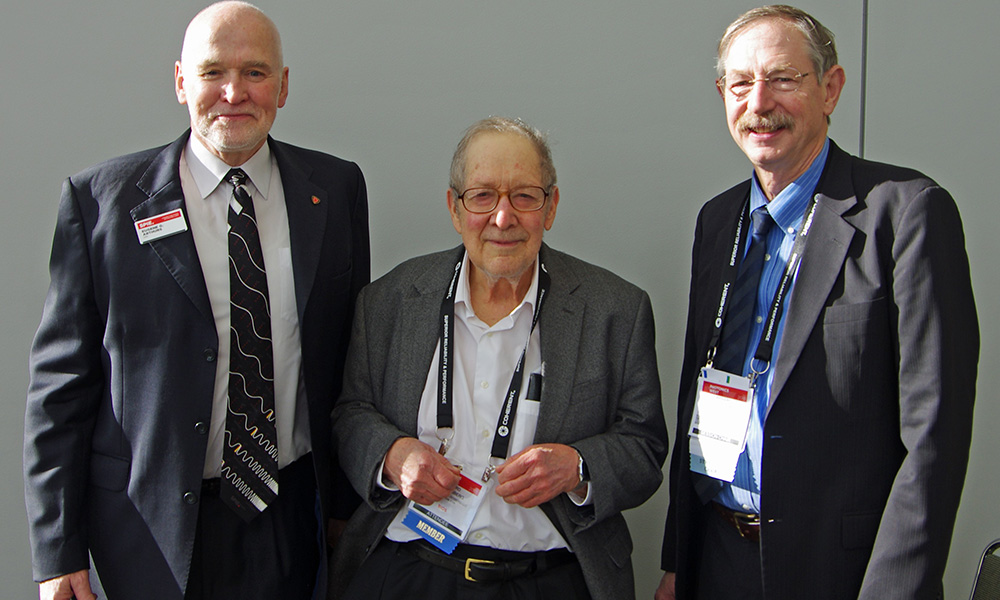
SPIE Member Howard R. Schlossberg passed away on 28 September.
Born in Brooklyn, New York in 1938, Schlossberg initially planned to be a chemical engineer, but that idea morphed into the pursuit of the more challenging subject of physics. He attended MIT where he received his bachelor’s degree in 1960 in physics. He attended Brandeis for his graduate work with a National Defense Education Fellowship, and returned to MIT to study under Ali Javan, where he held a close relationship with Professor Charles Townes.
After earning his doctorate degree at MIT in 1967, he took a job at Avco Everett Research Labs in Everett, Massachusetts. In 1968, he moved to the United States Air Force at the Cambridge Research Laboratory where he stayed until 1978, when he began his work for the Air Force Office of Scientific Research (AFOSR). At AFOSR, Schlossberg would be the centerpiece for basic research focused on Laser and Optical Physics for over 30 years. In his career, he oversaw the funding of grants for cutting-edge basic research that strongly influenced physics and biophysics that included the birth of Optical Coherence Tomography.
“He exercised a unique vision in advocating and supporting pioneering research and graduate education in the field of lasers and optics,” says William P. Roach, Chief Scientist at AFOSR. “A few examples include the optical parametric oscillators on all large Air Force aircraft that protects them against shoulder launched heat seeking missiles, and excimer laser photolithography, which is now the standard for all microelectronic chip production.”
During his time at AFOSR, Schlossberg nurtured several fledgling projects into translational applications by listening to his gut as well as to young scientists. In a 2018 interview at SPIE Photonics West, he stated, "Clear communication is good. I like to think there's a lot of subjects, particularly the biological, medical ones that are not things I'm educated in, but I'm generally scientifically educated so that if you can explain it well, I'll understand it."
He also noted that he was often compelled by smart researchers' hunger for success, the so-called fire in their belly. "They wanted to do novel things," he explained. "And we were supposed to do novel things, even if we failed occasionally. But you never completely failed. Sometimes I thought, ‘Well, it may or may not work, but I'd like to see how they do it.'"
Highly involved with SPIE, Schlossberg contributed as an author or editor to SPIE conference proceedings, including Laser Spectroscopy: Applications and Techniques and Nonlinear Optical Properties of Materials.
Schlossberg retired in 2014, but remained active in the community, attending conferences and meetings to connect with colleagues and learn about new research. He will be remembered for his unique vision, always championing pioneering research and education in optics.