I walked the vast halls of the Moscone Center in 2018, attending my first international conference as a PhD student from the Indian Institute of Science in Bangalore. The scale of the exhibition, the energy of the plenary sessions, and the excitement of sharing research left a lasting impression on me. Over the years, I have been fortunate to return to SPIE Photonics West, each time growing a little more as a researcher.
But this year was different.
I arrived not just as a scientist, at Photonics West in 2026, but as a new mother to a one-year-old, balancing my postdoctoral work at the French National Center for Scientific Research with the realities of caregiving. Like many working parents, I faced a difficult question: how do I participate fully in a conference when stepping away from my child for a week is simply not an option?
With two presentations scheduled at a pivotal stage in my career, my husband and I decided to attend as a family. Support from the SPIE Family Care Grant helped cover part of our travel, which made that choice possible.
What I did not expect was how seamlessly we would be welcomed.
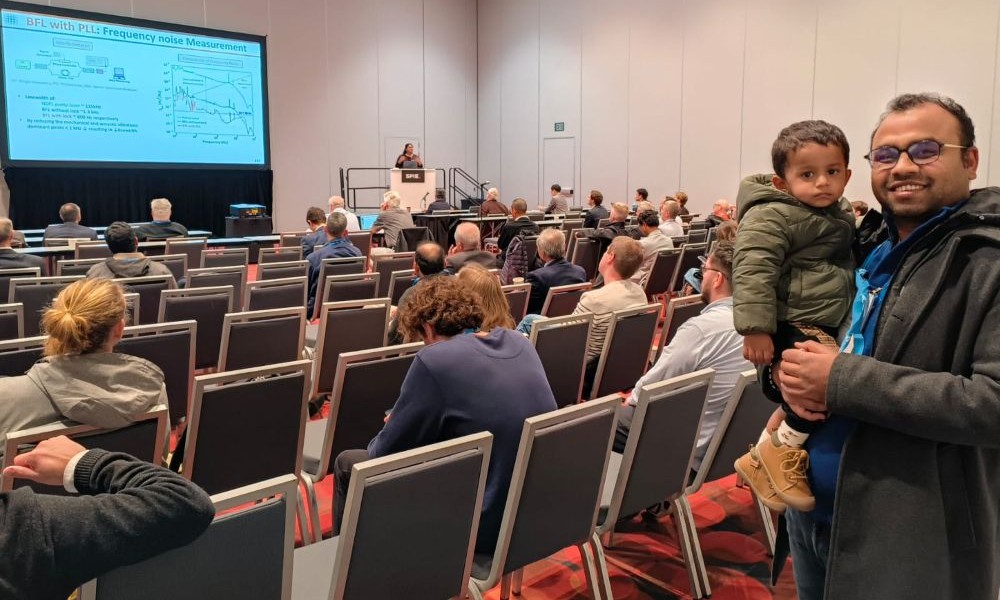
 On the first day, while collecting my badge, I learned that children could be accommodated at the conference. When I enquired, the staff warmly arranged both exhibition and conference access (with a SPIE Youth Badge) during my presentations for my child and my partner. It was a small gesture, but it reflected something much larger: a genuine commitment to inclusion.
As we made our way through the exhibition hall and poster sessions, I found myself explaining lasers and optics in the simplest, most playful terms to my child. What is usually a purely professional space became something more human — shared, joyful, and unexpectedly meaningful (at least for me; he seemed more impressed by the blinking lights than the physics).
The most unforgettable experience came during my presentation on a neodymium-pumped Brillouin fiber laser. At the back of the room was my child, quietly watching and listening. There was a gleam of curiosity in his eyes that I will carry with me for years. In that moment, the divide between my professional and personal worlds dissolved. I was not choosing between being a researcher and a mother — I was both, fully.
At the end of my talk, I cheerfully thanked my partner and my child. Only then did many in the audience realize a baby had been there all along. To me, that captured something essential: When the environment is supportive, caregiving does not have to be invisible, nor does it have to come at the cost of professional engagement.
This experience underscored an important truth. While a supportive partner makes an enormous difference, institutional support is equally critical. Conferences are where ideas are exchanged, collaborations are formed, and careers are shaped. Making them accessible to researchers with families is not just thoughtful — it is necessary.
Equally empowering at Photonics West were the discussions at the Career Hub Stage in Moscone West, where panels chaired by distinguished women across research, industry, and entrepreneurship created space for honest and meaningful dialogue. Conversations around mentorship, time management, and navigating key professional challenges resonated deeply. Hearing these experiences shared so openly was both reassuring and inspiring — it highlighted that the path many of us are navigating is not solitary, but shared. For women in science, especially those balancing multiple roles, such visibility and dialogue are incredibly empowering.
SPIE’s efforts toward family inclusivity — from the Family Care Grant to flexible access and thoughtful touches like child-friendly activities and therapy dogs — go beyond convenience. They actively enable participation. They send a clear message: You belong here, in all aspects of your life.
For early-career researchers in particular, this matters deeply. These are often the years when professional momentum and personal responsibilities intersect most intensely. Creating space for both is essential to building a more inclusive and diverse scientific community.
For me, Photonics West 2026 was not just another conference. It was a moment of alignment — where my roles as a scientist and a mother could coexist without compromise.
And that made all the difference.
Find out more about SPIE Family Care Grants
Roopa Prakash is currently a Marie Curie Postdoctoral Fellow at the French National Centre for Scientific Research (CNRS) in the Photonics, Numerical and Nanoscience Laboratory (LP2N) in Talence, France.