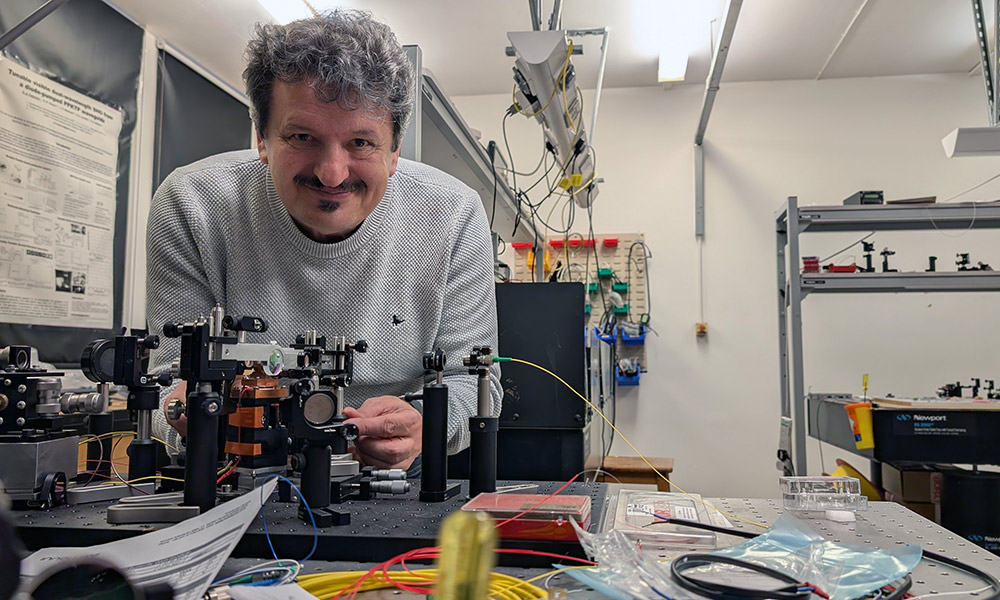
Edik Rafailov, a professor in the College of Engineering and Physical Sciences at Aston University, has made transformative contributions to laser physics and photonics across more than three decades. He pioneered the development of the first high-efficiency aluminum-free semiconductor laser diodes, enabling multi-watt, low-degradation, high wall-plug efficiency lasers. This breakthrough, achieved early in his career, dramatically improved laser reliability and performance, catalyzing the widespread industrial adoption of laser technology.
He later led global efforts in the development of ultrafast lasers based on quantum dot (QD) structures: his group was the first to demonstrate compact femtosecond QD lasers, significantly advancing ultrafast optics. He further applied this technology to create the world’s smallest femtosecond laser, revolutionizing access to ultrashort-pulse sources for biomedical, telecom, and industrial use. In non-linear optics, Rafailov pioneered quasi-phase-matching in multimode waveguides using tunable QD lasers, enabling highly efficient frequency conversion across broad spectral ranges. These innovations facilitated the miniaturization and cost reduction of visible lasers, contributing to the widespread use of compact photonic devices in spectroscopy, imaging, and diagnostics. As coordinator of large-scale EU projects (FAST-DOT, NEWLED), Rafailov demonstrated exceptional leadership in advancing diode-pumped ultrafast sources and efficient LED platforms. These initiatives spurred major industrial outcomes, including job creation and technology transfer, exemplifying his impact on both the science and commercial ecosystems.
An SPIE Fellow Member, Rafailov’s contributions to SPIE reflect his commitment to advancing photonics research, supporting early-career researchers, and fostering global collaboration across academia and industry. He has authored numerous SPIE journal and proceedings papers and has served on multiple conference committees for both SPIE Optics + Photonics and SPIE Photonics West. He serves as the SPIE Student Chapter Adviser at Aston University, where he actively mentors and supports the next generation of photonics researchers. Under his guidance, the university’s student chapter has grown in visibility and impact, engaging in outreach activities, international collaborations, and conference participation. In addition, Rafailov encourages student involvement in SPIE events and facilitates their applications for SPIE grants and travel scholarships. His commitment to student development and career progression is evident in his continuous promotion of the Society’s mission, helping students gain access to global research networks and professional opportunities.
“Professor Rafailov is one of very few people, who has shaped the global research agenda in lasers and photonic systems,” says Head of the Characterization and Modeling Division at LPICM, Ecole Polytechnique, Tatiana Novikova. “His contributions to high-power aluminium-free diode lasers and ultrafast quantum dot laser technology, and their transformative impact on non-linear optics and biomedical photonics, have expanded the spectral reach and functional versatility of diode-based laser systems. His ability to translate fundamental research into practical technologies is matched by a strong commitment to education and mentoring. As the SPIE Student Chapter Adviser at Aston University, Professor Rafailov has always encouraged young scientists to engage in optics outreach, attend international conferences, and pursue research careers in optics and photonics.”