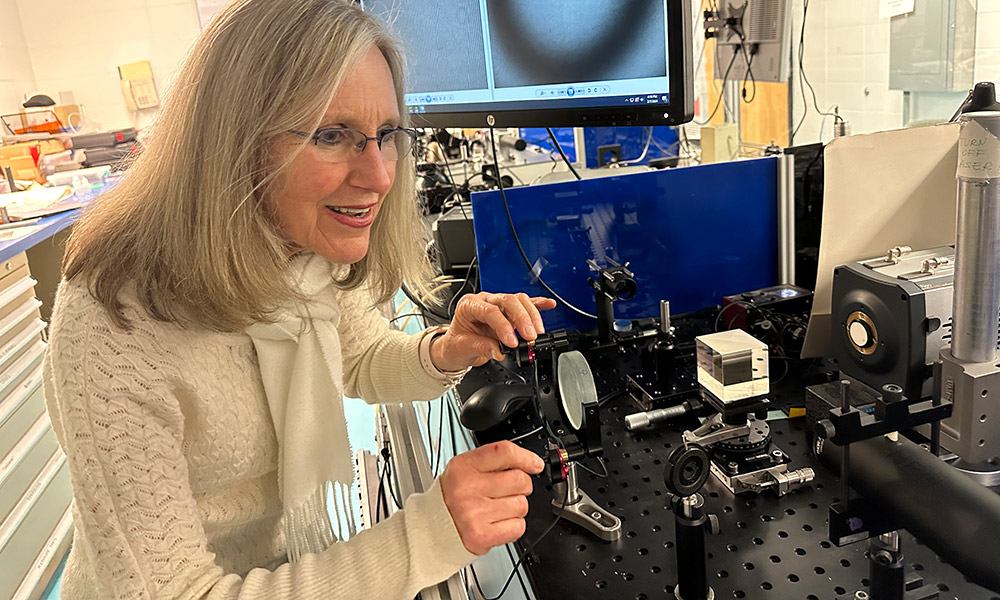
Carmen Menoni, a professor at Colorado State University (CSU), has pioneered the use of bright beams of extreme ultraviolet laser light to demonstrate novel imaging methodologies that can capture dynamic interactions and map chemical composition at the nanoscale. Menoni has also done world-leading research in optical thin film materials that is pushing the frontiers in dielectric coatings for ultra-high intensity lasers with applications to laser fusion and for gravitational wave detectors. In addition, at CSU she has established a vibrant research program, encompassing important areas of optical and laser science: As a co-principal investigator of a $40-million grant from the National Science Foundation that established the Engineering Research Center for Extreme Ultraviolet (EUV) Science and Technology at CSU, Menoni and faculty and researchers from CSU, the University of Colorado, the University of California, Berkeley, and Lawrence Berkeley National Laboratory demonstrated novel nano-imaging, nano-spectroscopy, and nanopatterning methodologies using table-top extreme ultraviolet (13.2 nm <l<46.9 nm) lasers. These works are the first to demonstrate imaging in this region of the electromagnetic spectrum with practical EUV sources.
An SPIE Fellow Member, Menoni is an active chair, co-chair, session chair, and organizing committee member across multiple SPIE conferences including “Laser-Induced Damage In Optical Materials,” “Optical Technologies for Inertial Fusion Energy,” “Compact Radiation Sources from EUV to Gamma-rays: Development and Applications,” “X-Ray Lasers and Coherent X-Ray Sources: Development and Applications,” and “Optical Designs, Materials, and Components for Inertial Fusion Energy (IFE).”
“I have known Professor Menoni for approximately 30 years, since shortly after her appointment to the CSU faculty,” says J. Gary Eden, Intel Alumni Endowed Chair Emeritus Professor at the University of Illinois (Urbana-Champaign) Grainger College of Engineering. “Since that time, I have followed her career closely, partly because Carmen’s research in the physics and engineering of optics at short wavelengths overlaps significantly with my own efforts in the field of ultraviolet lasers. For years, she has led a team that has been pursuing optical imaging in the λ < 50 nm spectral region with discharge- and laser plasma-pumped lasers developed at Colorado State. Her group is clearly the leader worldwide and, through relentless improvement of the lasers’ coherence properties, she succeeded in imaging below 30 nm — a remarkable achievement. Aside from the obvious impact that this capability has had on the continuous development of microelectronic chips of ever-increasing computational power, Carmen has applied EUV imaging to areas not imaginable even several years ago. As one example, I was present in the audience when she gave an invited talk several years ago at an international quantum electronics conference. After describing one imaging feat after the other — including Talbot imaging of nanoarrays — she wowed the audience with a video demonstrating the ability to image the tip of an atomic force microscope in real time. No one has the accomplishments of Carmen Menoni in the area of imaging in the region below 100 nm. Overall, she has been a leader worldwide in optics for decades and is a pioneer in developing UV and EUV optical coatings, mirrors, and other optical components, in particular. She employed these new optical tools to establish new standards for imaging at short wavelengths and, in so doing, has won the admiration of all her colleagues in this field.”
Meet the other 2026 SPIE Society Award winners.
Read more about the SPIE Maria Goeppert Mayer Award in Photonics.