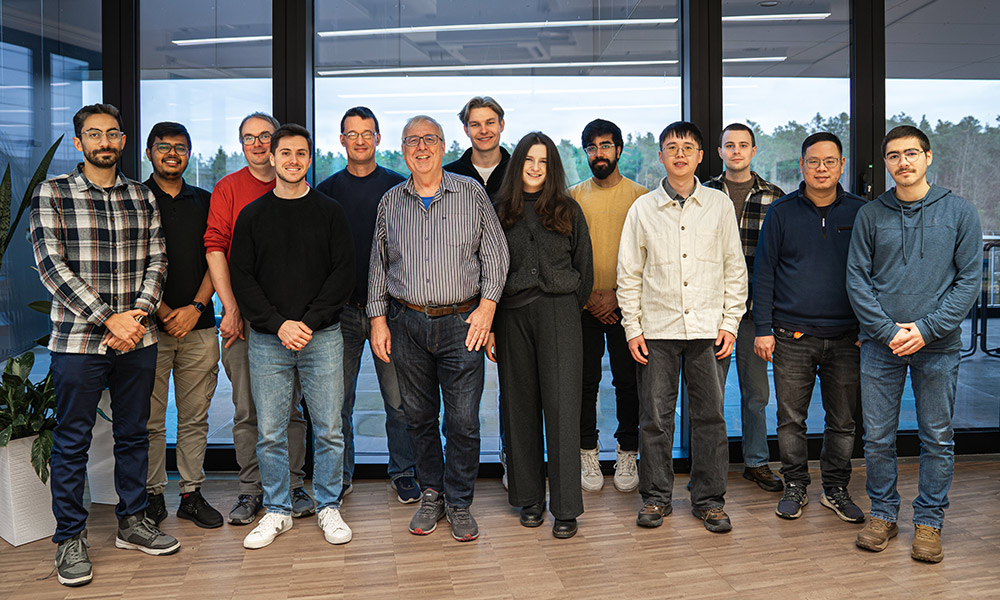
Andreas Erdmann established the Computational Lithography and Optics group at the Fraunhofer-Institute for Integrated Systems and Device Technology in 1999 and has led the group ever since. He currently also teaches at the Friedrich-Alexander-Universität’s Erlangen Graduate School in Advanced Optical Technologies. His career spans nearly four decades of research and development in applied optics — including holography, nonlinear optics, guided wave optics, and modeling of optical systems — and 30 years of research and development in lithography modeling. Erdmann’s achievements include developing rigorous electromagnetic methods for accurate modeling of light diffraction from small features on DUV and EUV masks, elucidating the 3D effects of the EUV mask and their roles in image formation. He and his team also revealed the importance of wave coupling and waveguiding effects in low-refractive index (low-n) absorber materials and other mechanisms in EUV lithography. The theoretical framework and simulation tools have been key to the optimization of masks in DUV and EUV lithography.
An SPIE Fellow Member, Erdmann’s dedication to his students at the institute and the university has made him a committed and prolific educator. Many of his former students now work at major semiconductor companies, and his 2021 SPIE Press book, Optical and EUV lithography: A Modeling Perspective, educates many young engineers entering the field of semiconductor lithography. Erdmann is the author or co-author of more than 188 articles in SPIE journals and conference proceedings. He has also served as conference chair and program committee member for multiple SPIE conferences including Advanced Lithography + Patterning and Optical Systems Design. In addition, Erdmann is a reviewer for the SPIE journals Optical Engineering and Journal of Micro/Nanopatterning, Materials and Metrology.
“It has been my pleasure to have known Andreas for almost 30 years as a researcher in lithography simulation and later as a colleague, providing me direct insight into his contributions to the field,” says Nikon Research Corporation of America President, CEO, and COO, and recipient of the 2017 SPIE Frits Zernike Award for Microlithography Donis G. Flagello. “Professor Erdmann has made foundational contributions to computational lithography that have advanced micro- and nano-fabrication capabilities. His leadership in developing simulation platforms like Fraunhofer IISB's Dr.LiTHO has enabled researchers and engineers to design and optimize lithographic processes, while his current work on wave coupling and waveguiding in low-n absorber materials for EUV, and exploration of machine learning and physics-informed neural networks for lithography modeling, demonstrates continued innovation. Professor Erdmann's contributions, specifically to computational lithography have been instrumental to the advancement and knowledge base in our industry, and his work has illuminated complex optical phenomena and provided simulation capabilities that support each successive technology node development. But Professor Erdmann's impact extends beyond individual research: He has mentored 16 PhD students and 23 Master's students, and regularly delivers university lectures and conference courses, disseminating knowledge to the global community.”
Meet the other 2026 SPIE Society Award winners.
Read more about the SPIE Frits Zernike Award for Microlithography.