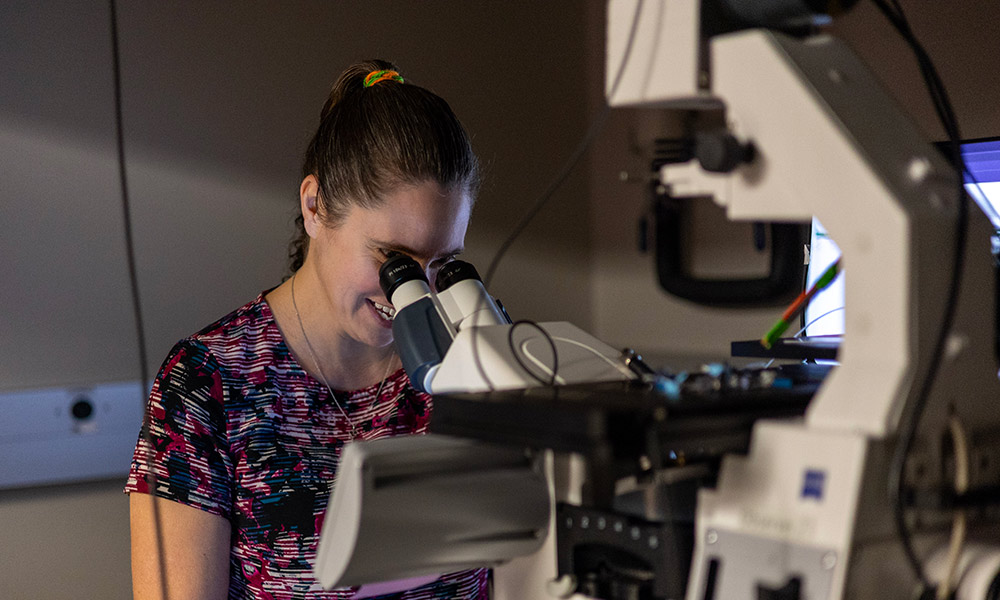
Alex Walsh, an associate professor of biomedical engineering at Texas A&M, is a rising leader in biophotonics, advancing label-free optical microscopy by integrating fluorescence lifetime imaging with machine learning. Her work has improved specificity in metabolic profiling of cells, enabled live-cell immune phenotyping, and expanded access to advanced microscopy through protocols and algorithms for image segmentation and heterogeneity analysis. In her first five years as faculty, she published 23 peer-reviewed papers, raised over $10M in funding, delivered 36 invited talks, two keynotes, and mentored over 30 undergrads, as well as eight PhD and two Master’s students. She teaches courses and workshops, reaching more than 200 students. Across her academic and community-focused efforts, her work bridges discovery, access, and education, to accelerate adoption of complex imaging technologies into practical tools for scientific discovery and training the next generation of researchers.
Since 2021, Walsh has served as the faculty adviser for Texas A&M’s SPIE Student Chapter. Other Society-related roles include serving on the Education and Outreach Committee, being an associate editor for SPIE’s Biophotonics Discovery journal, and participating as a co-chair of the “Optical Interactions with Tissue and Cells” and “Multiscale Imaging and Spectroscopy” conferences at SPIE Photonics West. She has regularly served as a session chair at Photonics West, and has attended, presented, and been an invited speaker at SPIE conferences regularly since 2011. She has also contributed as a reviewer for SPIE journals, as well as for the Berns-SPIE SPARK Grants and Outreach Grants.
“In addition to Alex’s excellence in research, her advocacy for the inclusion and success of underrepresented people in science, engineering, and academics set her apart from her peers,” says Biohub Senior Program Manager and Texas A&M Biomedical Engineering Adjunct Faculty Kristen Maitland. “She has and continues to recruit and support diverse students for her research group and the department. In summary, Alex is a stellar early-career academic who has demonstrated extraordinary technical innovation, a strong commitment to education and mentorship, and an ongoing dedication to SPIE and the optics community. She is a pioneer in the development and application of optical microscopy innovations. Her accomplishments during her independent career are remarkable in both breadth and depth, and she is clearly on a trajectory to become a transformative leader in our field.”
Meet the other 2026 SPIE Society Award winners.
Read more about the SPIE Early Career Achievement Award – Academic Focus.