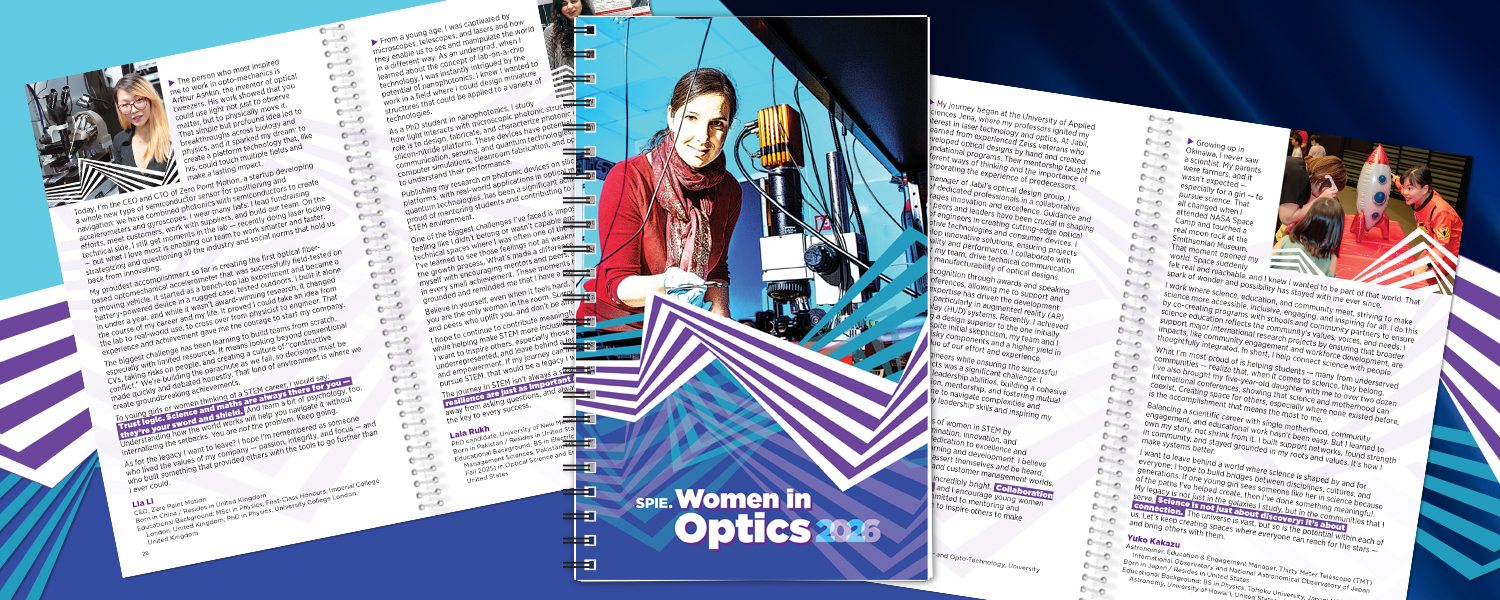
“STEM is an incredible field, full of opportunities,” says imec R&D Manager Andrela Santos, “and we need more diverse voices at the table.” “I aspire to serve as a positive role model for my daughters,” says Lockheed Martin Senior Research Engineer Anee Azim, “and to inspire individuals in the STEM fields.” “Optics is not just about light,” says Stanford University Postdoctoral Fellow Hulya Torun. “It’s about illuminating possibilities.”
These are just a handful of the 26 STEM-focused voices in the 2026 SPIE Women in Optics notebook, a compelling group of optics and photonics professionals that includes early-career researchers and postdocs, senior engineers and R&D engineers, as well as directors of operations, professors, and CEOs.
Each year since 2005, the SPIE Women in Optics notebook has showcased creative, inspiring, and engaging profiles of women working in STEM across industry, government, and academia. More than 20 years later, it continues to embrace its original mission to be an informative and motivating resource for those considering careers in optics, photonics, and other STEM-related fields. Year after year, the publication has highlighted the careers — from challenges to achievements — of scientists, engineers, researchers, students, and industry leaders, sharing their successes and setbacks as well as their outreach activities and mentorship of others; each year, the Women in Optics publication has tracked participants’ diligence in staying their chosen course, through serendipity and support, luck, and logistics. As OptiCardio Co-founder and Researcher Haiqiu Yang notes this year: “It’s good to think big and dream big, but what’s more important is making it practical.”
As always, the 2026 SPIE Women in Optics notebook offers a comprehensive view of the international optics and photonics community’s range and diversity. This year’s cohort represents multiple countries from around the world, and their areas of expertise and interest encompass multitudes: astronomy; education and engagement; mechanical engineering; optical systems for automotive technologies as well as consumer devices; developing affordable and accessible imaging tools, and developing advanced optical systems for deep-tissue analysis and point-of-care monitoring; designing high-precision optical components for both healthcare and industrial applications, from thermal cameras to low-vision aids; and working to innovate products and approaches across engineering, marketing, and sales. As it becomes quickly apparent, many of these pioneering women hold more than one professional role. “I wear many hats,” says Zero Point Motion CEO Lia Li. “I lead fundraising efforts, meet customers, work with suppliers, and build our team. On the technical side, I still get moments in the lab — recently doing laser locking — but what I love most is enabling our team to work smarter and faster, strategizing and questioning all the industry and social norms that hold us back from innovating.”
The SPIE Women in Optics notebook also features a shrove of blank pages for jotting down inspired notes, as well as a calendar segment highlighting annual STEM-focused days: International Day of Women and Girls in Science (11 February), Introduce a Girl to Engineering Day (27 February), International Women’s Day (8 March), the International Day of Light (16 May), and International Women in Engineering Day (23 June).
The notebook is available at no cost to science teachers, educators, career counselors, community clubs, students, and the general public. SPIE offers both downloadable versions and print copies below. We also welcome your input: Please add your nomination for the inspiring role models who will be featured in the 2027 SPIE Women in Optics notebook.
In Dava Sobel's book The Elements of Marie Curie: How the Glow of Radium Lit a Path for Women in Science, we learn about Curie's global influence on women in science. Nearly a century after her death, Marie Sklodowska-Curie remains the most recognized female scientist in the world.
What makes her the only woman scientist that most people can name? Many women traveled to Paris to work with Curie, returning to their home countries to make significant contributions to science, thus becoming part of her legacy. Curie was an inspiring mentor who, for decades, was often the only woman at international scientific meetings, shaping our collective understanding of the world.
Thankfully, times have changed, albeit much more slowly than we would have liked! For 21 years, the SPIE Women in Optics notebook has showcased women’s achievements in optics, photonics, and other scientific fields. Each story is unique, while sharing common themes of ambition, impact, and contributions to the betterment of society.
Like Curie, these women inspire us to leverage our talents and make a difference in the world. I am proud to be part of this community, advancing women in science.
We carry forward Curie’s empowering work. I hope that in the future, many of our names will be on the lips of people around the world.

Halina Rubinsztein-Dunlop
Professor of Quantum Physics, The University of Queensland; Deputy Director of the Australian Research Council Centre of Excellence in Quantum Biotechnology
Featured in the 2010 Women in Optics notebook
2025 SPIE Gold Medal recipient
Have copies sent directly to you! Orders of more than a full box (82) must be approved by an SPIE staff member.


Physicist

Senior Research Engineer

Postdoctoral Associate

Assistant Professor

Sr. Director of Operations

Senior Scientist
Professor

Astronomer, Education & Engagement Manager

Principal Scientist

Principal Optical Design Engineer

Doctoral Researcher/PhD Student

CEO

Professor/Researcher

Head of Optics & Photonics Laboratory

Associate Professor of Physics and Optical Sciences

Hardware Development Engineer

PhD candidate

R&D Manager

Manager of Lithography Process Research

Senior Scientist

R&D Engineer

Postdoctoral Fellow

Director

Project Manager

Co-Founder, Researcher

Technical Manager of Advanced Technologies