
A dye can selectively absorb light with certain wavelengths corresponding to certain electronic transitions. However, it may also emit fluorescence and even exhibit laser gain. A wide range of emission wavelengths—from the ultraviolet to the near-infrared region—is accessible with different laser dyes, most often used in a liquid solution. They offer a broad gain bandwidth and thus broad wavelength tunability as well as the potential for ultrashort pulse generation with passive mode locking (see p. 107). Upper-state lifetimes are typically a few nanoseconds, and the gain per unit length can be rather high (on the order of 103/cm).
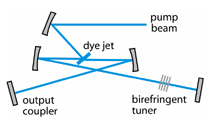 Most dye lasers use a thin jet (with or without a thin cuvette) of dye solution. The dye molecules are exposed to the pump light only for a short time interval. From time to time, the dye solution has to be exchanged because it degrades during operation. The laser resonator may contain a birefringent tuner (or some other kind of tuner) for adjusting the emission wavelength.
There are also dye lasers that utilize a large volume of dye solution pumped with a flash lamp or a Q-switched laser. Such dye lasers can generate pulses with many millijoules.
While dye lasers have dominated the fields of tunable lasers and ultrashort pulse generation for a long time, they have been largely replaced by solid-state lasers (often based on Ti:sapphire), which avoid the disadvantages of handling poisonous dye solutions, a limited lifetime, and limited output power. However, dye lasers are still used in some areas, such as spectroscopy with wavelengths that are otherwise hard to generate.
Properties of Dye Lasers
| Aspect | Properties |
| important types | continuous-wave or mode-locked Rhodamine 6G lasers; flashlamp-pumped lasers with various dyes |
| applications | spectroscopy; ultrashort pulse generation |
| pump sources | other lasers or flash lamps |
| power efficiency | a few percent to an order of 50% |
| accessible wavelengths | mostly visible and near infrared |
| wavelength tuning | possible over tens of nanometers |
| average output power | typically between 10 mW and 1 W, but >1 kW is possible |
| beam quality | normally diffraction-limited; worse for pulsed high-power devices |
| continuous-wave operation | yes |
| nanosecond pulse generation | yes, with pulsed pumping |
| picosecond & femtosecond pulse generation | yes, with mode locking |
R. Paschotta, Field Guide to Lasers, SPIE Press, Bellingham, WA (2008).
View SPIE terms of use.
