
The speed of light in a transmitting medium is less than that of the speed of light in a vacuum. The index of refraction, n, is the ratio of the speed of light in a vacuum, c, to the speed of light in a medium, c':

One consequence of this difference in speed is that when light goes from one medium to another at an angle, the propagation vector in the new medium has a different angle with respect to the normal.
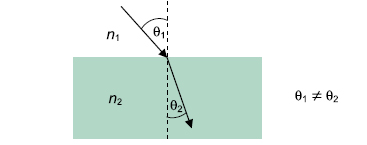
This change in direction of propagation is called refraction. The relationship between the indices of refraction and the angles is
n1 sinθ1 = n2 sinθ2
This relationship is called Snell's law.
Indices of refraction are temperature-dependent and wavelength-dependent.
Indices of refraction of common materials*
| material | n | material | n |
| air | 1.0003 | water | ~1.33 |
| flint glass | 1.55 | rock salt | 1.544 |
| quartz | 1.544, 1.553 | diamond | 2.417 |
*for light having a wavelength of ~550-590 nm
D. W. Ball, Field Guide to Spectroscopy, SPIE Press, Bellingham, WA (2006).
View SPIE terms of use.
