
At the beginning of the nineteenth century the only known way to generate polarized light was with a calcite crystal. In 1808, using a calcite crystal, Malus discovered that natural incident light became polarized when it wasreflected by a glass surface, and that the light reflected close to an angle of incidence of 57° could be extinguished when viewed through the crystal. He then proposed that natural light consisted of the s- and p-polarizations, which were perpendicular to each other.
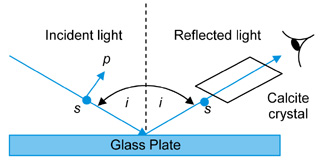
Since the intensity of the reflected light varied from a maximum to a minimum as the crystal was rotated, Malus proposed that the amplitude of the reflected beammust be A = A0 cosθ. However, in order to obtain the intensity, Malus squared the amplitude relation so that the intensity equation I(θ) of the reflected polarized light was
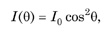
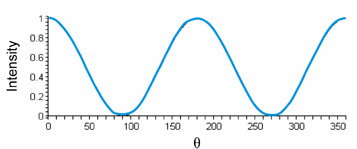
where I0 = A02. this equation is known as Malus’s Law. A normalized plot of Malus’s Law is shown below.
E. Collett, Field Guide to Polarization, SPIE Press, Bellingham, WA (2005).
View SPIE terms of use.
